


Feedback Form To Evaluate Training Program Effectiveness On Job Employee Training Program For Skills




Try Before you Buy Download Free Sample Product
 Impress Your
 Audience
 100%
100% Editable
 Save Hours
 of Time


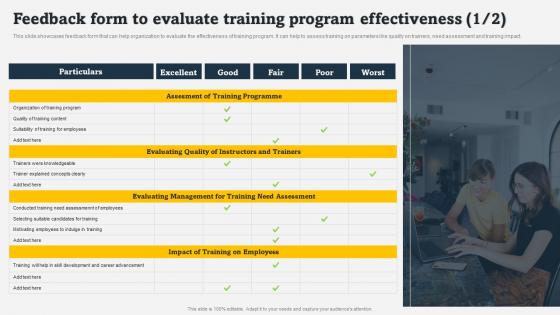
This slide showcases feedback form that can help organization to evaluate the effectiveness of training program. It can help to assess training on parameters like quality on trainers, need assessment and training impact.
People who downloaded this PowerPoint presentation also viewed the following :
Feedback Form To Evaluate Training Program Effectiveness On Job Employee Training Program For Skills with all 7 slides:
Use our Feedback Form To Evaluate Training Program Effectiveness On Job Employee Training Program For Skills to effectively help you save your valuable time. They are readymade to fit into any presentation structure.





FAQs for Feedback Form To Evaluate Training Program Effectiveness On Job Employee Training
Key metrics for assessing training program effectiveness include learning outcomes, behavioral changes, business impact, participant satisfaction, and knowledge retention rates. These measurements enable organizations to evaluate ROI through improved performance, reduced errors, and enhanced productivity, with many companies finding that comprehensive assessment across these areas ultimately delivers stronger employee capabilities and competitive advantage in their respective markets.
Participant feedback can be systematically integrated through structured surveys, focus groups, real-time polling during sessions, post-training assessments, and longitudinal follow-up questionnaires that track skill application over time. Organizations in healthcare, finance, and manufacturing increasingly use digital feedback platforms and analytics dashboards to aggregate insights, identify improvement opportunities, and demonstrate training ROI, ultimately enhancing program effectiveness.
Pre-training assessment establishes baseline knowledge, skills, and competencies, enabling organizations to customize content, set realistic expectations, and measure actual learning gains. Through comprehensive evaluation of existing capabilities, companies can identify specific skill gaps, tailor delivery methods, and allocate resources more effectively, ultimately delivering personalized learning experiences and demonstrable ROI on training investments.
Kirkpatrick's four-level model emphasizes learning progression from reaction to results, while ROI models focus on quantifiable financial returns and cost-benefit analysis. In practice, organizations often find Kirkpatrick more comprehensive for skill development programs, while ROI approaches work better for leadership training, with many companies combining both models to balance learning outcomes with measurable business impact.
Methods include performance metrics comparison, 360-degree feedback assessments, skill-based evaluations, productivity measurements, and behavioral observation tools. These approaches enable organizations to track improvements in job performance, task completion rates, and competency development, with many companies finding that combining quantitative data with qualitative feedback delivers comprehensive insights into training effectiveness and ROI.
Organizations ensure training alignment with business objectives by conducting comprehensive needs assessments, mapping learning outcomes to specific performance metrics, involving leadership in program design, and establishing clear connections between skill development and strategic goals. This strategic approach enables companies to measure ROI through improved productivity, enhanced employee capabilities, and accelerated business results, with many organizations finding that aligned training programs deliver measurable competitive advantages.
Common challenges during training program evaluation include measuring long-term behavioral change, isolating training impact from other factors, obtaining honest participant feedback, and quantifying ROI on soft skills development. Many organizations find that establishing baseline metrics, using multiple assessment methods, and conducting follow-up evaluations over time helps address these obstacles, ultimately delivering more accurate insights and strategic training investments.
Technology enhances training program evaluation through learning management systems, AI-powered analytics, mobile assessment tools, real-time feedback platforms, and automated reporting dashboards. These solutions streamline data collection, enable continuous performance tracking, and deliver comprehensive insights across multiple training initiatives, with many organizations finding that automated evaluation processes reduce administrative overhead while providing more accurate, actionable intelligence for strategic workforce development decisions.
Qualitative data enhances quantitative metrics by providing context around behavioral changes, skill application, and participant experiences that numbers alone cannot capture. Through focus groups, interviews, and observational assessments, organizations gain deeper insights into training effectiveness, identifying specific areas for improvement while understanding how learning translates into workplace performance and employee engagement.
Best practices for presenting evaluation results include creating clear visual summaries, focusing on actionable insights, tailoring content to audience needs, providing context through benchmarks, and highlighting both successes and improvement opportunities. These approaches enhance stakeholder engagement by translating complex data into strategic narratives, connecting outcomes to business objectives, and demonstrating program ROI, ultimately enabling informed decision-making and continued organizational support.
Organizations foster continuous improvement by establishing regular feedback loops, creating action plans from evaluation data, encouraging open dialogue about training effectiveness, and implementing iterative program updates. Through systematic review processes, companies like manufacturing firms and healthcare institutions transform evaluation insights into enhanced training methodologies, improved performance metrics, and strategic workforce development initiatives, ultimately delivering competitive advantage and organizational growth.
Effective training program evaluation tools include learning management systems with analytics dashboards, survey platforms like SurveyMonkey, assessment software, ROI calculation templates, and performance tracking systems. These resources streamline evaluation by measuring participant engagement, knowledge retention, and behavioral changes, with many organizations finding that integrated platforms ultimately deliver comprehensive insights and demonstrate measurable training impact.
The evaluation process can remain flexible through modular assessment frameworks, iterative feedback cycles, real-time data collection, and adaptive measurement criteria that evolve with organizational priorities. Through agile evaluation methodologies, companies across sectors like healthcare and finance can pivot assessment strategies mid-program, ultimately delivering more relevant insights and better training outcomes.
Effective engagement strategies include interactive feedback sessions, gamified assessment tools, peer-to-peer evaluation components, multimedia response formats, and real-time polling systems. These approaches streamline the evaluation process by encouraging honest participation, reducing survey fatigue, and generating more actionable insights, with many organizations finding that varied evaluation methods ultimately deliver higher response rates and better program improvement data.
Evaluation findings directly inform future training needs assessments by revealing skill gaps, identifying high-impact content areas, and highlighting delivery method preferences across different employee segments. These insights enable organizations to refine their assessment criteria, target specific competency areas more precisely, and allocate training resources strategically, ultimately creating more effective programs that address actual performance gaps rather than perceived needs.
-
I can say with full confidence that all your business, academic, or professional work requirements will be sufficed with SlideTeam. Their gallery is as rich as 2Million+!!
-
I'm happy to discover your PowerPoint presentations and templates. They met my expectations precisely. Very innovative!