


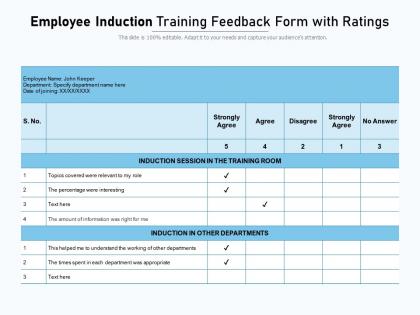
Employee induction training feedback form with ratings




Try Before you Buy Download Free Sample Product
 Impress Your
 Audience
 100%
100% Editable
 Save Hours
 of Time


Our Employee Induction Training Feedback Form With Ratings are topically designed to provide an attractive backdrop to any subject. Use them to look like a presentation pro.
People who downloaded this PowerPoint presentation also viewed the following :
Employee induction training feedback form with ratings with all 2 slides:
Use our Employee Induction Training Feedback Form With Ratings to effectively help you save your valuable time. They are readymade to fit into any presentation structure.
FAQs for Employee induction training feedback
So we focus on three big things with new hire training. First, getting them up to speed on company culture and what we're all about. Then making sure they actually understand their role - not just tasks, but how they fit in overall. Plus connecting them with key people and resources they'll use regularly. We definitely learned this the hard way, but dumping everything on someone day one is a disaster! The training also hits all the boring but necessary stuff - system logins, policies, safety rules. By the end, they should feel ready to jump in, not like they're drowning. Oh and definitely check in after their first week - sometimes things don't click until they're actually doing the work.
Track post-training tests and have managers check in at 30/60/90 days - that's your baseline. Retention rates matter too. Quick pulse surveys work, but honestly? The random hallway conversations tell you way more than formal surveys ever will. Time-to-productivity is huge - compare how fast new people hit milestones versus the last batch you hired. Oh, and exit interviews when someone bails early - that's where the real insights are. Don't overthink it though. Pick 2-3 simple things to measure and you'll be fine.
Honestly, the buddy system is where it's at. New hires absolutely love having that one go-to person for all their "stupid" questions - takes so much pressure off. Job shadowing and getting hands-on with actual systems work great too. Meeting the team face-to-face is huge. What bombs every time? Those marathon PowerPoint sessions about company history and endless policy slides. People just zone out completely. If you're redoing your program, definitely go heavy on the interactive stuff and peer connections. Way better than just dumping information on people.
Oh totally! Information overload is the worst one - they just dump everything on people day one and everyone checks out mentally. Then you've got scheduling disasters where important people don't show up or things run forever. The content's usually stale too, which honestly makes me want to fall asleep just thinking about it. Tech problems are inevitable - systems crash or nobody can log in. Super frustrating. Break stuff into smaller pieces so people can actually absorb it. Double-check everyone's calendar beforehand (learned that the hard way). Always have a backup plan when the wifi dies or whatever.
Don't just cram culture into one session - that's painful for everyone. Storytelling works way better. Get leaders sharing real stories about how your values actually played out, like during a crisis or major win. Those generic "integrity and teamwork" slides? Total waste of time. Case studies are solid - new hires can work through scenarios using your principles. Oh, and pair them with culture champions for the first month. The whole thing needs to feel real and lived-in, not like corporate buzzword bingo on slides.
So we do a mix of things - digital surveys after each training bit, then formal sit-downs with managers at 30 and 90 days. Slack check-ins work great too, honestly those random conversations tell you more than formal stuff sometimes. There's an anonymous portal for sensitive feedback. Oh, and ask specific questions about the actual content and process - not just "how'd it go?" That generic stuff is useless. The informal approach really works though, people open up more when it doesn't feel like an official interview or whatever.
Honestly, just split your onboarding into two parts - the general company stuff everyone needs, then role-specific tracks. Sales people need CRM training, devs need system access, marketing wants brand guidelines. We made this mistake where our designers had to sit through accounting demos they'd literally never touch again lol. Get different mentors for different roles too - match newbies with someone doing similar work. Templates for each department save you tons of time so you're not starting from scratch every hire. The core culture intro stays the same, but everything else should actually relate to what they'll be doing day-to-day.
Honestly, tech makes the whole induction thing so much easier. We've got this LMS thing where new people can do the training modules whenever - no more scheduling nightmares. It tracks everything automatically which is amazing because I used to spend forever chasing people for completion rates. Video calls work great for introductions with team leads, and there's this mobile app (though half the older staff still call me instead of using it lol). The analytics are actually pretty useful - you can see exactly where people get stuck and fix your content. Game changer for sure.
So we totally overhauled orientation after getting roasted in feedback. That marathon first day? Gone - now it's spread across your whole first week. Nobody gave a damn about our 1987 founding story anyway, so we scrapped most of the company history fluff. Instead you'll get actual useful stuff about how things work here. Oh, and way more face time with your manager plus those department breakouts everyone wanted. The feedback forms come straight to me now btw, so don't hold back!
Honestly, you gotta nail down your materials first - like actual scripts and timing guides for whoever's running it. Train those trainers too because I've watched programs completely bomb when people just improvise the whole thing. Use checklists so nothing gets skipped. Here's what really works though: ask your new hires what they actually retained afterward. That feedback will tell you exactly where things are going off the rails. Oh, and do those calibration meetings where trainers sync up - sounds boring but it's clutch for catching inconsistencies early.
Hey! Your buddy mentor is honestly the best resource - they'll answer literally anything you throw at them. There's an online portal with all the training modules, which is pretty comprehensive. HR does these weekly Q&A things for new people too. The intranet has guides you can download, and there's a Slack channel specifically for newbies where people ask everything from coffee locations to actual work stuff (it gets pretty random honestly). Connect with your buddy first day for sure - they make everything way easier. Oh, and those HR sessions are actually more helpful than I expected them to be.
Track your new hires for about 6-12 months - compare the ones who did your induction program vs those who didn't. Check retention rates, how fast they get productive, performance scores, manager feedback. That kind of stuff. Quarterly check-ins are honestly clutch because people forget everything from week one if you don't circle back. I'd survey them at 3, 6, and 12 months too, see if the training actually helped. Just throw it all in a basic spreadsheet (nothing fancy). After a few months you'll start spotting the trends. Oh, and manager feedback is usually more telling than the formal metrics anyway.
Definitely make it interactive - breakout rooms are your best friend here. New hires can actually chat with teammates instead of staring at screens alone. Oh, and assign someone as their "text buddy" for week one. Trust me, they'll have weird questions about everything from Slack etiquette to where the bathroom is (well, their home bathroom, but you know what I mean). Ship them a welcome box too. Sounds dorky but everyone gets excited about mail. Check in frequently that first month - way easier to fix stuff early than deal with a confused, frustrated employee later.
Make it actually anonymous - like third-party surveys, not HR collecting it directly. I've watched "anonymous" sessions where managers were obviously tracking who said what. Awkward. Show them feedback works by sharing wins upfront: "Your feedback got us those new laptops last quarter." Timing's key too. Wait 2-3 weeks so they've settled but aren't too comfortable to be honest yet. Send a simple survey with ratings plus text boxes. The real trick? Prove their input matters by following through visibly.
Oh, mentors are basically lifesavers for new hires! They're the person who answers all those "dumb" questions that really aren't dumb at all. Your new employees need someone for daily support and help figuring out company culture - stuff that formal training totally misses. Honestly, I think of them as human GPS systems for the workplace. Plus they give you real feedback about how your induction's actually working. Just make sure you're matching people up thoughtfully and giving mentors clear expectations. Don't just throw random people together and hope it works out.
-
Best way of representation of the topic.
-
Great product with highly impressive and engaging designs.