


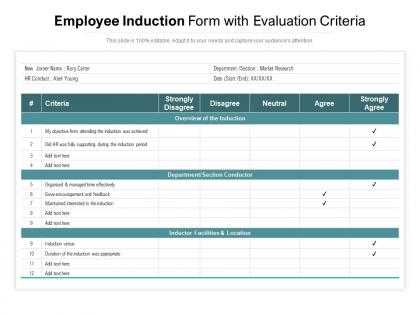
Employee induction form with evaluation criteria




Try Before you Buy Download Free Sample Product
 Impress Your
 Audience
 100%
100% Editable
 Save Hours
 of Time


Our Employee Induction Form With Evaluation Criteria are topically designed to provide an attractive backdrop to any subject. Use them to look like a presentation pro.
People who downloaded this PowerPoint presentation also viewed the following :
Employee induction form with evaluation criteria with all 2 slides:
Use our Employee Induction Form With Evaluation Criteria to effectively help you save your valuable time. They are readymade to fit into any presentation structure.
FAQs for Employee induction form
Effective employee induction evaluations should include comprehension assessments of company policies, role-specific responsibilities, workplace safety protocols, cultural integration measures, and feedback collection mechanisms. These elements enable organizations to identify knowledge gaps, measure engagement levels, and refine their onboarding processes, ultimately delivering improved employee retention and faster productivity ramp-up across departments.
Feedback from new hires can be collected through structured surveys, one-on-one meetings with HR representatives, focus groups with recent cohorts, digital feedback platforms, and informal check-ins with supervisors. These methods enable organizations to identify process gaps, enhance program effectiveness, and streamline onboarding experiences, with many companies finding that systematic feedback collection significantly improves retention rates and accelerates employee productivity.
Employee induction success metrics include completion rates, time-to-productivity measurements, retention rates within the first year, employee satisfaction scores, and manager feedback assessments. These indicators enable organizations to streamline their onboarding processes by identifying gaps, enhancing engagement strategies, and reducing turnover costs, ultimately delivering faster integration and improved long-term performance outcomes.
Employee induction evaluations should be conducted at multiple touchpoints: immediately after onboarding completion, at 30 days, 60 days, and 90 days into employment. This structured approach enables organizations to identify knowledge gaps, measure engagement levels, and refine training processes, with many companies finding that regular evaluations significantly improve retention rates and accelerate employee productivity.
Management plays a crucial role by setting evaluation criteria, monitoring progress through regular check-ins, gathering feedback from new hires and supervisors, and analyzing retention data to identify improvement areas. Through strategic oversight and systematic assessment, managers ensure induction programs deliver enhanced employee engagement, faster productivity ramp-up, and reduced turnover, ultimately strengthening organizational performance and competitive advantage.
Technology enhances employee induction evaluation through digital feedback platforms, automated assessment tools, real-time analytics dashboards, mobile learning apps, and AI-powered progress tracking systems. These solutions streamline data collection, enable immediate feedback loops, and provide comprehensive insights into new hire progress, with many organizations finding that automated evaluations reduce administrative burden while delivering more personalized and effective onboarding experiences.
Cultural fit during induction evaluation can be assessed through behavioral observations, peer feedback sessions, participation in team activities, alignment with company values exercises, and mentor evaluations. These assessment methods enable organizations to gauge how well new hires integrate with existing team dynamics, embrace organizational values, and adapt to workplace norms, ultimately ensuring stronger retention and enhanced collaborative effectiveness.
Organizations face challenges including inconsistent feedback collection, difficulty measuring long-term retention impact, lack of standardized evaluation metrics, and varying manager assessment quality across departments. Many companies find that tracking actual skill development versus initial expectations proves complex, while balancing comprehensive evaluation with administrative efficiency ultimately requires strategic resource allocation and systematic approaches to deliver meaningful insights.
Organizations ensure unbiased induction evaluations through standardized assessment criteria, multiple evaluator perspectives, structured feedback forms, and blind review processes where possible. These approaches streamline evaluation consistency by eliminating subjective interpretations, incorporating diverse viewpoints from HR, supervisors, and peers, and focusing on measurable competencies, ultimately delivering fair assessments that enhance employee confidence and organizational credibility.
Best practices for one-on-one evaluations with new hires include scheduling regular check-ins, creating structured feedback frameworks, setting clear expectations, and encouraging open dialogue about challenges and progress. These approaches streamline the integration process by building trust, identifying support needs early, and ensuring alignment with company culture, with many organizations finding that consistent evaluation touchpoints significantly improve retention rates and accelerate productivity timelines.
Continuous improvement integrates into employee induction evaluation through regular feedback collection, performance metric analysis, mentor assessments, and systematic process reviews. Organizations enhance their frameworks by tracking completion rates, measuring time-to-productivity, and gathering stakeholder input, with many companies finding that iterative refinements deliver better retention rates and faster employee integration.
Aligning induction evaluations with business goals ensures new hires understand strategic priorities, performance expectations, and their role in organizational success from day one. This strategic alignment enhances employee engagement, accelerates productivity, and reduces turnover, with many companies finding that goal-aligned induction programs deliver faster integration and stronger long-term performance outcomes.
Peer feedback can be incorporated through structured buddy systems, cross-departmental collaboration assessments, team integration surveys, and informal mentorship evaluations during the induction period. These approaches enable organizations to gather comprehensive insights into new hires' interpersonal skills, cultural fit, and collaborative abilities, while fostering stronger team dynamics and ultimately delivering more accurate performance assessments.
A well-structured induction evaluation significantly enhances employee retention by identifying gaps in onboarding processes, measuring new hire satisfaction, and ensuring role clarity from day one. Organizations with comprehensive evaluation systems streamline integration experiences, reduce early turnover costs, and create stronger employee engagement, with many companies finding that systematic feedback collection during induction ultimately delivers improved retention rates and competitive hiring advantages.
Organizations tailor induction evaluations by customizing assessment criteria, learning objectives, and performance metrics for each role's specific requirements, responsibilities, and departmental goals. Through role-specific competency frameworks, departments like sales focus on client interaction skills while IT emphasizes technical proficiencies, ultimately ensuring targeted development and improved job readiness across diverse organizational functions.
-
Wonderful templates design to use in business meetings.
-
Qualitative and comprehensive slides.