


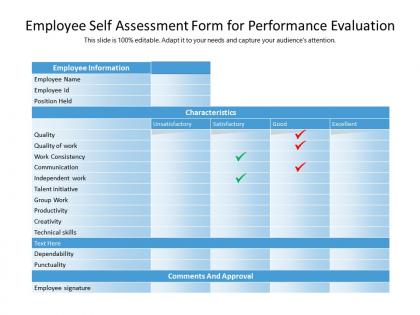
Employee self assessment form for performance evaluation




Try Before you Buy Download Free Sample Product
 Impress Your
 Audience
 100%
100% Editable
 Save Hours
 of Time


Our Employee Self Assessment Form For Performance Evaluation are topically designed to provide an attractive backdrop to any subject. Use them to look like a presentation pro.
People who downloaded this PowerPoint presentation also viewed the following :
Employee self assessment form for performance evaluation with all 2 slides:
Use our Employee Self Assessment Form For Performance Evaluation to effectively help you save your valuable time. They are readymade to fit into any presentation structure.
FAQs for Employee self assessment form
Employee self-assessment delivers enhanced self-awareness, improved goal alignment, increased engagement, streamlined performance reviews, and stronger manager-employee communication. Through regular self-reflection, organizations enable employees to identify development opportunities, track progress more effectively, and take ownership of their career growth, while managers gain deeper insights into team motivations, ultimately creating more productive and transparent performance management processes.
Organizations can encourage honest self-assessment by creating psychologically safe environments, providing clear evaluation frameworks, offering regular feedback sessions, and connecting self-reflection to professional development opportunities. Through structured templates and training programs, companies in sectors like healthcare and financial services streamline the process while ensuring constructive outcomes, ultimately delivering enhanced performance transparency and stronger employee engagement across teams.
Popular employee self-assessment frameworks include competency-based models, 360-degree feedback systems, SMART goal evaluations, behavioral assessment tools, and performance scorecards. These frameworks streamline evaluation processes by encouraging structured reflection, identifying development opportunities, and aligning individual goals with organizational objectives, with many companies finding that systematic self-assessment approaches ultimately enhance employee engagement and performance outcomes.
Employee self-assessment contributes to personal and professional development by encouraging reflection on strengths, identifying skill gaps, setting targeted goals, and fostering ownership of career growth. Through structured self-evaluation processes, employees enhance self-awareness, align their aspirations with organizational objectives, and create actionable development plans, ultimately delivering improved performance and increased job satisfaction across various industries.
Feedback serves as a critical validation and calibration tool in employee self-assessment, enabling individuals to compare their self-perceptions with manager observations, peer insights, and objective performance data. This multi-source input helps employees identify blind spots, confirm strengths, and develop more accurate self-awareness, ultimately enhancing professional development and aligning personal growth goals with organizational expectations.
Self-assessment significantly impacts performance reviews by providing managers comprehensive insights into employee perspectives, achievements, and development areas, creating more balanced evaluations. This strategic combination enhances transparency and accuracy in promotion decisions, with many organizations finding that employees who regularly self-assess demonstrate stronger self-awareness and accountability, ultimately delivering fairer advancement opportunities and improved talent retention.
Leaders can foster self-reflection through regular one-on-one check-ins, structured reflection templates, peer feedback sessions, and goal-setting workshops that encourage introspective thinking. These approaches enable employees to assess their performance, identify growth areas, and develop actionable improvement plans, while organizations benefit from increased engagement, better self-awareness, and ultimately stronger team performance across departments.
Common self-assessment pitfalls include overestimating achievements, undervaluing contributions, focusing solely on recent events, avoiding constructive criticism, and failing to align responses with organizational goals. While these challenges present obstacles, employees increasingly find that structured preparation, honest reflection, and strategic goal-setting ultimately deliver more accurate evaluations and stronger career advancement opportunities.
Technology supports self-assessment through automated feedback systems, mobile apps for real-time input, analytics dashboards for performance tracking, and AI-powered goal-setting tools. These platforms streamline data collection, enhance accuracy through objective metrics, and enable continuous monitoring, with many organizations finding that digital solutions deliver faster evaluation cycles, improved employee engagement, and more strategic development insights.
Self-assessment helps identify skill gaps by enabling employees to evaluate current competencies against role requirements, industry standards, and career aspirations through structured reflection and feedback analysis. This process reveals specific areas for improvement while highlighting strengths, ultimately enabling targeted training investments, personalized development plans, and strategic career progression that aligns individual growth with organizational needs.
Self-assessment varies significantly across organizational cultures, with hierarchical companies emphasizing goal alignment and structured reviews, while innovative cultures prioritize creative problem-solving and adaptability metrics. Industries like healthcare focus on patient outcomes and compliance standards, whereas tech companies emphasize innovation metrics and agile methodologies, ultimately enabling organizations to align evaluation processes with their strategic objectives and competitive advantages.
Employee self-assessment effectiveness can be measured through completion rates, goal achievement percentages, performance improvement scores, employee engagement levels, and 360-degree feedback correlation metrics. These measurements enable organizations to track participation quality, skill development progress, and alignment between self-evaluation accuracy and supervisor assessments, ultimately delivering enhanced professional development outcomes and stronger performance management processes.
Self-assessment fosters engagement by empowering employees to actively participate in their professional development, identify growth opportunities, and take ownership of career progression. Through regular self-reflection and goal-setting, organizations enable stronger manager-employee relationships, clearer development pathways, and enhanced job satisfaction, ultimately reducing turnover while building more committed, motivated teams.
Organizations should provide self-assessment training covering goal-setting frameworks, reflective questioning techniques, performance metric identification, feedback interpretation skills, and personal development planning methods. These resources enable employees to conduct meaningful evaluations through structured templates, skills assessment tools, and development resources, with many companies finding that comprehensive training ultimately enhances employee engagement and career progression outcomes.
Self-assessment processes can be tailored through flexible formats, culturally sensitive language, varied communication styles, personalized goal-setting frameworks, and diverse feedback mechanisms. By incorporating team members' cultural backgrounds, work preferences, and individual strengths, organizations enhance engagement and accuracy, with many finding that customized approaches deliver more meaningful insights and stronger professional development outcomes.
No Reviews