


Employee performance assessment powerpoint presentation slides




Try Before you Buy Download Free Sample Product
 Impress Your
 Audience
 100%
100% Editable
 Save Hours
 of Time


Introducing Employee Performance Assessment PowerPoint Presentation Slides for showcasing the performance report of an employee on a regular basis. With the help of this employee evaluation PowerPoint presentation template an organization reviews the work of an individual employee in specific areas. Check the performance level of your workers using our employee review PPT slides. There are three main functions that are involved in the performance appraisal presentation deck with which employee performance is measured, such as providing feedback to every individual on the basis of their progressive report, modifying their performance report, and providing future job assignments. Employee annual analysis PPT deck includes slides such as assessment criteria table, evaluation review chart, self-evaluation form, cross-training chart, etc. This employee annual evaluation PowerPoint presentation template is helpful in creating a performance report of the staff. You can use this performance rating PPT slides in order to increase the economic growth of the organization. Therefore, download this ready-to-use performance rating PPT visuals and assess the employee’s work and productivity.
People who downloaded this PowerPoint presentation also viewed the following :
Content of this Powerpoint Presentation
Slide 1: This slide introduces Employee Performance Assessment. State Your Company Name and begin.
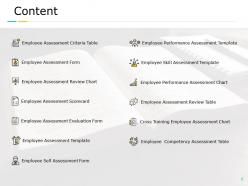
Slide 2: This slide shows Content of the presentation.
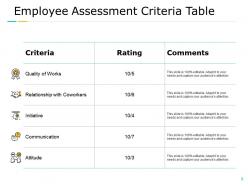
Slide 3: This slide presents Employee Assessment Criteria Table describing quality of works, relationship with coworkers, initiative, communication and attitude.
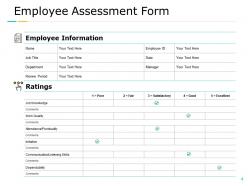
Slide 4: This slide displays Employee Assessment Form with employee information and ratings.
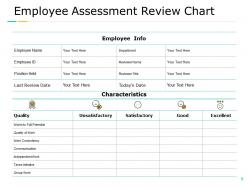
Slide 5: This slide represents Employee Assessment Review Chart with employee information and characteristics.
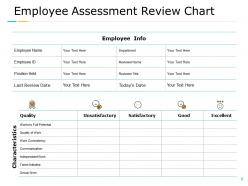
Slide 6: This is an optional slide on Employee Assessment Review Chart.
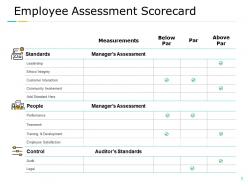
Slide 7: This slide showcases Employee Assessment Scorecard in a tabular form with categories as measurements, below par, par and above par.
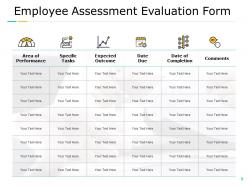
Slide 8: This slide shows Employee Assessment Evaluation Form with categories as- area of performance, specific tasks, expected outcome, date due, date of completion and comments.
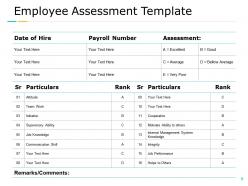
Slide 9: This slide presents Employee Assessment Template with date of hire, payroll number and assessment.
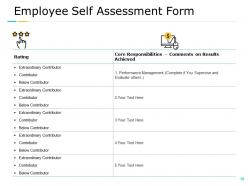
Slide 10: This slide displays Employee Self Assessment Form describing ratings.
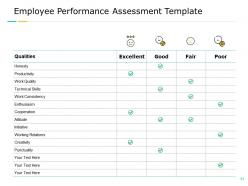
Slide 11: This slide represents Employee Performance Assessment Template.
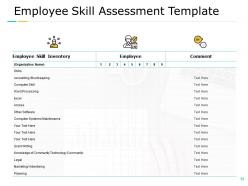
Slide 12: This slide showcases Employee Skill Assessment Template with categories as employee skill inventory, employee and comments.
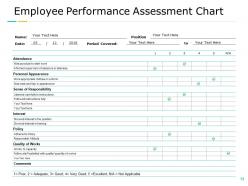
Slide 13: This slide shows Employee Performance Assessment Chart with attendance, personal appearance, sense of responsibility, interest, policy, quality of works and comments.
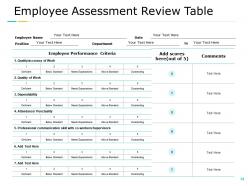
Slide 14: This slide presents Employee Assessment Review Table. You can add or edit data as per requirements.
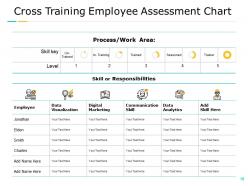
Slide 15: This slide displays Cross Training Employee Assessment Chart with process/work area and skills/responsibilities.
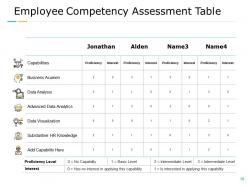
Slide 16: This slide represents Employee Competency Assessment Table with categories as- capabilities, business acumen, data analysis, advanced data analysis, data visualization and substantive Hr knowledge.
Slide 17: This slide showcases Employee Performance Assessment Icons.
Slide 18: This is Our Target slide. State your targets here.
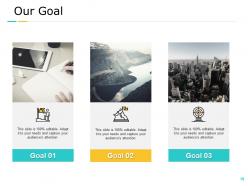
Slide 19: This is Our Goal slide. Show your firm's goals here.
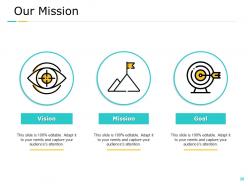
Slide 20: This is Our Mission slide with related imagery and text boxes.
Slide 21: This is Bulb or Idea slide to state a new idea or highlight information, specifications etc.
Slide 22: This is About Us slide to show company specifications etc.
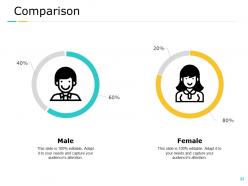
Slide 23: This is a Comparison slide to state comparison between commodities, entities etc.
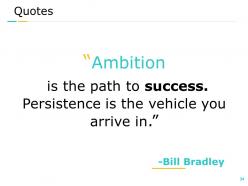
Slide 24: This is a Quotes slide to convey message, beliefs etc.
Slide 25: This is Meet Our Team slide with names and designation.
Slide 26: This slide is titled as Post It. Post your important notes here.
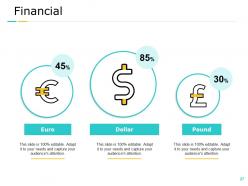
Slide 27: This is a Financial slide. Show your finance related stuff here.
Slide 28: This is a Thank You slide with address, contact numbers and email address.
Employee performance assessment powerpoint presentation slides with all 28 slides:
Highlight important articles included with our Employee Performance Assessment Powerpoint Presentation Slides. It helps advertise the journal.

FAQs for Employee performance assessment
Employee performance assessments should prioritize KPIs including goal achievement rates, quality metrics, productivity measurements, collaboration effectiveness, and skill development progress. These indicators enable organizations to evaluate comprehensive performance by measuring output consistency, customer satisfaction scores, and team contribution levels, with many companies finding that balanced scorecards ultimately deliver improved employee engagement and strategic alignment.
Managers provide constructive feedback by focusing on specific behaviors and measurable outcomes, balancing recognition of achievements with actionable improvement areas, and creating dialogue-based conversations rather than one-way critiques. Through structured frameworks like SBI (Situation-Behavior-Impact), organizations streamline evaluation processes, enhance employee development, and strengthen manager-employee relationships, ultimately delivering improved performance and higher engagement across teams.
Common biases include halo effect, recency bias, confirmation bias, similarity bias, and central tendency bias. These cognitive shortcuts can significantly skew performance evaluations by overemphasizing recent events, personal preferences, or single traits, with many organizations finding that structured assessment frameworks and multiple evaluators help minimize these distortions, ultimately delivering fairer evaluations and improved employee development outcomes.
Performance assessments should be conducted quarterly for formal reviews, with monthly check-ins and ongoing feedback throughout the year to maximize effectiveness. This strategic combination enables managers to address issues promptly, track progress consistently, and align employee development with organizational goals, with many companies finding that frequent touchpoints significantly enhance employee engagement, productivity, and retention rates.
Self-assessment enables employees to reflect on their achievements, identify growth areas, and align personal goals with organizational objectives, fostering ownership and accountability. This process enhances manager-employee dialogue during formal reviews, with many organizations finding that self-reflective employees demonstrate greater engagement and contribute more effectively to performance improvement discussions.
Technology streamlines employee performance assessments by automating data collection, enabling real-time feedback tracking, and providing analytics-driven insights into productivity patterns. Through AI-powered platforms, HR departments deliver more objective evaluations, reduce administrative burden, and enhance goal-setting processes, with many organizations finding that digital assessment tools ultimately improve employee engagement and organizational performance outcomes.
Performance standards should be established using criteria including specific measurable objectives, role-relevant competencies, behavioral expectations, quality benchmarks, and timeline requirements. These standards work best when they align with organizational goals, incorporate both quantitative metrics and qualitative assessments, and provide clear pathways for advancement, with many companies finding that well-defined criteria enhance employee engagement and ultimately drive better business outcomes.
Objectivity in performance appraisals requires standardized evaluation criteria, multiple assessor perspectives, and data-driven metrics rather than subjective opinions. Organizations achieve this through structured rating scales, 360-degree feedback systems, and regular calibration sessions among managers, with many companies finding that combining quantitative performance data with behavioral assessments delivers more consistent, fair evaluations.
Company culture significantly influences employee performance assessments by shaping evaluation criteria, feedback delivery methods, manager-employee relationships, and overall assessment transparency. Organizations with collaborative cultures often emphasize team contributions and peer feedback, while results-driven environments focus on individual metrics and outcomes, ultimately determining whether assessments enhance employee development or create workplace tension.
Peer reviews can be integrated through structured feedback cycles, 360-degree evaluation systems, anonymous digital platforms, cross-functional assessment panels, and competency-based scoring frameworks. These approaches enable organizations to capture comprehensive performance insights from multiple perspectives, while streamlining data collection and enhancing evaluation accuracy, ultimately delivering more balanced assessments and improved team dynamics.
Strategies include targeted coaching, skills development programs, mentorship pairing, performance improvement plans, and regular check-ins with clear milestones. These approaches streamline employee growth by addressing specific skill gaps, providing structured guidance, and establishing accountability measures, with many organizations finding that strategic support ultimately enhances retention and transforms underperformers into valuable contributors.
Performance assessments align with career development through goal-setting frameworks, skill gap analysis, mentorship programs, and individualized development plans that connect current performance to future aspirations. By incorporating competency mapping, growth trajectories, and targeted training recommendations, organizations enable employees to visualize advancement pathways while delivering enhanced retention, engagement, and strategic talent development across all levels.
Organizations can measure employee engagement alongside performance through pulse surveys, 360-degree feedback, one-on-one check-ins, peer collaboration assessments, and retention analytics. These methods streamline evaluation by combining productivity metrics with satisfaction indicators, enabling managers to identify high-performers who drive team morale while addressing disengagement early, ultimately delivering stronger workplace culture and sustainable business results.
Performance assessments in remote or hybrid environments should emphasize outcome-based metrics, regular virtual check-ins, collaborative goal-setting, and digital performance tracking tools rather than traditional time-based evaluations. These adaptations enable managers to focus on productivity and results while maintaining employee engagement, with many organizations finding that flexible assessment schedules and video-based feedback sessions ultimately deliver stronger performance insights and improved remote team dynamics.
Employee performance evaluations carry legal implications including discrimination claims, wrongful termination lawsuits, defamation risks, privacy violations, and documentation requirements under employment law. These assessments must comply with equal opportunity regulations, maintain objective criteria, and follow consistent procedures, with many organizations finding that standardized evaluation processes, proper training, and thorough documentation ultimately minimize legal exposure while enhancing workplace fairness.
No Reviews