


Performance review powerpoint presentation slides






Try Before you Buy Download Free Sample Product
 Impress Your
 Audience
 100%
100% Editable
 Save Hours
 of Time


Select our performance review PowerPoint Presentation slide to highlight key features of your business and its functioning. You can easily demonstrate your thoughts and ideas with our visually impressive PowerPoint design. Make use of this professionally designed performance review PPT template to shape up your knowledge and experience about the performance of your employees. This performance review PowerPoint deck has been designed with all the important aspects related to performance review such as evaluation criteria, 360-degree performance appraisal, guidelines for feedback, employee rating summary, performance measures, etc. Performance reviews allow you and the employee to clearly see how he or she is improving compared with earlier reviews. This review also shows whether an employee is ready to assume more responsibility. Our performance review PowerPoint slides highlight skill deficiencies and clearly point to where a staff member could use additional training. Showcase your aspects with this ready-to-use performance review PowerPoint template. Our Performance Review Powerpoint Presentation Slides are a good investment. A high degree of interest is guaranteed.
People who downloaded this PowerPoint presentation also viewed the following :
Content of this Powerpoint Presentation
Slide 1: This slide introduces PERFORMANCE Review. State Your Company Name and begin.
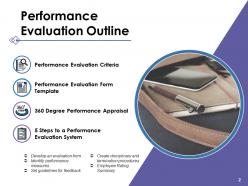
Slide 2: This slide shows Performance Evaluation Outline describing- Performance Evaluation Criteria, Performance Evaluation Form Template, 360 Degree Performance Appraisal, 5 Steps to a Performance Evaluation System, Develop an evaluation form, Identify performance measures, Set guidelines for feedback, Create disciplinary and termination procedures, Employee Rating Summary.
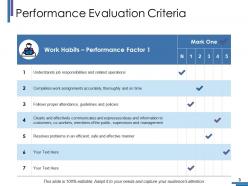
Slide 3: This slide presents Performance Evaluation Criteria in tabular form with related text.
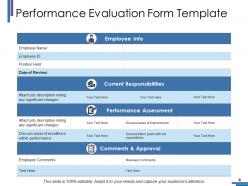
Slide 4: This slide displays Performance Evaluation Form Template describing- Employee info, Current responsibilities, performance assessment etc.
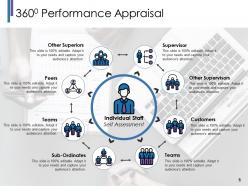
Slide 5: This slide represents 360 degree Performance Appraisal describing- Supervisor, Other Supervisors, Customers, Teams, Sub-Ordinates, Peers etc.
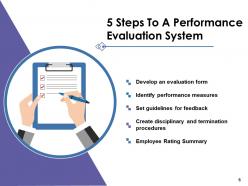
Slide 6: This slide showcases 5 Steps To A Performance Evaluation System describing- Develop an evaluation form, Identify performance measures, Set guidelines for feedback, Create disciplinary and termination procedures, Employee Rating Summary.
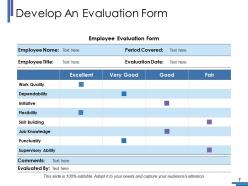
Slide 7: This slide shows Develop An Evaluation Form in tabular form with qualities as excellent, very good, good, fair etc.
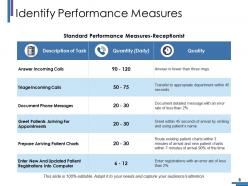
Slide 8: This slide presents Identify Performance Measures with categories as- Description of task, quantity and quality.
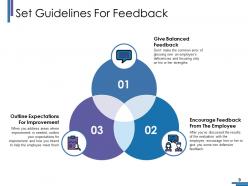
Slide 9: This slide displays Set Guidelines For Feedback as- Give Balanced Feedback, Encourage Feedback From The Employee, Outline Expectations For Improvement.
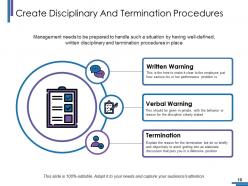
Slide 10: This slide represents Create Disciplinary And Termination Procedures with- Written Warning, Verbal Warning, Termination.
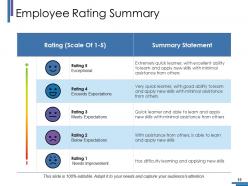
Slide 11: This slide showcases Employee Rating Summary with rating scale and summary statement.
Slide 12: This slide shows Performance Review Icons.
Slide 13: This slide is titled as Additional slide for moving forward.
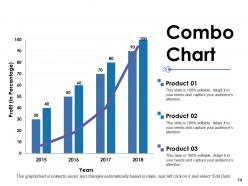
Slide 14: This slide shows Combo Chart with three products comparison.
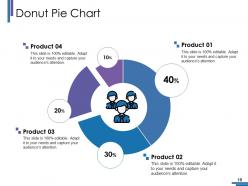
Slide 15: This slide displays Donut Pie Chart with four products comparison.
Slide 16: This is Our Mission slide with related imagery and text.
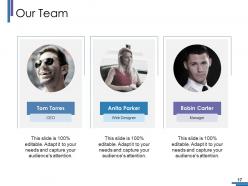
Slide 17: This is Our Team slide with names and designation.
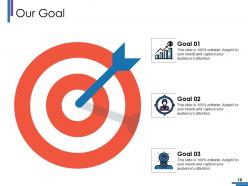
Slide 18: This is Our Goal slide. State your important goals here.
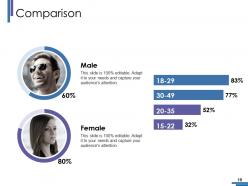
Slide 19: This is a Comparison slide with text boxes to show information.
Slide 20: This is a Quotes slide to highlight or state anything specific.
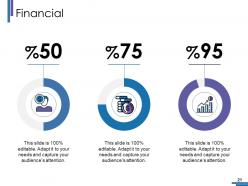
Slide 21: This is a Financial slide. Show your finance related stuff here.
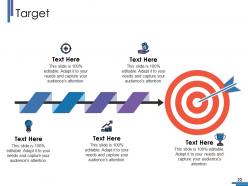
Slide 22: This is a Target slide. Show your targets here.
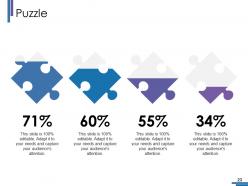
Slide 23: This is a Puzzle slide with text boxes.
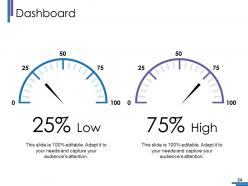
Slide 24: This slide shows Dashboard with text boxes to show information.
Slide 25: This is a Venn slide with additional text boxes.
Slide 26: This is a Bulb Or Idea slide to state a new idea or highlight specifications, information etc.
Slide 27: This slide displays Magnifying Glass with text boxes.
Slide 28: This is a Thank You slide with address, contact numbers and email address.
Performance review powerpoint presentation slides with all 28 slides:
Gains happen with our Performance Review Powerpoint Presentation Slides. Assets will grow by the day.
FAQs for Performance review
Okay so here's what actually works - give specific examples instead of generic "good job" stuff. Like, what exactly did they crush? Where did they mess up? I focus on what people *did*, not their personality. Honestly, half the reviews I've sat through are just managers reading off a script. Don't do that. Let them talk back, ask questions, push back even. You're building a plan together, not lecturing them. Oh and definitely end with real next steps. Not "we'll revisit this" but actual dates and actions. Otherwise it's just paperwork nobody remembers.
Honestly, most companies mess this up - they just copy-paste generic review templates instead of actually tying evaluations to what they claim to care about. Build your review questions around your actual values. If collaboration matters, measure that specifically. Innovation a priority? Create evaluation points for it. I've watched so many performance reviews that feel completely random compared to what leadership preaches at all-hands meetings. It's wild how disconnected they get. Map each company value to behaviors you can actually track and measure. Then ask questions that push people toward those behaviors. Way more effective than the usual "meets expectations" nonsense.
Don't go after personality stuff - stick to behaviors. Like "your presentation needed more data" not "you're not detail-oriented." I love the SBI thing: Situation, Behavior, Impact. Way less weird for everyone. Mix in some good stuff too, don't just dump on them. Come with real examples - vague feedback is useless honestly. Ask questions like "what would help you nail this next time?" Gets them problem-solving instead of just sitting there feeling bad. Oh and definitely make it a back-and-forth conversation. Nobody likes being lectured at.
Definitely have them do their self-eval first - gives you way better insight into how they see things vs your perspective. I give people about a week, though half of them procrastinate until literally the day before lol. During the actual meeting, use their writeup as your jumping off point. Go through their accomplishments, what they struggled with, goals they want to work on. It's amazing how different you might view the same situation! Makes it feel less like you're just lecturing them. Oh and bring up specific stuff they mentioned - shows you actually read it.
Honestly, metrics are a lifesaver for performance reviews because they keep you from just going off vibes. Track stuff like how often people hit their goals, meet deadlines, quality scores - whatever actually matters for their job. I learned this the hard way after giving reviews based on whatever I could remember from the past month. Numbers don't care if someone annoys you in meetings. The trick is collecting this data all year long though, not panicking and trying to piece things together last minute. Trust me, it makes the whole process way less awkward.
Ask open-ended stuff like "How's this quarter going for you?" or "What's been tough lately?" Then actually listen - don't just rattle off your notes! I swear half the managers I know just plow through their agenda without stopping. Get their take on goals and what kind of help they need. Really consider what they're saying when you're planning their next steps. Aim for listening like 50% of the time instead of just talking at them. It makes such a difference when people feel heard.
Don't wait until the last second to prep - that's just setting yourself up to fail. Collect specific examples all year long, both good stuff and things that need work. Whatever you do, don't ambush them with problems from like six months ago. Nobody wants that conversation! Make sure they can actually talk too, not just sit there getting lectured. I'd focus way more on what's next rather than rehashing old mistakes. Come with real ideas for how they can improve, maybe some training or resources. The whole thing should feel like you're planning their future together, not just pointing out what sucked.
Honestly, just get a decent performance management platform - it'll save your sanity. Instead of trying to remember what Sarah did in March (spoiler: you won't), these things track goals all year long. They handle the annoying stuff like scheduling and reminders automatically. All the feedback lives in one spot, which is clutch when review time hits. The analytics are pretty cool too - you'll notice team patterns you'd totally miss otherwise. Just pick something dead simple though, because if it's complicated your team will revolt and you'll be back to spreadsheets.
Give your team at least 2-3 weeks notice with clear criteria they'll be judged on. Send them self-assessment forms beforehand - honestly, it makes such a difference when people come prepared. Throughout the year, managers should do informal check-ins so nothing's a shock later. Nobody wants those awkward "wait, what?" conversations. Give concrete examples of both good performance and improvement areas. Oh, and make it feel collaborative rather than something happening TO them. When employees can actually reflect first, the whole thing flows way better and feels less like a interrogation.
Honestly, quarterly reviews are where it's at. Annual ones are kinda pointless - by then everyone's forgotten what actually happened six months ago. With quarterly, feedback still feels relevant and people can actually do something about it. Plus you're seeing real progress every three months instead of this weird once-a-year judgment day thing. I mean, some places do monthly check-ins too, especially for new hires. Way better approach. Just schedule your next one three months out instead of waiting around for the annual circus. Trust me, you'll see the difference immediately.
Oh man, performance reviews get SO messy when cultural stuff comes into play. Like, I had this one coworker who thought I was being way too vague with feedback - turns out he expected really direct criticism. Meanwhile, another teammate seemed uncomfortable whenever I was straightforward about areas to improve. Some people from more hierarchical backgrounds hate promoting themselves or getting called out publicly. Communication styles are all over the place too. What feels constructive to you might sound brutal to someone else. You've gotta figure out each person's background and switch up your approach - maybe written feedback works better for some people, or you need to frame conversations totally differently. It's honestly exhausting but worth it.
Ugh, vague goals are the worst. You know how managers love saying "improve your communication skills" then act surprised when you don't read their minds? SMART goals fix that mess. You get actual specifics - like "present to the sales team monthly" instead of random fluff. The measurable part means you can prove you did the work (super helpful during review season). And honestly? Those awkward check-ins become way easier when you both know exactly what you're supposed to be doing. Next time, just push back if they give you wishy-washy goals and ask for real deadlines.
Honestly, 360 feedback can be a game-changer if you do it right. Get peers and direct reports to anonymously rate performance through one of those online platforms - most are pretty decent these days. The real challenge? People are scared to be honest because they don't want drama later. I'd focus your questions on actual behaviors instead of vague personality stuff. Confidentiality is huge here. Oh, and definitely pilot it with a few managers who are actually excited about it first. Once you've figured out what works (and what doesn't), then roll it out wider. Trust me, you'll hit some bumps initially.
First thing - figure out if it's actually a performance issue or if they're missing training/resources. That happens more than you'd think. Then create a solid improvement plan with clear goals and deadlines so nobody's guessing what success looks like. I'd do weekly check-ins to track progress and offer support. Maybe pair them with someone who's crushing it as a mentor? Document the whole process too - saves your butt later and shows you gave them a fair shot. The key is being thorough but not making it feel like you're just building a case to fire them.
Follow-ups are honestly a game changer - they turn your review from a one-time thing into actual development. Most people forget half the stuff you talked about anyway (I know I do). Monthly or quarterly works depending on the person. You can track goal progress, clear up confusion, and pivot when something's not clicking. The whole point is showing your team you're genuinely invested in helping them grow, not just going through the motions. Make them feel like coaching conversations rather than formal sit-downs. That's when the real progress happens.
-
As a people manager, it's always hard for me to perform review tasks. SlideTeam templates were a bliss for me.