


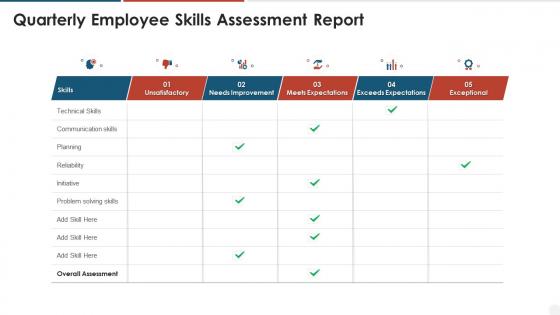
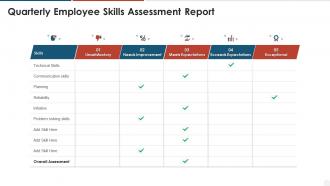
Quarterly employee skills assessment report




Try Before you Buy Download Free Sample Product
 Impress Your
 Audience
 100%
100% Editable
 Save Hours
 of Time


Our Quarterly Employee Skills Assessment Report are topically designed to provide an attractive backdrop to any subject. Use them to look like a presentation pro.
People who downloaded this PowerPoint presentation also viewed the following :
Quarterly employee skills assessment report with all 2 slides:
Use our Quarterly Employee Skills Assessment Report to effectively help you save your valuable time. They are readymade to fit into any presentation structure.
FAQs for Quarterly employee
Look at three things: can they actually do the technical stuff, do they have decent soft skills, and will they mesh with your team culture? I've watched so many "perfect on paper" candidates crash and burn because nobody checked if they could communicate or solve problems under pressure. Also test how fast they pick up new things - super crucial if your industry moves quickly. Oh, and definitely see how they handle working with others if that's part of the gig. Pro tip: make yourself a little scoring sheet beforehand so you're not just winging it based on whether you liked their vibe.
Hard skills are pretty straightforward - just do practical tests, check their certifications, or have them show you their portfolio. Soft skills though? Total nightmare to figure out honestly. Behavioral interviews help a lot, and getting feedback from their teammates gives you the real scoop. Don't just pick one method - mix a few together. I'd make a skill matrix for each role (sounds fancy but it's basically just a checklist) and use that to measure everything. Works way better than winging it.
Honestly, self-assessment is where you should start with any skills thing. You know yourself better than anyone else does, right? Rate yourself on specific stuff first - be really honest though, not just what sounds good on paper. I used to just list impressive-sounding skills until I realized that was pointless. Compare your self-ratings with what others tell you. That's how you spot blind spots and figure out what you actually need to work on. It might feel a bit weird at first, but it's way more effective than just winging it.
Honestly, tech has totally changed how we assess skills at work. AI platforms can screen candidates automatically and build custom tests that actually make sense. The gamified stuff is pretty cool - people don't dread taking assessments as much when they feel like mini-games. Instead of waiting around for yearly reviews (ugh), you get real-time dashboards tracking everything. Video assessments work way better for gauging soft skills too. I mean, watching someone explain a problem tells you so much more than a written test. Everything's backed by actual data, so you can skip the guesswork and build development plans that aren't total garbage.
Get yourself some solid rubrics first - define what good actually looks like for each skill you're testing. Blind reviews are clutch too, strip out names and anything identifying so you're just judging the work itself. I'd bring in multiple people to score things since we're all biased whether we admit it or not. Document why you scored someone a certain way as you go. Oh, and definitely audit what you're doing now - if certain groups keep scoring lower, there's probably something funky in your process. The whole "stick to your criteria religiously" thing is harder than it sounds but makes a huge difference.
First thing - get your people to actually think about where they want to go career-wise. Then figure out what skills they have versus what they'll need. I've seen way too many assessments that are just random competency lists that don't connect to anything real. Skip that noise. Focus on the actual gaps between their current abilities and their next role. Once you have that data, work with their managers to turn it into real development plans - not just generic training modules. Give them stretch assignments that matter. The whole point is making sure you're measuring stuff that actually moves the needle for their growth.
Honestly, there's a bunch of ways to do this. Video calls where they actually show you their work are solid - way better than just talking about it. Take-home projects that look like real tasks from your job work really well too. Screen sharing is clutch because you can watch how they think through problems. Coding tests or portfolio reviews depend on what you're hiring for, obviously. I always think giving people actual scenarios beats those weird hypothetical interview questions anyway. Just pick whatever feels most natural for how your team already works. Oh, and make sure it actually matches what they'd be doing daily - seems obvious but people mess this up all the time.
Schedule those one-on-ones within a week - don't let it drag out. Start with what they're crushing, then move into growth areas with real examples from the assessment. People actually listen when they don't feel ambushed, you know? Connect each gap to something actionable like training or mentoring opportunities. Document it all because you'll need it later for performance reviews. Oh, and always wrap up with clear next steps they can actually do something about. Being direct works, but you've got to balance it with support or they'll just shut down.
Track the obvious stuff first - performance scores, how fast people pick up new tasks, completion rates. But don't sleep on the softer signs either. Self-assessments show confidence levels, and watch who starts volunteering for harder projects (that's usually a dead giveaway). Error rates tell you a lot too. I'd do check-ins at 30, 60, 90 days instead of just one-off snapshots - trends matter way more. Oh, and get peer feedback scores if you can. Honestly, just throw it all into one simple dashboard so you're not drowning in separate reports.
Map your skills tests directly to what people actually do in the role - that's the key. A developer needs coding challenges, but your sales team should get real customer scenarios they'd handle. Healthcare jobs? Test compliance knowledge. Finance roles need analytical thinking. Here's what I've learned though - skip the vague "communication skills" tests. Instead, check how someone communicates in YOUR specific work setup. Build everything around actual job tasks and situations your team deals with every day. Way more useful than generic assessments.
Honestly? Getting buy-in is your biggest headache. Most people think it's just another pointless HR thing to check boxes. Can't say I disagree sometimes. Time's always an issue too - nobody has bandwidth for "proper" assessments. Soft skills are impossible to measure compared to technical stuff, and good luck keeping everything updated when skills change every five minutes. Oh, and departments will track things totally differently, which gets messy fast. Start with just one team though. Make it dead simple and actually show people how it helps them, not just the company. That's the only way it'll work.
Honestly, skills tests are game-changers for fair hiring. Instead of judging people by their college or resume fluff, you're actually seeing what they can do. Someone who taught themselves coding or learned marketing through side projects? They finally get noticed. Map out the real skills each job needs first - not the nice-to-haves, the must-haves. Then test for those specific things. I've seen companies find amazing people they would've totally missed otherwise, especially from groups that don't always have the "right" background on paper. It cuts through so much of the unconscious bias stuff.
Honestly, standardized tests are kinda trash for hiring. They miss so much - like creativity, teamwork, how someone thinks through weird problems. I bombed the SATs but turned out fine, you know? Some brilliant people just freeze up on tests. The tests can't tell you if someone's actually pleasant to work with or how they handle chaos (which let's be real, is most jobs). My take? Don't ditch them completely, but pair them with actual work samples or those scenario-based interviews. Way better picture of what you're getting.
Just add a skills section to your regular performance reviews - way easier than doing separate meetings later. Have employees rate themselves first, then you can give your take and spot any gaps. Honestly, this approach feels less forced than those standalone skills assessments that everyone dreads. Map whatever gaps you find to their development goals for next quarter. That way you're not just rehashing old stuff - you're actually building a plan to get them better at what they need. Works pretty well in my experience, and people seem to like having it all in one conversation.
Once you've done that first assessment, set up check-ins every few months to see how everyone's progressing. Quarterly works well, but honestly twice a year might be more realistic depending on your workload. Give each person specific goals they can actually measure - vague stuff doesn't help anyone. Peer feedback sessions are gold because people learn way better from their teammates than from formal training half the time. Cross-training builds skills AND makes the team tighter. Document everything so you can catch patterns later. The biggest thing? Don't let it become a one-time thing and then forget about it. Consistency beats perfection here.
-
It saves your time and decrease your efforts in half.