


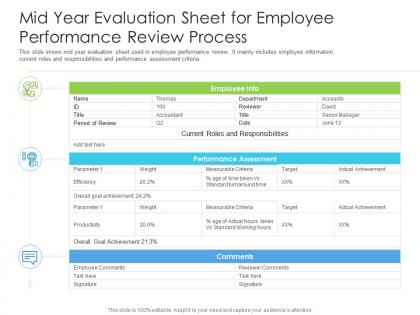
Mid year evaluation sheet for employee performance review process




Try Before you Buy Download Free Sample Product
 Impress Your
 Audience
 100%
100% Editable
 Save Hours
 of Time


Our Mid Year Evaluation Sheet For Employee Performance Review Process are topically designed to provide an attractive backdrop to any subject. Use them to look like a presentation pro.
People who downloaded this PowerPoint presentation also viewed the following :
Mid year evaluation sheet for employee performance review process with all 2 slides:
Use our Mid Year Evaluation Sheet For Employee Performance Review Process to effectively help you save your valuable time. They are readymade to fit into any presentation structure.
FAQs for Mid year evaluation sheet for employee
Key components include clear performance criteria, regular feedback sessions, goal-setting frameworks, self-assessment opportunities, and documented performance records. These elements work together by establishing transparent expectations, facilitating continuous improvement, and enabling strategic talent development, with many organizations finding that structured evaluation processes ultimately enhance employee engagement and drive measurable productivity gains.
Organizations ensure objectivity and fairness in employee evaluations through standardized criteria, multiple evaluator perspectives, structured feedback processes, and comprehensive documentation. These approaches streamline assessment consistency by eliminating personal bias, incorporating peer and customer input, and maintaining transparent performance metrics, with many companies finding that regular calibration sessions and clear rubrics ultimately deliver more accurate evaluations and enhanced employee trust.
Employee self-assessment enables individuals to reflect on their achievements, identify growth areas, and set future goals while providing managers valuable insights into employee perspectives and motivations. This collaborative approach enhances evaluation accuracy by combining manager observations with employee insights, ultimately fostering greater ownership of professional development and alignment between individual aspirations and organizational objectives.
Feedback from peers and clients enhances employee evaluation by providing comprehensive 360-degree perspectives, revealing collaboration skills, customer service quality, and interpersonal effectiveness that managers cannot directly observe. This multi-source approach enables organizations to assess communication abilities, teamwork dynamics, and client relationship management, ultimately delivering more accurate performance insights and identifying development opportunities that drive both individual growth and organizational success.
Performance metrics vary by role but typically include productivity measures, quality indicators, goal achievement rates, customer satisfaction scores, and behavioral competencies like collaboration and leadership potential. These assessments work most effectively when tailored to specific functions, with sales teams measured on revenue targets and conversion rates, while customer service roles focus on response times and satisfaction ratings, ultimately delivering comprehensive insights that enable strategic talent development and organizational growth.
Technology streamlines employee evaluation through automated performance tracking, real-time feedback systems, goal-setting dashboards, analytics-driven insights, and centralized documentation platforms. These digital solutions enable HR departments to reduce administrative burden, eliminate scheduling conflicts, and generate comprehensive performance reports, while managers gain data-driven insights that enhance decision-making and ultimately deliver more objective, consistent evaluations across organizations.
Common pitfalls include recency bias, lack of documentation, unclear criteria, avoiding difficult conversations, and inconsistent standards across team members. These evaluation errors undermine performance management by creating unfair assessments, reducing employee trust, and missing development opportunities, with many organizations finding that structured frameworks and regular feedback cycles deliver more accurate evaluations and stronger team performance.
Performance evaluations align with company goals through strategic objective setting, competency-based assessments, value-driven behavioral metrics, and outcome measurement frameworks. By incorporating specific goal achievements, cultural alignment indicators, and strategic contribution assessments, organizations streamline talent development while reinforcing organizational priorities, ultimately delivering enhanced performance clarity and stronger employee engagement across all levels.
Regular feedback significantly enhances employee motivation and productivity by providing clear performance expectations, recognizing achievements, and identifying development opportunities early. Through consistent communication, organizations streamline performance management, reduce turnover costs, and accelerate skill development, with many companies finding that employees receiving weekly feedback deliver 12% better results than those evaluated annually.
Organizations should address underperformance through clear documentation, specific improvement plans with measurable goals, regular check-ins, and targeted training or mentoring support. This structured approach enables managers to provide actionable feedback while creating accountability frameworks, with many companies finding that early intervention and collaborative goal-setting ultimately transforms underperformers into productive contributors.
Evaluators need training in performance measurement frameworks, feedback delivery techniques, bias recognition, goal-setting methodologies, and documentation standards. Through structured programs, managers develop skills in conducting objective assessments, facilitating meaningful conversations, and creating actionable development plans, with many organizations finding that well-trained evaluators significantly enhance employee engagement and retention rates.
Employee evaluations contribute to talent development and succession planning by identifying skill gaps, assessing leadership potential, and mapping career progression pathways through structured feedback processes. These assessments enable organizations to create targeted development programs, strategically allocate training resources, and build robust talent pipelines, with many companies finding that systematic evaluations ultimately enhance employee retention and organizational readiness.
Strategies include transparent criteria communication, regular feedback sessions, two-way dialogue opportunities, self-assessment integration, and goal-setting collaboration. These approaches enhance engagement by fostering trust, reducing anxiety, and creating development-focused conversations, with many organizations finding that employees respond more positively when evaluations emphasize growth opportunities rather than purely performance measurement.
Constructive feedback fosters growth by focusing on specific behaviors rather than personal traits, providing actionable recommendations, and creating collaborative improvement plans with clear timelines. Through regular check-ins and balanced recognition of strengths alongside development areas, managers enable employees to enhance performance while maintaining motivation, ultimately delivering stronger team capabilities and increased organizational effectiveness.
Legal considerations during employee evaluations include anti-discrimination compliance, documentation requirements, due process procedures, privacy protections, and adherence to labor law standards. These frameworks ensure evaluations remain objective, consistent, and defensible, with many organizations finding that structured evaluation processes minimize legal risks while enhancing transparency, ultimately delivering better employee relations and reduced liability exposure.
-
I discovered this website through a google search, the services matched my needs perfectly and the pricing was very reasonable. I was thrilled with the product and the customer service. I will definitely use their slides again for my presentations and recommend them to other colleagues.
-
Professional and unique presentations.
-
Use of icon with content is very relateable, informative and appealing.
-
Really like the color and design of the presentation.
-
Excellent products for quick understanding.