


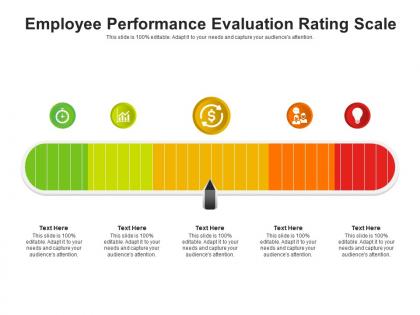
Employee performance evaluation rating scale infographic template




Try Before you Buy Download Free Sample Product
 Impress Your
 Audience
 100%
100% Editable
 Save Hours
 of Time


Give your usual presentation a brand new look by enhancing its aesthetics using this Employee Performance Evaluation Rating Scale Infographic Template. This PPT slide is drafted using different vector based icons, graphics, and other visual content that can be used by any industry professional. As such, it can be used to display and share information on any topic. With a combination of invaluable information and visual content, this is a great template to use for impressing your viewers, staff, management, or any other individual. This template is designed in such a way that it will not only help you give clarifiers but also reinforce positive actions by your target audience. The feature of in built editable components further adds to the versatility of this slide. Therefore, download it now.
People who downloaded this PowerPoint presentation also viewed the following :
Employee performance evaluation rating scale infographic template with all 2 slides:
Use our Employee Performance Evaluation Rating Scale Infographic Template to effectively help you save your valuable time. They are readymade to fit into any presentation structure.
FAQs for Employee performance evaluation rating
So they look at the usual stuff - did you hit your targets, work quality, how productive you were. Teamwork matters too. Attendance and whether you actually take initiative count, plus any skill development you've done. Customer satisfaction is huge if you deal with clients directly - honestly that one can totally save you or screw you over. Each department weights things differently though. HR should break it down when review season starts, but I'd definitely ask your manager what they care about most. Some teams are super numbers-focused while others prioritize the soft skills more.
Honestly, it's a game changer. Instead of that dreaded annual review where everyone's shocked by feedback they've never heard before, you're just having normal conversations all year. I can't remember what I had for lunch yesterday, let alone how someone handled a project six months ago - so why wait? Give feedback right after stuff happens. People actually have time to fix things or build on what's working. The timing thing is huge too - you can call out great work when it's fresh instead of some random Tuesday in December. Just make it casual, like during your regular check-ins or right after wrapping up a project.
Oh, self-assessments are honestly a game-changer. Your employees get to think through their wins and struggles beforehand instead of being put on the spot. Way more productive conversations that way. Ask specific stuff though - not just "how'd you do" but actual prompts about projects, skills they want to build, roadblocks they hit. I learned this the hard way after some awkward reviews where people just stared at me blankly. The trick is referencing their answers during your meeting so they know you didn't just ignore what they wrote.
Honestly, just digitizing your forms will save you so much time. Tech handles all the boring stuff - scheduling, reminders, collecting feedback automatically. Way better than digging through old emails trying to remember what Sarah accomplished in March, you know? Goal-tracking platforms keep everything current instead of that last-minute scramble we all do. Analytics help you spot who's crushing it and who needs help. Digital forms make comparisons way fairer too. Best part? Everything's actually in one place for once instead of scattered everywhere. Start there - you'll thank me later.
Oh man, performance reviews are such a minefield! You've got recency bias where you only remember last week's drama. Then there's the halo effect - someone's amazing at presentations so suddenly they're perfect at everything. I'm guilty of confirmation bias too, where I basically hunt for examples that prove my gut feeling about someone. Similarity bias is weird but real - we rate people higher when they're like us. The worst though? When you compare employees to each other instead of actual job standards. Keep notes year-round and use those structured forms, trust me.
OK so the SMART goals thing is actually legit, even though it sounds super corporate. You want specific numbers - like "bump customer satisfaction from 7.2 to 8.0 by Q3" instead of just "make customers happier." Break big stuff into smaller wins so people can see they're making progress. Each goal should connect to what they actually do every day, not some random thing they can't control. Oh, and be really clear about what "winning" looks like from the start. Nobody likes getting blindsided during performance reviews - that's just awkward for everyone.
Honestly, don't try to do this alone - that's where bias creeps in. Mix it up with 360 reviews, peer feedback, self-assessments. I'd set up clear rating scales so you're not just winging it based on gut feelings. Document stuff all year long because December brain fog is real and you'll forget everything. Train your managers on unconscious bias (we're all guilty of favoring mini-mes). Having HR double-check before finalizing isn't a bad idea either. Multiple perspectives are your friend here - keeps any one person from steamrolling the whole process.
So basically, 360-degree feedback pulls input from everyone who actually works with someone - their boss, coworkers, people under them, sometimes even clients. Way better than just getting the manager's perspective, which let's be honest, can miss a lot. You catch blind spots this way and get real insights for development. The trick though? You've gotta train people how to give useful feedback first. Otherwise you end up with useless stuff like "they seem nice" which doesn't help anyone figure out what to improve on.
Make it a real conversation, not just you talking at them. I always set expectations early so people actually know what they're shooting for. Don't save up feedback all year - that's brutal for everyone involved. Ugh, I've watched so many managers just wing it with cookie-cutter comments. Be specific instead. Got a great example of how they helped land that client? Use it. Connect their work to actual results when you can. Here's the key part though - always end with concrete next steps and growth opportunities. They should walk out pumped up, not wanting to hide under their desk.
Look, performance reviews shouldn't just sit in a file somewhere collecting dust. Take whatever gaps or growth areas you found and actually DO something with them - build training plans, map out career paths, whatever makes sense. Most companies totally blow this part, honestly. They'll spend all this time on the review then... nothing. Connect those feedback conversations to real action: specific training, mentoring, stretch projects. Your team needs to see that their review actually leads somewhere, you know? Otherwise it's just another pointless meeting they'll dread.
Oh man, performance reviews! Honestly they don't have to be as painful as everyone makes them out to be. Do your homework first - look over their work and goals beforehand. The good ones feel more like you're coaching than judging, you know? Ask stuff like "what support do you need?" instead of just telling them what they did wrong. Let them talk too - make it actually two-way. Specific examples work way better than vague comments. Oh and definitely end with real next steps, not just "let's touch base soon" because we both know that never happens. Give them space to ask questions too.
Honestly, skip the whole "butts in seats" mentality and track actual results instead. Monthly check-ins work way better than waiting for annual reviews - I learned that the hard way. Document everything since you can't just walk over and see what's happening. Peer feedback becomes huge when you're managing remotely, way more than I expected. Your evaluation criteria needs to match remote reality too: communication skills, hitting deadlines, self-direction. That stuff matters more now. Oh, and have real conversations throughout the year, not just formal review talk.
Your company's culture totally dictates how performance reviews actually work. Collaborative places care way more about teamwork than solo wins. Risk-averse companies? They're obsessed with hitting numbers over creative thinking - super annoying if you're innovative. I've noticed transparent cultures have way better two-way conversations during reviews instead of just your boss talking at you. Bottom line: your review process should match what the company actually cares about, not whatever's in that dusty employee handbook nobody reads.
Honestly, I'd mix direct questions with watching how they actually behave. During reviews, ask about job satisfaction and career goals - but also throw in something like "What energizes you most at work?" People get surprisingly real with that one. Then look at the obvious stuff: are they volunteering for projects or just doing the bare minimum? Do they pitch ideas or mentor newer people? Attendance patterns tell you a lot too. The trick is combining what they say with what you're actually seeing day-to-day. Self-reported feelings only go so far, you know?
Oh man, performance reviews can totally screw you over legally if you mess them up. Discrimination lawsuits are the big one - like if your evaluations show you're harder on older employees or women, you're toast. Also, don't document problems and then just... do nothing about it. That inconsistency will come back to haunt you in court. I swear, HR departments love telling war stories about companies that got sued over this stuff. Keep everything factual and job-focused. Apply the same standards to everyone or you'll regret it later.
-
Use of icon with content is very relateable, informative and appealing.
-
Awesomely designed templates, Easy to understand.
-
Good research work and creative work done on every template.