


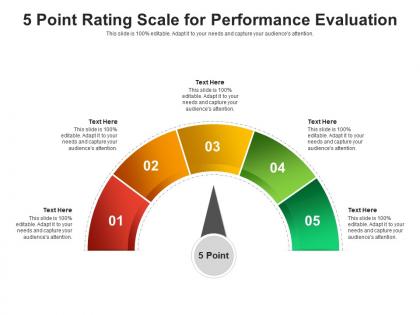
5 point rating scale for performance evaluation infographic template




Try Before you Buy Download Free Sample Product
 Impress Your
 Audience
 100%
100% Editable
 Save Hours
 of Time


This is a 5 Point Rating Scale For Performance Evaluation Infographic Template that can be used by professionals belonging to any domain. It is a powerful illustrative tool that can be deployed to showcase consumer behavior, sales reports, progress reports, IT research results, and many more. In short, this PPT layout works for every industry, irrespective of its operations. The combination of compelling information and visual content added in this template makes it a very resourceful layout to grab. Utilize it to present information and insightful details about your business or the finished product that can be visualized from the onset. This PPT design features high quality elements like graphics, icons, etc. that can be used to further enhance the illustrative properties of a presentation. It can also be reproduced as PNG, JPG and PDF, for the users convenience.
People who downloaded this PowerPoint presentation also viewed the following :
5 point rating scale for performance evaluation infographic template with all 2 slides:
Use our 5 Point Rating Scale For Performance Evaluation Infographic Template to effectively help you save your valuable time. They are readymade to fit into any presentation structure.
FAQs for 5 point rating scale for performance
Honestly, 5-point scales just work better. You get enough detail to actually separate good performers from average ones, but it's not overwhelming like those crazy 10-point systems that nobody knows how to use. Plus your team will actually understand their ratings instead of being confused. It makes everything way more consistent between different managers too - we're all using the same basic framework. The middle point thing is huge because it stops that grade inflation problem where everyone gets rated too high. Oh, and definitely spell out what each number means upfront or you'll have chaos later.
Honestly, start by having them rate themselves first - people are way more honest than you'd expect. Then compare scores during your actual feedback chat. The real gold is when your ratings don't match up, that's where the good conversations happen about what they think vs. what you're seeing. Just make sure everyone knows what each number actually means for different skills. Oh and definitely tie everything back to specific examples, not just vague "you did good" stuff. The whole point isn't the number itself, it's getting people talking about growth areas and next steps.
Honestly, 5-point scales just make way more sense. You get clear boundaries - like "exceeds expectations" vs "meets expectations" vs "needs improvement." No more guessing games between a 6 and 7 on those messy 10-point systems. Everyone can actually follow the same criteria instead of making stuff up as they go. Your team won't be confused about their ratings either. I mean, who has time to explain why someone got a 7.3 instead of a 7.8? That's just ridiculous. The five levels match how you're already thinking about performance anyway, so it feels natural. Way less headache for everyone involved.
Honestly, the worst part is that central tendency thing - managers just throw everyone in the middle because they're scared of extremes. Super frustrating. Different departments will rate totally differently too (marketing's always way nicer than finance lol). And then employees want detailed explanations for their number, but what can you really say about a "3"? You should definitely set up clear examples for each rating level. Like, what does a 4 actually look like versus a 5? Train your managers to use the whole scale - otherwise what's the point of having five options, right?
Train your managers on what each rating actually means - like, give them real examples for every number. The worst thing is when they're scared to use 1s and 5s because they seem "too harsh" or whatever. That's literally why you have 5 points though! Instead of fuzzy stuff like "meets expectations," use concrete behaviors people can actually see. Make managers write out why they picked each rating. Having multiple people evaluate the same person helps too, but honestly that's not always realistic. Start with getting everyone on the same page about what the ratings mean first.
Oh man, the worst mistake? Thinking those rating scales work like actual math. A 4 isn't literally double a 2, you know? People are weird with these things - they'll avoid giving 1s or 5s, everyone just camps out around 3-4, and honestly "satisfactory" means something totally different to each person. Skip calculating fancy averages. Look at the spread instead and pay attention to those rare 1s and 5s - that's where the good stuff is. I usually just bucket everything into high/medium/low categories. Way more useful than stressing over whether something's a 3.2 or 3.4.
From what I've seen, employees usually think 5-point scales are pretty fair. Three points feels too cramped - like there's no room to actually capture performance. But go beyond 7 and people get confused about what separates a 6 from a 7, you know? Five gives you that sweet spot with "meets expectations" in the middle, plus clear space for both struggling and crushing it. Here's the thing though - none of this matters if your descriptions suck. I've watched scales completely tank because nobody could figure out what each rating actually meant. Your team needs to know exactly what gets them each score, or they'll just think the whole thing's rigged.
Honestly, skip 5-point scales when you need real developmental feedback. They're terrible for complex skills that don't fit neat little boxes. Like, imagine rating a genius programmer who can't present to save their life - those scales just don't capture that kind of nuance. Most people end up clustered in the middle anyway because managers play it safe. For senior folks or specialized roles, narrative feedback works way better. You actually learn something useful instead of just getting a random number. If you're genuinely trying to help people grow rather than rank them, go with written evaluations. Way more helpful.
Okay so the big thing is getting your managers on the same page about what each rating actually means. Most places totally bomb this part - they just assume everyone knows what a "4" looks like, which is ridiculous. Have them practice rating identical scenarios together first. Then do those calibration workshops where they compare scores and hash out the differences until everyone's consistent. Oh, and definitely cover the bias stuff - like how managers love giving everyone 3s or only remembering what happened last week. Honestly? Just give them tons of real examples to work through before they're rating people on their own.
Oh man, this is such a pain point! Different cultures totally mess with how people use rating scales. Like, Japanese employees hardly ever give top ratings because of the whole humility thing - honestly it makes sense but yeah, drives managers nuts. Some cultures stick to the middle numbers and avoid 1s or 5s completely. Others see a "3" as basically an insult when you meant it as average. My advice? Write super clear descriptions for each rating level. Then actually train people on what the numbers mean for your company specifically. Otherwise you'll get wildly inconsistent feedback that doesn't help anyone.
Honestly, just get performance management software - it'll save you so much time. BambooHR or 15Five handle all the rating collection and spit out reports automatically. Way better than those nightmare spreadsheets we've all dealt with! Set up automated deadline reminders first thing. Templates are huge too since they keep everyone using the same 5-point scale. Some platforms even catch weird outliers in ratings, which is pretty cool. I'd start simple though - just digitize what you're doing now, then add the fancy automation stuff once people aren't freaking out about change.
Look, don't just focus on last month's drama - you need the whole year documented. I learned this the hard way! Start keeping running notes on specific examples, good and bad stuff. Set a monthly phone reminder to write down key incidents or you'll totally forget. Use your rating rubric the same way every time. Maybe have another manager double-check a few reviews? They'll catch things you miss. Stick to actual behaviors and real results, not just your gut feeling about someone. Trust me, set up that note-taking system now before you're trying to remember what Sarah did back in March.
Honestly? 5-point scales can backfire pretty hard. Most managers chicken out and give everyone 3s or 4s, so your top people feel ignored while mediocre ones think they're crushing it. I've seen this mess up entire teams. Employees get obsessed with chasing that perfect 5 instead of actually improving where they need to. The trick is using the full scale - like actually differentiating between performance levels. You gotta have real conversations about what those numbers mean too, not just slap a rating on someone and call it done. Otherwise you'll have frustrated high performers and clueless underperformers.
So definitely add some open-ended comment boxes and maybe peer surveys to go with your 5-point scale. Self-assessments are actually pretty solid - people can be surprisingly honest about themselves (though yeah, some are brutal on themselves lol). If it makes sense for your situation, try 360 feedback from reports, colleagues, customers. The real magic happens when people share actual stories behind those numbers. Like specific times someone crushed it or really struggled with something. Don't go crazy with too many methods at once though - feedback fatigue is real. Start small with one or two extras.
Check your rating distribution first - if everyone's getting 3s, your managers are probably playing it safe instead of giving real feedback. Honestly, this happens way more than companies admit. Also look at whether ratings actually match business results like who gets promoted or stays around. Different managers should rate similar work the same way, so track that consistency too. I'd review these numbers quarterly and tweak your training if things look off. Most places never bother checking if their scale actually works, which is nuts when you think about it.
-
Innovative and attractive designs.
-
Very unique, user-friendly presentation interface.
-
Amazing product with appealing content and design.