

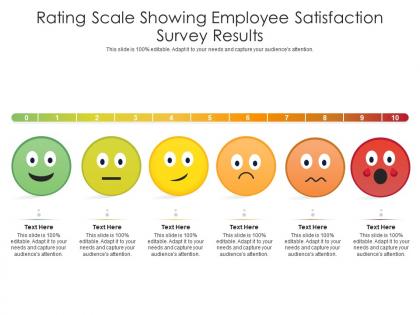
Rating scale showing employee satisfaction survey results infographic template




Try Before you Buy Download Free Sample Product
 Impress Your
 Audience
 100%
100% Editable
 Save Hours
 of Time


This Rating Scale Showing Employee Satisfaction Survey Results Infographic Template is a professionally drafted slide that can be deployed by managers, executives, owners, consultants, and other individuals to make their presentation more visually appealing. This layout helps the viewers gain quality information in less amount of time, thus conveying your message in the best possible manner. It reinforces the topics presented and makes their explanation more simplified, which is why this infographic template will suit any professional domain. Its vivid colors, graphics, design, etc., not only increases the aesthetics of the slideshows but also initiates immediate action. One of the advantages of downloading this PowerPoint design is that it can be reproduced as PNGs, JPGs, and PDFs that can be stored for further application. Hence, without indulging in a vigorous brainstorming session, download this layout now.
People who downloaded this PowerPoint presentation also viewed the following :
Rating scale showing employee satisfaction survey results infographic template with all 2 slides:
Use our Rating Scale Showing Employee Satisfaction Survey Results Infographic Template to effectively help you save your valuable time. They are readymade to fit into any presentation structure.
FAQs for Rating scale showing employee satisfaction survey
So I just looked at our survey results - people want clear growth paths and managers who don't suck at listening. Recognition matters tons too, not just the fake "great job" stuff. Flexible schedules are non-negotiable now, honestly everyone's burned out from rigid expectations. Free snacks actually made the list which cracked me up. But real talk, autonomy and feeling connected to what you're doing keeps people around. Regular one-on-ones help - just ask what they actually want to learn or work on next.
So I checked out those survey numbers you mentioned. Engineering and Marketing are crushing it - both hit the 80s. Customer Service and Operations? Not so much, they're stuck around 60-70. Sales is weird though, all over the map depending on quota pressure I think. The main issues seem to be workload stuff and people wanting better growth paths. Honestly, I'd focus on those lower-scoring departments first. That's where you'll actually see some real improvement instead of just tweaking what's already working fine.
So I looked at those survey results - workload management is killing people, like 65% mentioned it. Career development is a mess too, nobody knows where they're going. Oh and leadership communication? Total disaster. Honestly, the workload thing doesn't surprise me at all, everyone's drowning with unrealistic deadlines. They're all connected though - if leaders actually talked to people about expectations and growth plans, half these problems would disappear. I'd tackle communication first since it'll help fix the other stuff. People just want to know what's happening and that someone cares about their future there.
Dude, work-life balance stuff makes such a difference for employee happiness. Like, seriously - in every survey I've seen, it's always near the top. People just want flexible schedules, remote options, decent time off. Basic stuff, right? But companies still screw it up all the time. The numbers don't lie though - teams with good balance policies score way higher on satisfaction, like 20-30% better. Oh, and here's the thing - actually ask your people what flexibility they need instead of guessing. You'll probably be surprised by their answers.
Dude, communication from managers is literally everything for keeping employees happy. I see it in every survey we do. Clear expectations, regular feedback, actually listening - that stuff makes satisfaction scores shoot up. Without it? People feel totally lost and ignored. I've watched teams with okay benefits but solid communication crush teams that had incredible perks but managers who basically ghosted everyone. Weekly check-ins are a game changer if you're not doing those yet. Two-way conversations beat corporate announcements every time.
Honestly, recognition systems can work really well if you don't mess them up. Generic "thanks team" emails sent weeks later? Total waste. People want to feel seen for what they actually did - like, call out the specific thing they crushed. Cash is obviously great, but I've seen personalized shout-outs make people way happier than expected. Mix public recognition with rewards that actually mean something to your team. Oh, and be consistent about it. Random recognition here and there can backfire hard.
Honestly? Most places do yearly surveys but that's way too slow if you actually want to fix stuff. I'd go with quarterly mini-surveys instead - like 5-10 questions max, not those brutal 50-question monsters nobody wants to fill out. Here's the thing though: frequency doesn't matter if you don't do anything with the feedback. People will just stop responding. Start with quarterly check-ins plus one big annual survey, then see how it goes. You can always tweak based on response rates and how fast you can actually make changes happen.
So we do both number-crunching and reading through all the written comments. The stats help us catch trends and see how different departments compare. Reading responses is honestly a pain but that's where the good stuff hides. Heat maps are clutch for spotting problem areas fast. Cross-tabs show how things connect - like maybe remote workers are happier but only in certain roles? Start with your main satisfaction numbers first, then figure out what's actually driving those scores up or down for each team.
So we use these third-party platforms that automatically strip out anything identifying before we even see the data. Demographics get lumped into big buckets - like "5+ years" instead of your actual start date, stuff like that. I used to worry about this too honestly, but the system's pretty solid. Managers only get team summaries with at least 5 responses, never individual stuff. Oh and we don't share the raw data either. The trick is actually explaining this whole process upfront in your survey intro. Otherwise people won't trust it and you'll get garbage feedback.
So we actually did follow through on a bunch of stuff from last year's survey. Flexible work arrangements are finally happening - took forever but whatever. Monthly team check-ins started too, plus we completely redid the performance review thing to focus more on development instead of just critique. The office kitchen got a major upgrade (honestly was about time). Career paths are way clearer now for each department. Some changes rolled out faster than others obviously. We're checking the numbers every quarter to see what's working. You'll get a full breakdown next week showing which concerns we tackled and what's still being worked on.
Yeah, there's totally a connection there. Teams with crappy satisfaction scores almost always see people bail within 6-12 months - I've seen it happen so many times. Watch for red flags in management relationships, career growth stuff, and work-life balance responses especially. Here's the annoying part though: by the time your survey shows things are going downhill, some folks are already mentally done or secretly job hunting. Anything below 3.5 on a 5-point scale? That's your cue to actually do something about those specific issues before everyone starts heading for the exits.
Dude, professional development is seriously one of the biggest drivers of job satisfaction - like, it consistently ranks at the top in employee surveys. Here's the thing: when people feel stuck in their role with nowhere to go, they get restless super quickly. Training programs, mentoring, new project opportunities - all that stuff sends the message that you see a future for them beyond just doing their current job forever. Honestly, I've seen teams where morale tanked because management only cared about today's output, not where people wanted their careers to go. Skills development keeps people engaged too. If satisfaction's dropping, I'd definitely start there.
Yeah, remote work definitely makes people happier overall. The flexibility thing is huge - no commute, better work-life balance, all that good stuff. People feel way more autonomous when they're working from home. The downside? Some folks get pretty lonely and miss the office chatter (honestly, I kinda get it). Communication can get tricky too. From what I've seen, hybrid setups usually win because everyone gets to pick what works for them. You should totally add some specific remote work questions to your next survey - like what schedule people actually want, not just generic satisfaction stuff.
So work-life balance keeps climbing every year - actually beat out salary as the top concern in our latest surveys. Remote flexibility is still huge, obviously. But here's what's really interesting: people are getting way more specific about wanting clear career paths and actual development opportunities. Oh, and the feedback on management quality? Brutal honesty compared to a few years ago. Everyone wants transparency now. You'll probably see the same patterns with your team, so I'd start there - those four things should be your focus.
Share results fast - like within 2-4 weeks max. Use everything: all-hands meetings, team huddles, emails, dashboards. Don't sugarcoat the feedback either. Good and bad stuff needs to get out there. Honestly, people get SO pissed when surveys just vanish into thin air. Create actual action items with deadlines and assign owners based on what you learned. Can't fix everything right away? That's fine, just explain why and when you'll circle back. Even acknowledging the feedback shows you weren't just going through the motions.
-
Colors used are bright and distinctive.
-
Informative design.
-
Great designs, Easily Editable.
-
Perfect template with attractive color combination.
-
Design layout is very impressive.