

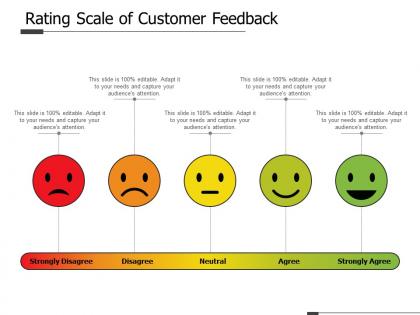
Rating scale of customer feedback




Try Before you Buy Download Free Sample Product
 Impress Your
 Audience
 100%
100% Editable
 Save Hours
 of Time


Figure out correct answers with our Rating Scale Of Customer Feedback. Discover the formula that fits exactly.
People who downloaded this PowerPoint presentation also viewed the following :
Rating scale of customer feedback with all 5 slides:
Drive away the blues with our Rating Scale Of Customer Feedback. They are bound to make you feel happy again.
FAQs for Rating scale
Most surveys stick with three main types: the classic 5-point scale (strongly disagree to agree), 1-10 ratings, or Net Promoter Score where people rate how likely they'd recommend you. Simple thumbs up/down works too when you want zero friction. Honestly? NPS is overhyped but executives love those numbers. Five-point scales are your friend - familiar enough that people don't overthink it, plus you get decent data without analysis paralysis. My advice would be starting there and seeing what your audience actually responds to. Oh, and avoid anything longer than 7 points unless you enjoy confusing people.
Oh yeah, survey design totally changes how people answer. Wild how much, actually. Like with 1-10 scales, everyone just picks 7 or 8 - they hate the extremes. But 5-point scales? People actually commit to an answer. Word choice is huge too. "Satisfied" vs "happy" can swing results by 10-15%. Plus people are lazy - they'll just pick whatever's listed first half the time. Honestly I'd test two versions on a small group before going wide. See which one actually gives you useful data instead of just... noise.
Honestly, Likert scales are perfect for this stuff. People know how to use them - everyone gets the 1-5 thing. You'll get way more responses than with those essay-style questions that make people panic and bail out. The data's actually useful too since you can track changes month to month and spot weird patterns. Quick for customers, easy for you to crunch numbers later. Oh, and definitely throw in a comment box underneath though. The ratings show you there's a problem, but you need those random customer rants to figure out what's actually broken.
Check where most of your ratings are landing first - high end, low end, or scattered everywhere? Don't just look at averages though, they're pretty useless if people are split between love-it-or-hate-it responses. I'd focus on the percentage breakdown for each rating level instead. Track how things change over time rather than freaking out about one bad month. The written comments are gold - match them up with specific rating ranges to understand what's actually driving those numbers. Oh, and set up regular review cycles so you're not just hoarding data like some kind of feedback dragon. Actually do something with what you learn!
Ask about specific stuff, not vague "rate your experience" nonsense. Like "How easy was it to find what you needed?" or "Did we respond quickly enough?" Make your scale logical too - I've seen surveys where 1 means excellent and it's so confusing! Just do 1 = bad, 5 = good. Simple. Don't cram multiple things into one question either. "How was our speed and accuracy?" is really two separate issues. Your customers won't know which one to focus on. Oh, and definitely test questions with a few people first. You'll catch weird phrasing before sending it to everyone.
So you want balanced scales first - like proper 5-point ones with a real middle option. Don't do that "How amazing was our service?" garbage because yeah, that's obviously leading people. Just stick with neutral stuff like "How would you rate..." Mix up your question order too if you can. Oh and test everything internally first - if you immediately know the "right" answer, your customers will spot it from a mile away. Different scale types help break patterns. The wording thing is honestly the biggest trap most people fall into though.
Your scale labels totally matter more than people realize. Like, "satisfied" versus "very satisfied" - customers think "satisfied" sounds meh, so they'll bump their rating up just to show they're actually happy. I've watched this screw up data so many times! You want labels that feel natural and cover how people really feel about stuff. Short sentences work. When "satisfied" feels too blah, everyone clusters in the higher ratings and your results get wonky. Honestly, just test the labels with actual customers first - see if they match how people naturally talk about their experiences.
Oh man, this drives me crazy! People constantly flip the scale - half think 1 is best, others assume 10's the top. Then you've got cultural differences making it messier since rating expectations aren't universal. I always see folks avoiding extremes too, clustering around middle numbers. They'll rate something 5/10 thinking that means "good" when you designed it as average. Your labels are everything though - "satisfied" means totally different things to different people. Honestly, I'd test your scale with a few people first. Clear anchors help too, like "1 = extremely dissatisfied, 10 = extremely satisfied."
Honestly, I'd go with the 5-point scale. People just get it - bad to good, simple as that. Response rates are way better because it doesn't look scary or time-consuming. Sure, the 10-point gives you more detailed data, but here's the thing - most people still just pick round numbers like 5, 7, or 10 anyway. What's the real difference between rating something a 6 versus 7? Half your respondents won't even know. Unless you're doing some heavy statistical analysis (which, let's be real, most of us aren't), the 5-point will give you everything you need without overwhelming anyone.
Honestly, rating scales are like a cheat code for product decisions. Low scores on specific features? That's literally your to-do list handed to you on a silver platter. You'll know exactly where to spend your dev time instead of just throwing darts at a board. Track the trends too - super satisfying when you see scores jump after a fix (or really depressing when they don't, but whatever). The real magic happens when you break down feedback by user segments. Different user types hate different things, which sounds obvious but you'd be surprised how often teams miss this. Just connect those scores straight to your sprint planning and you're golden.
Honestly, AI makes analyzing rating data so much easier than doing it by hand. You can spot patterns across thousands of responses that would take forever to find manually. The cool part is how it connects numerical ratings with actual written feedback - like showing you exactly why someone gave you 3 stars instead of 5. It'll even predict which customers might bail based on their response patterns. Natural language processing does most of the heavy lifting here, finding sentiment trends and linking ratings to specific themes or keywords. Way better than drowning in spreadsheets! Just dump your existing feedback into an AI tool and see what pops up.
Different cultures handle rating scales totally differently, which is kinda fascinating honestly. Like in many Asian countries, people avoid giving harsh ratings because it feels rude - they'll cluster around 3s and 4s instead of being brutally honest with 1s and 2s. Meanwhile other cultures don't hesitate to slam you with extremes. The number of rating options matters too. Some cultures actually prefer even-numbered scales since it forces you to pick a side rather than hiding in the neutral middle. I'd definitely test your scale with different groups first. You might need regional tweaks to get real feedback instead of just polite responses.
Honestly, people need to feel safe being real with you. I'd go with 1-10 scales instead of those cramped 1-5 ones - gives them room to breathe. Always throw in text boxes too, that's where you get the actual good stuff. Don't ask right after something happens when they're all heated up. Wait a day or two, let things settle. But here's the big thing - you gotta show you're listening. Reply when you can, mention what you've changed based on past feedback. Nobody wants to waste time on surveys that disappear into the void, you know? Once they see their words actually move the needle, they'll be way more honest next time.
Break down your follow-ups by rating - happy customers get thank-yous and referral requests. Low scores? Jump on damage control ASAP. The middle ratings are actually where you can learn the most - send them deeper surveys to figure out what'd make them happier. Most companies are terrible at this part, honestly. They collect feedback then... nothing. Set up alerts so bad reviews hit your team's inbox within hours. Oh, and always circle back to people who complained. They need to see you actually listened and fixed something.
Dude, you should totally try visual rating scales instead of those boring number things. Stars, emojis, color bars - anything beats plain old 1-10 scales. People actually *want* to click on them because they're fun and way easier to process. Response rates can jump like 30-40% just from making that switch, which honestly blew my mind when I first heard it. The trick is picking visuals that match your brand vibe though. Maybe start with star ratings or those smiley face emojis? They work for pretty much everything. Trust me, your customers will thank you for not making feedback feel like a math test.
No Reviews