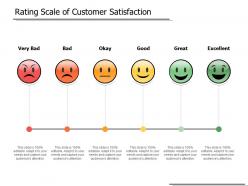
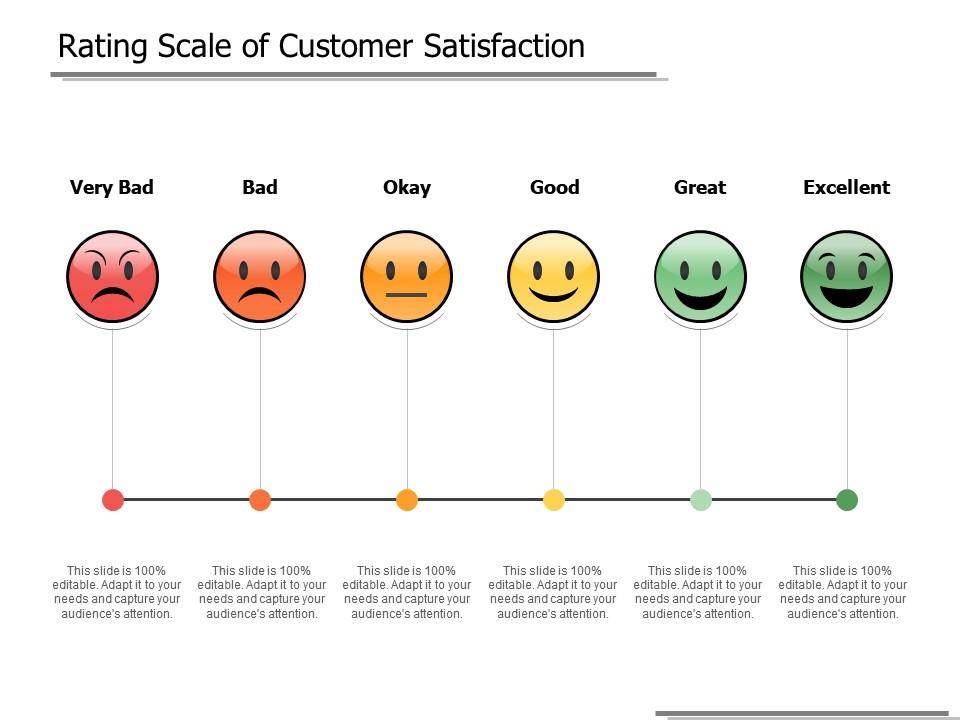
Rating scale of customer satisfaction
Try Before you Buy Download Free Sample Product
Audience
Editable
of Time
The competition falls further behind due to our Rating Scale Of Customer Satisfaction. Be able to cement your gains.
People who downloaded this PowerPoint presentation also viewed the following :
Rating scale of customer satisfaction with all 5 slides:
Our Rating Scale Of Customer Satisfaction assure you exclusive attention. They can be adjusted to fulfill your demand.
FAQs for Rating scale
Key components of an effective customer satisfaction scale include clear rating criteria, balanced response options, specific service attributes, demographic segments, and actionable metrics. These elements work together by measuring overall satisfaction, identifying improvement areas, and tracking performance trends, with many retail and service organizations finding that comprehensive scales ultimately deliver enhanced customer experiences and stronger loyalty rates.
Qualitative feedback integrates into quantitative measurements through sentiment analysis, coded response categories, mixed-method surveys, and thematic scoring systems that convert narrative insights into measurable data points. This strategic combination enables organizations to capture nuanced customer emotions while maintaining statistical rigor, with retail and hospitality sectors finding that blended approaches deliver deeper insights and more actionable improvement strategies.
Cultural context significantly influences customer satisfaction scale design through communication styles, expectation levels, response patterns, and value systems that vary across regions and demographics. Organizations must adapt their scales by incorporating culturally relevant metrics, adjusting rating interpretations, and accounting for cultural biases in feedback expression, with many global companies finding that localized satisfaction measurements deliver more accurate insights and enhanced customer experiences.
Different industries significantly impact customer satisfaction scales through varying service expectations, interaction frequency, and outcome measures, requiring tailored approaches for sectors like healthcare, retail, and financial services. While healthcare might emphasize trust and care quality, retail focuses on convenience and product satisfaction, and banks prioritize security and efficiency, with many organizations finding that industry-specific scales deliver more accurate insights and actionable improvement strategies.
Likert scales offer standardized measurement, quantifiable data analysis, easy comparison across time periods, statistical reliability, and straightforward customer comprehension for satisfaction surveys. These structured rating systems enable businesses to track satisfaction trends, benchmark performance against competitors, and identify specific improvement areas, with many service organizations finding that consistent Likert measurement delivers actionable insights for enhancing customer experiences.
Businesses ensure reliability by using consistent measurement intervals, standardized question formats, adequate sample sizes, and regular calibration checks across different customer segments. Through systematic data validation, statistical testing, and cross-referencing multiple feedback channels, organizations can minimize bias and measurement errors, ultimately delivering more accurate insights that drive strategic improvements in service delivery.
**INPUT**: What methods can be used to validate a newly developed customer satisfaction scale? **OUTPUT**: Validation methods include content validity through expert reviews, construct validity via factor analysis, criterion validity against established metrics, test-retest reliability, and internal consistency measures. These approaches work together by ensuring accuracy, reliability, and practical applicability, with many organizations finding that comprehensive validation ultimately delivers more actionable insights and strategic competitive advantage. [Word count: 56 words]
Customer satisfaction scales can be adjusted by mapping specific metrics to individual touchpoints, customizing question formats for each interaction stage, and aligning rating criteria with touchpoint-specific outcomes like response time or resolution quality. This targeted approach enables businesses to identify precise friction points across their customer journey, from initial contact through post-purchase support, ultimately delivering more personalized experiences and strategic improvements.
Best practices for administering customer satisfaction surveys include optimal timing after interactions, mobile-friendly designs, clear incentives, personalized invitations, and brief questionnaires under five minutes. These approaches maximize response rates by respecting customer time, offering convenient access across devices, and providing value exchange, with many retail and service organizations finding that strategic timing and personalized outreach significantly enhance participation and data quality.
Businesses should update their customer satisfaction scales annually or bi-annually, with more frequent reviews during major product launches, market shifts, or regulatory changes. Through regular assessment, companies can capture evolving customer expectations, emerging touchpoints, and changing industry standards, while ensuring their measurement frameworks remain aligned with current market dynamics, ultimately delivering more accurate insights and competitive advantage.
Benchmarking customer satisfaction scores against industry standards provides strategic context for performance evaluation, identifies competitive positioning gaps, and reveals improvement opportunities across service delivery touchpoints. This comparative analysis enables organizations to set realistic targets, prioritize resource allocation effectively, and develop data-driven strategies, with many companies finding that systematic benchmarking ultimately delivers enhanced customer retention and sustainable competitive advantage.
Technology enhances customer satisfaction data collection through automated surveys, real-time feedback systems, social media monitoring, AI-powered sentiment analysis, and mobile app integrations. These digital tools streamline response gathering across multiple touchpoints, with retail chains and financial services finding that automated systems deliver faster insights, higher response rates, and more comprehensive customer understanding.
Common pitfalls include overemphasizing high scores without investigating underlying concerns, ignoring response bias from dissatisfied customers who don't participate, and failing to segment results by demographics or purchase behavior. Organizations often misinterpret neutral responses as satisfaction rather than indifference, while overlooking qualitative feedback that explains quantitative scores, ultimately missing opportunities for targeted improvements and enhanced customer retention strategies.
Customer satisfaction scores correlate directly with business outcomes through increased customer lifetime value, reduced churn rates, and enhanced word-of-mouth referrals. Companies with higher satisfaction ratings typically see 10-15% revenue growth and 25% better retention, with many organizations finding that satisfied customers spend significantly more and require lower acquisition costs, ultimately delivering sustainable competitive advantage.
Key factors include population size, desired confidence level, margin of error, expected response rates, and budget constraints, along with survey complexity and demographic segmentation requirements. Organizations typically find that larger samples provide more reliable insights but require balancing statistical accuracy with resource allocation, with many businesses discovering that strategic sampling across customer segments delivers actionable feedback while maintaining cost efficiency.
-
nice