

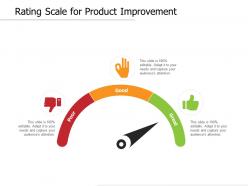
Rating scale for product improvement





Try Before you Buy Download Free Sample Product
 Impress Your
Audience
 100%
Editable
 Save Hours
of Time


Generate a great deal of admiration with our Rating Scale For Product Improvement. Your erudition will be applauded.
People who downloaded this PowerPoint presentation also viewed the following :
Rating scale for product improvement with all 6 slides:
Our Rating Scale For Product Improvement ensure your erudition is applauded. You will generate a great deal of admiration.


FAQs for Rating scale
Key factors include measurement objectives, scale granularity, user experience complexity, data collection methods, and actionable feedback mechanisms. These elements work together by ensuring comprehensive coverage of product dimensions, enabling meaningful user responses, and delivering insights that drive strategic improvements, with many organizations finding that well-designed scales significantly enhance product development cycles and customer satisfaction outcomes.
Qualitative feedback integrates into quantitative rating systems through sentiment analysis, coded response categorization, weighted scoring mechanisms, and correlation mapping between comments and numerical ratings. This strategic combination enables organizations to identify specific improvement areas, validate quantitative trends with detailed insights, and deliver more nuanced product enhancements, ultimately providing comprehensive understanding of customer experiences.
Common pitfalls include using vague descriptors, creating too many or too few scale points, failing to define rating criteria clearly, and designing biased questions that lead responses. These design flaws can skew feedback collection, create inconsistent user interpretations, and ultimately deliver unreliable data for product development decisions, with many organizations finding that poorly constructed scales actually hinder rather than enhance improvement efforts.
Cultural differences significantly impact rating scale interpretation through varying communication styles, numerical associations, and feedback norms across different societies and regions. While Western cultures often embrace direct criticism and mid-range ratings, many Asian cultures favor harmony and extreme politeness, leading to consistently higher scores, with organizations finding that localized scales and cultural context training ultimately deliver more accurate feedback and meaningful product improvements.
Ensuring reliability and validity requires systematic testing through test-retest reliability, internal consistency measures, criterion validity assessments, and cross-validation studies across diverse user groups. These methods enhance rating accuracy by establishing consistent measurement patterns, correlating with actual product performance metrics, and validating scale effectiveness across different demographics, ultimately delivering more credible consumer insights and strategic market positioning.
User experience alongside product functionality can be quantified through multi-dimensional rating scales incorporating usability metrics, task completion rates, user satisfaction scores, performance benchmarks, and feature effectiveness ratings. Organizations like software companies, e-commerce platforms, and mobile app developers increasingly combine quantitative measures with qualitative feedback, ultimately delivering comprehensive product insights that streamline development cycles and enhance competitive positioning in user-centric markets.
Customer segmentation enables organizations to create targeted product improvement rating scales by identifying distinct user groups, their specific needs, usage patterns, and satisfaction drivers. Through demographic, behavioral, and psychographic segmentation, companies can design customized rating criteria and question frameworks that resonate with each segment, ultimately delivering more actionable insights and strategic product enhancements.
Stakeholders can be effectively engaged through collaborative workshops, structured interviews, and iterative feedback sessions that incorporate their expertise and perspectives into scale development. By involving key participants from different departments, organizations ensure the rating scale reflects real-world usage scenarios, addresses specific operational needs, and gains broader organizational buy-in, ultimately delivering more accurate assessments and smoother implementation across teams.
Best practices for training team members include establishing clear rating criteria definitions, conducting hands-on calibration sessions with sample scenarios, providing real product examples across different rating levels, and implementing peer review processes. These approaches enhance consistency by ensuring uniform interpretation, reducing scoring variability, and building confidence in assessment accuracy, with many organizations finding that regular refresher sessions and cross-functional workshops ultimately deliver more reliable improvement insights.
Technology enhances rating scale data collection and analysis through automated survey platforms, real-time analytics, AI-powered sentiment analysis, mobile integration, and cloud-based dashboards. These solutions streamline feedback gathering by eliminating manual processing, detecting response patterns instantly, and providing predictive insights, with many organizations finding that automated systems deliver faster decision-making and improved customer experiences.
Digital tools significantly enhance product improvement rating by enabling real-time data collection, automated analytics, advanced visualization capabilities, and broader stakeholder participation compared to traditional paper-based methods. Through cloud-based platforms and mobile applications, organizations streamline feedback processes, reduce evaluation timeframes, and generate more comprehensive insights, with many companies finding that digital approaches deliver faster decision-making and improved product outcomes.
Changes in external market conditions should be reflected through dynamic weight adjustments, revised evaluation criteria, updated competitive benchmarks, and modified timeline expectations within the rating scale. This adaptive approach enables organizations to maintain relevance across shifting consumer demands, regulatory changes, and technological disruptions, with many companies finding that flexible rating frameworks ultimately deliver more accurate improvement priorities and sustained competitive advantage.
Rating scales enable organizations to systematically evaluate and rank product improvements by quantifying user feedback, stakeholder input, and business impact across consistent criteria. Through structured scoring frameworks, companies can objectively compare enhancement opportunities, allocate resources strategically, and focus development efforts on high-impact changes, ultimately delivering faster time-to-market and competitive advantage.
Key metrics include improvement completion rates, rating score trends over time, customer satisfaction deltas, feature adoption rates, and complaint resolution percentages. These measurements enable organizations to quantify enhancement impact by tracking before-and-after performance, monitoring user engagement with updated features, and measuring customer retention improvements, ultimately delivering measurable ROI on product development investments.
Iterative testing improves rating scales through A/B comparisons of different formats, user feedback analysis, response pattern evaluation, and cognitive load assessment. Through systematic testing cycles, organizations can identify optimal anchor points, reduce response bias, and enhance scale clarity, with many product teams finding that continuous refinement delivers more accurate user insights and higher completion rates.
No Reviews