


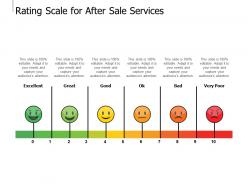
Rating scale for after sale services





Try Before you Buy Download Free Sample Product
 Impress Your
Audience
 100%
Editable
 Save Hours
of Time


Ease your cost burden with our Rating Scale For After Sale Services. They are cheaper than you expect.
People who downloaded this PowerPoint presentation also viewed the following :
Rating scale for after sale services with all 5 slides:
Our Rating Scale For After Sale Services are cheaper than you expect. They will ease your cost burden.


FAQs for Rating scale for
Key components should include response time metrics, resolution effectiveness, staff professionalism, communication quality, follow-up consistency, and overall customer satisfaction scores. These elements enable businesses to systematically evaluate service delivery across touchpoints, with many retail and technology companies finding that comprehensive rating frameworks streamline feedback analysis, enhance service standards, and ultimately deliver improved customer retention and competitive advantage.
Businesses can effectively collect customer feedback on after-sale service through automated email surveys, SMS questionnaires, mobile app ratings, phone interviews, and social media monitoring. These methods enable organizations to capture immediate post-purchase insights, track service quality trends, and identify improvement opportunities, with many companies finding that multi-channel approaches deliver higher response rates and more comprehensive customer experience data.
Customer satisfaction scores, response time metrics, first-call resolution rates, Net Promoter Score, and service cost per interaction are most valuable for assessing after-sale service performance. These metrics work together by measuring customer experience quality, operational efficiency, and financial impact, with many organizations finding that combining satisfaction data with resolution speed ultimately delivers competitive advantage and improved customer retention rates.
Cultural differences significantly impact after-sale service rating scales through varying communication styles, expectation levels, and feedback patterns across regions. While Western customers often provide direct, detailed feedback, Asian cultures may emphasize politeness over criticism, and collectivist societies prioritize relationship maintenance, ultimately requiring businesses to adapt their rating methodologies and interpretation frameworks for accurate, culturally-sensitive service assessments.
Technology enhances after-sale service ratings by automating support processes, enabling real-time customer tracking, and facilitating faster issue resolution through AI-powered chatbots and predictive analytics. These digital solutions streamline communication channels, improve response times, and deliver personalized experiences, with many organizations finding that integrated technology platforms ultimately boost customer satisfaction scores and competitive advantage.
After-sale service ratings significantly influence customer loyalty by building trust, demonstrating commitment to satisfaction, and creating positive experiences that encourage repeat purchases. High ratings enhance brand reputation and competitive advantage, with many retail and technology companies finding that excellent post-purchase support reduces churn rates, increases customer lifetime value, and generates valuable referrals through satisfied customers.
Common pitfalls include poorly designed rating questions, insufficient response collection methods, lack of staff training on feedback processes, inadequate follow-up protocols, and failure to integrate ratings with actionable improvement strategies. Many retail and service organizations find that without proper implementation planning, rating scales become mere data collection exercises rather than strategic tools for enhancing customer retention and competitive advantage.
Training and development enhance after-sale service ratings by improving technical competencies, communication skills, and problem-solving abilities among support teams. Through structured programs, organizations streamline response times, increase first-call resolution rates, and deliver more personalized customer experiences, with many companies finding that well-trained staff ultimately boost satisfaction scores and customer retention significantly.
Benchmarking methods include industry association surveys, third-party research reports, competitor analysis through public reviews, customer satisfaction databases, and professional benchmarking services. These approaches enable organizations to compare performance metrics, identify improvement opportunities, and establish competitive positioning, with many companies finding that systematic benchmarking ultimately delivers enhanced service strategies and stronger customer retention rates.
After-sale service ratings should be communicated through comprehensive dashboards, executive summaries, customer feedback reports, trend analyses, and stakeholder presentations that highlight key performance metrics. These communication methods enhance transparency by providing real-time insights, quarterly performance reviews, and actionable recommendations, ultimately enabling organizations to demonstrate service excellence while identifying improvement opportunities for sustained competitive advantage.
Descriptive analytics track rating trends and patterns, predictive analytics forecast customer satisfaction outcomes, diagnostic analytics identify root causes of service issues, and prescriptive analytics recommend improvement strategies. These approaches enable organizations to transform rating data into actionable insights, with many retail and technology companies finding that integrated analytics deliver enhanced customer retention, streamlined service processes, and sustained competitive advantage.
Visual presentation formats enhance after-sale service rating understanding by transforming complex data into intuitive charts, color-coded dashboards, interactive heat maps, and comparative graphs that highlight trends and patterns. These visual tools enable businesses to quickly identify service gaps, track performance improvements, and communicate results to stakeholders more effectively, with many organizations finding that visual formats accelerate decision-making and enhance customer experience strategies.
Best practices for continuously improving after-sale service include analyzing rating trends to identify pain points, implementing feedback loops with customer follow-ups, training staff based on specific rating comments, and establishing service recovery protocols for low ratings. Through systematic review processes, organizations streamline response times, enhance technician training, and personalize customer interactions, with many companies finding that proactive communication and swift issue resolution significantly boost satisfaction scores and customer retention.
Social media provides valuable after-sale service insights through customer feedback monitoring, sentiment analysis, direct message interactions, and review tracking across platforms like Twitter, Facebook, and LinkedIn. These channels enable businesses to identify service gaps, measure customer satisfaction in real-time, and respond proactively to concerns, with many organizations finding that social listening tools ultimately deliver enhanced service quality and stronger customer relationships.
Making after-sale service ratings more actionable requires categorizing feedback into specific operational areas like response time, technical expertise, and resolution effectiveness, while implementing automated workflows that route issues directly to relevant departments. Organizations increasingly combine quantitative scores with qualitative insights, enabling targeted improvements in service delivery, staff training protocols, and customer communication processes, ultimately transforming ratings into strategic competitive advantages.
No Reviews