


Rating scale of product quality




Try Before you Buy Download Free Sample Product
 Impress Your
 Audience
 100%
100% Editable
 Save Hours
 of Time


Be assured of a grand finale with our Rating Scale Of Product Quality. Build firmly upon a good beginning.
People who downloaded this PowerPoint presentation also viewed the following :
Content of this Powerpoint Presentation
Description:
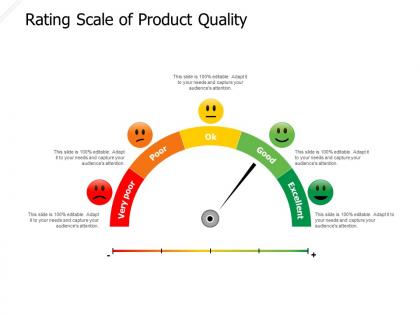
The image depicts a "Rating Scale of Product Quality" consisting of a semi-circular meter indicating five levels of product quality assessment, from "Very Poor" to "Excellent." Each quality level is represented by a color-coded segment and a corresponding emoticon reflecting customer satisfaction, ranging from a very sad face for "Very Poor" to a very happy face for "Excellent." The needle points towards "Good," suggesting this is the assessed level of product quality. Text on each end of the scale reiterates that the slide is "100% editable," meaning that the presentation can be customized to fit the presenter's needs and tailor it to captivate the audience's attention.
Use Cases:
This slide is versatile and can be utilized across various industries for different applications:
1. Retail:
Use: Customer satisfaction tracking for products
Presenter: Customer Service Manager
Audience: Staff and Stakeholders
2. Hospitality:
Use: Rating guest experience and accommodation quality
Presenter: Hotel Operations Manager
Audience: Hotel staff and management
3. Software Development:
Use: Evaluating software user experience and interface quality
Presenter: Product Manager
Audience: Development team and investors
4. Automotive:
Use: Assessing vehicle quality and customer satisfaction
Presenter: Quality Assurance Lead
Audience: Engineering team and executives
5. Education:
Use: Grading the educational content or educator performance
Presenter: Academic Coordinator
Audience: Educational staff and administration
6. Food Services:
Use: Determining quality levels of food and service in restaurants
Presenter: Head Chef or Restaurant Manager
Audience: Culinary and service team
7. Healthcare:
Use: Gauging patient satisfaction with medical care or facilities
Presenter: Hospital Administrator
Audience: Healthcare staff and board members
Rating scale of product quality with all 6 slides:
Our Rating Scale Of Product Quality ensure different cultures don't deter you. You will be comfortable anywhere on earth.


FAQs for Rating scale
Focus on what actually matters to your users first - don't just steal from other companies since their needs are probably way different. Each thing you're rating needs clear definitions and examples so people can judge objectively. Your scale should show real differences without being crazy complicated to use. Who's doing the rating matters too - are they experts or regular users? Honestly, most companies skip this part but you really need to test it on actual products first. See if it can tell good quality from garbage before you commit to using it everywhere.
Your customers basically tell you what your rating scale should measure. Premium products need way more detailed criteria - build quality, durability, all that stuff. Scale range is huge too. Rating luxury items on 1-5? That's kinda useless since everything should be "good" anyway. You'd want 7-10 points to actually show differences. Market expectations are totally different - "excellent" for budget stuff isn't the same as high-end excellent. Honestly, I'd just survey your customers first. Figure out what quality means to them, then design your scale around that.
So basically, industry standards give your rating scale instant credibility. Customers already know what ISO ratings mean, for example - you don't have to explain everything from scratch. It's honestly a huge time-saver too since you're not creating something completely new. Standards also keep you legally covered if anyone questions your ratings later. Oh, and competitors are probably using similar frameworks anyway, so it makes comparisons easier for buyers. I'd definitely look up what standards your industry already follows and just build around those. Way smarter than trying to reinvent everything yourself.
Honestly, you gotta stay on top of this stuff - I'd say quarterly reviews or at least twice a year. So many companies are still using 2019 criteria and then acting shocked when their ratings don't match what customers actually think. Check what your competitors are doing, ask your quality team if the current metrics even make sense anymore. The big tell? If your ratings aren't lining up with customer satisfaction scores, that's when you know it's time to update everything. Maybe tweak those rating thresholds too - customer expectations shift way faster than we think they will.
Hey! So for getting feedback on product quality, I'd start with post-purchase surveys - they're super easy to set up and give you steady data. Online reviews and social monitoring are goldmines since people are already talking about your stuff anyway. Focus groups give you amazing insights, but honestly they're expensive and coordinating schedules is the worst. If you've got a digital product, try those little feedback pop-ups. Phone calls work great for your VIP customers too. Start simple with the email surveys first - you can always get fancier later once you see what works.
Make it visual first - stars, colors, simple numbers that anyone can scan quickly. Honestly, most people have zero patience for long explanations anyway. Put the scale right on product pages and packaging where they'll actually see it. Keep the same format everywhere though, because repetition is what makes it stick. Your customers will learn it naturally if they keep seeing the same clear system. I'd start by checking where your ratings show up now - probably all over the place, right? Get that consistent and you're halfway there. Brief explanations work way better than detailed ones.
Honestly, a solid rating system is a game-changer for keeping customers coming back. People hate surprises when they're spending money - if they know your 3-star stuff is decent and 5-star is amazing, they'll trust you more. It shows you're not just throwing random products at them hoping something sticks. The whole transparency thing makes customers feel like you actually respect them enough to be upfront. Oh, and definitely look at whatever system you're using now - make sure it's specific enough that someone can guess if they'll be happy before they buy. Trust me, it's worth the effort.
Oh totally, culture plays a huge role in this stuff. Japanese people are super stingy with 5-star ratings - like a 4/5 from them basically means it's amazing. Americans? We hand out 5 stars like candy lol. Germans get really into the technical specs and how long something lasts, while other places care more about looks or brand names. There's also this weird thing where some cultures rate based on what they think everyone else would say rather than their own experience. Honestly makes comparing reviews across countries pretty tricky - you've got to adjust your expectations based on where the feedback's coming from.
Honestly, start with defect rates and customer satisfaction - those two will tell you the most right off the bat. Return/reject percentages are super useful too. If you're making physical stuff, definitely track first-pass yield because fixing problems later is such a pain. Customer satisfaction is kind of a nightmare to measure consistently, but it's probably your best indicator since people use your product way differently than your QA team tests it. Oh, and time-to-resolution for quality issues is worth watching. Those first two though? Easiest to set up and you'll get insights immediately.
Honestly, tech makes building rating scales way easier than it used to be. AI can dig through customer feedback to figure out what quality factors actually matter to people. Then you can use analytics tools to test your scale against real product data - no more shooting in the dark. Machine learning spots weird biases you might've missed too. Oh, and those automated survey platforms? Game changer for testing different versions quickly. I'd probably start by figuring out what your customers care about most, then let the tools help you fine-tune everything. Way better than the old trial-and-error approach.
Don't try to match customer reviews exactly - use them to fix your internal ratings instead. When customers keep rating stuff lower than you do, look at what they're actually saying. Maybe your standards are off or you're missing something obvious. The annoying part? Filtering out the crazy complaints from real issues. I mean, some people leave one-star reviews because their package was late, which tells you nothing about the actual product. Focus on patterns in the feedback to tweak your rating system. Quick test: compare your ratings to review sentiment for your top 10 products this week and see where things don't line up.
So here's the thing - simple 1-5 star ratings are super easy for customers, but they don't tell you much. You know people are unhappy but have no clue why. Detailed surveys with categories like durability and design? Way more useful data. Problem is, they're annoying to fill out and most people won't bother. My take: start with the simple stuff to get lots of responses. Then hit your regular customers with the detailed surveys - they actually care enough to help you out. Best of both worlds, honestly.
So break down your ratings by different product categories first - that's where you'll spot the real problems. Cross-check those numbers with actual customer comments too, because honestly the written feedback tells you way more than just scores. Don't try fixing everything at once though, that's a nightmare. Pick your 2-3 worst areas and tackle those first. Oh and set up some kind of monthly check-in so you're not blindsided later. Quick wins are your friend here - they keep you motivated when the bigger fixes take forever.
Dude, third-party certifications totally help with ratings. Customers don't trust companies when they're like "trust us, our stuff is amazing!" But slap on a UL or FDA certification? Game changer. People actually believe independent validation over marketing fluff. You'll see the biggest boost in electronics, food, and health stuff - basically anywhere safety matters. I'd honestly peek at what your competitors are doing first though. If they're all certified and you're not, you're gonna look sketchy by comparison. Worth the investment if you ask me.
Honestly, just plaster those high ratings everywhere - your website, ads, packaging, all of it. People check reviews before buying literally anything now, so make those numbers impossible to miss. Show off specific improvements in testimonials too, like "we went from 3.2 to 4.8 stars!" Create comparison charts against competitors if yours are better. Customer quotes that mention your scores work great too. Oh, and case studies are clutch for this stuff. The whole point is getting those ratings in front of eyeballs wherever your customers might see your brand. It's basically free credibility.
No Reviews