

Credit rating scale with numberings




Try Before you Buy Download Free Sample Product
 Impress Your
 Audience
 100%
100% Editable
 Save Hours
 of Time


Call our Credit Rating Scale With Numberings to account. They take their responsibility seriously.
People who downloaded this PowerPoint presentation also viewed the following :
Content of this Powerpoint Presentation
Description:
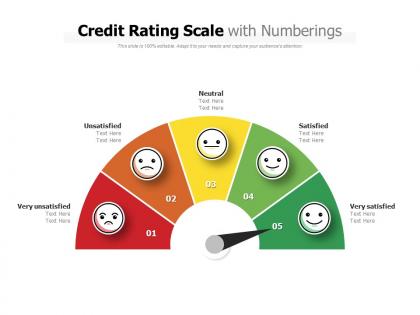
The image displays a PowerPoint slide titled "Credit Rating Scale with Numberings," which appears to be a misnomer as the visual content suggests a customer satisfaction meter rather than a financial credit rating. The scale is in the form of a semi-circle with five segments, each representing a level of customer satisfaction, numbered from 01 to 05:
1. Very unsatisfied (01):
Colored in red, indicating a very low level of satisfaction.
2. Unsatisfied (02):
Colored in orange, representing a level of dissatisfaction.
3. Neutral (03):
Colored in yellow, for an average or neutral response.
4. Satisfied (04):
Colored in light green, showing satisfaction.
5. Very satisfied (05):
Colored in dark green, depicting a high level of satisfaction.
Use Cases:
This satisfaction meter can be utilized across various industries for gauging customer or client satisfaction:
1. Hospitality:
Use: Measuring guest satisfaction with services
Presenter: Hotel Manager
Audience: Hotel staff, management
2. Retail:
Use: Rating customer satisfaction with shopping experience
Presenter: Store Manager
Audience: Retail employees, customer service team
3. Healthcare:
Use: Assessing patient satisfaction with healthcare services
Presenter: Hospital Administrator
Audience: Medical staff, patient care teams
4. Banking:
Use: Evaluating customer satisfaction with banking services
Presenter: Branch Manager
Audience: Bank staff, customer service representatives
5. Telecommunications:
Use: Determining customer satisfaction with network services
Presenter: Customer Service Director
Audience: Service agents, corporate management
6. Automotive:
Use: Rating customer satisfaction post-vehicle purchase
Presenter: Sales Manager
Audience: Sales team, after-sales support staff
7. Education:
Use: Gathering feedback on student or parent satisfaction with educational offerings
Presenter: School Principal
Audience: Teachers, parents, administrative staff
Credit rating scale with numberings with all 5 slides:
Click away on our Credit Rating Scale With Numberings site. Be prepared for a fascinating experience.




FAQs for Credit rating
Your payment history is like 35% of your score, so that's huge - basically just don't be late on stuff. Credit utilization matters a ton too - try to stay under 30% of your limits, but honestly under 10% is even better. Longer credit history helps because it gives lenders more to work with when they're judging you. Having different types of accounts is good, and too many new inquiries can ding you. Oh, and don't close your old cards even if you're not using them much. It's really just about paying on time and not maxing everything out.
Ugh, so the rating agencies can't even agree on letters, which is super annoying. Moody's does Aaa, Aa, A, Baa down to C. Meanwhile S&P and Fitch use AAA, AA, A, BBB down to D - at least those two figured out how to coordinate. Anything below BBB/Baa is junk bond territory across the board. They throw in extra modifiers too - Moody's adds numbers like 1,2,3 and the others do plus/minus signs. Just double-check which agency you're looking at since their ratings don't always line up perfectly.
So basically, when you have a high credit rating, lenders think you're not gonna screw them over. This means way better interest rates - we're talking 3% vs 7%, which is huge money over time. Like, tens of thousands saved on a mortgage. My cousin learned this the hard way when his rate was trash. For businesses it's the same deal, plus suppliers will actually give you credit. Really though, guard that score because it's literally cash in your pocket when you need to borrow. Worth obsessing over honestly.
So they're basically always watching your credit, which is honestly pretty invasive if you think about it. But the formal reviews usually happen once a year or when something big changes. Missing payments will definitely trigger a review, plus major debt changes or cash flow issues. Industry shifts can mess with your rating too - like if your whole sector suddenly looks risky. They won't just randomly tank your score though. You've got to actually screw something up first. Oh, and if you know something major's coming up financially, definitely call them first. Way better than letting them find out on their own.
Yeah, your credit score totally affects your loan rates. Lenders basically use it to figure out if you're gonna pay them back or not. Better score = lower rates because they trust you more. The difference is kinda wild though - someone with great credit might snag 4% while someone with trash credit gets hit with 12% or more on the exact same loan. I learned this the hard way when I was car shopping last year. If you're thinking about borrowing money for anything big, definitely check your score first. Maybe try to bump it up if you can.
Ugh, bad credit is such a pain. Lenders basically see you as risky so they'll either say no or charge you crazy high interest rates. You end up with those awful subprime loans that cost way more long-term. Down payments get bigger too. Oh and now even landlords check your credit which is ridiculous if you ask me. The annoying part? Some jobs will look at it during hiring. But you can fix it - just pay everything on time and don't max out your cards. Takes patience though.
Yeah, credit ratings basically move with the economy - it's pretty predictable. When things are good, companies get upgraded. Recession hits? Downgrades everywhere. Rating agencies watch GDP, unemployment, inflation, all that stuff because it shows if people can actually pay their debts back. Makes total sense, right? Companies lose cash flow during bad times, governments get squeezed on budgets. I always check the broader economic picture first when looking at credit risk - honestly saves you from surprises. Those indicators usually give you a heads up before the rating agencies make their moves.
Think of credit ratings like Yelp reviews for bonds - they tell you how sketchy or solid an investment might be. AAA rated stuff? Super safe but boring returns. Lower ratings mean more risk but hey, maybe better payoff. I honestly find them pretty useful as a starting point when I'm looking at bonds. Just don't get lazy and stop there though. You've still gotta check if it fits your risk tolerance and what you're actually trying to do with your money. They're helpful but not the final word.
So basically, AAA to BBB- ratings mean the borrower can actually pay you back. Below that? Higher risk, higher reward territory. Here's the thing - pension funds and boring conservative investors stick to investment-grade stuff. Makes sense, right? BB+ and lower is "junk bond" territory (kinda rude name honestly), but they pay better because you're taking more risk. The BBB-/BB+ split is massive though. Drop below BBB- and suddenly all those huge institutional investors can't touch you anymore - their rules won't let them. So if you're looking at credit, BBB- is like the golden ticket to those big money pools.
Honestly, paying bills on time is huge - like 35% of your score depends on it. Keep credit card balances under 30% of your limit if you can. Oh and don't close old cards even if you're not using them, that credit history length actually helps. I learned that one the hard way lol. Applying for too much new credit will hurt you temporarily too. The annoying thing is it takes forever to see real changes - we're talking months here, not weeks. But if you stick with it and check your free report once a year, you'll get there.
Oh man, so many people get this stuff wrong! First off, checking your own credit won't hurt your score at all. You don't need to carry a balance either - just pay it off every month. Closing old cards can actually backfire since it messes with your credit age. Your income doesn't directly affect your score, though obviously it matters for getting approved. Here's something that surprised me: there are different scoring models like FICO and VantageScore that can be like 50+ points apart. Honestly just check annualcreditreport.com regularly to see what's really going on.
Yeah so geopolitical stuff basically wrecks credit ratings left and right. Wars, political chaos, trade fights - rating agencies see that mess and start downgrading countries and companies fast. Russia's rating got demolished after Ukraine, which honestly wasn't surprising. The ripple effects hit whole industries though. Currency swings, supply chains getting screwed, sanctions - it all feeds into their decisions. If you're investing based on ratings, definitely watch the news cycle. Even rock-solid companies can get hit with sudden downgrades when the world goes sideways.
Found a mistake on your credit report? That sucks but it's fixable. Dispute it online with the credit bureau - way easier than calling or mailing stuff. Just explain what's wrong and upload any proof you have. They've got 30 days to look into it and respond. You can also go straight to whoever reported the bad info, which honestly sometimes gets results faster. Oh, and save screenshots of everything you submit because these companies can be flaky about following up. Don't let them ghost you past that 30-day mark.
Yeah, so credit ratings are kinda all over the place between countries. Each market has different agencies using their own scales - like you know S&P's AAA system here, but Japan does totally different letter combos. Some European countries have local agencies too. What really threw me off when I first learned this was that "AA" in one country doesn't mean the same risk as "AA" somewhere else. Different economies, different rules. Always double-check which agency did the rating and what their scale actually means before you invest in anything. Trust me on that one.
Keep your debt-to-equity ratio low and cash flow steady. Pay everything on time - sounds obvious but you'd be shocked how many companies mess this up. Talk to rating agencies before making big moves, don't wait for them to find out. I'd suggest monitoring your key ratios monthly because problems snowball fast. The agencies love when you're proactive, so maybe schedule yearly check-ins to discuss where you're headed. It's basically personal finance with more zeros and way more people watching your every move.
No Reviews