


Summary Of Customer Satisfaction Survey Questionnaire And Results Survey SS




Try Before you Buy Download Free Sample Product
 Impress Your
 Audience
 100%
100% Editable
 Save Hours
 of Time


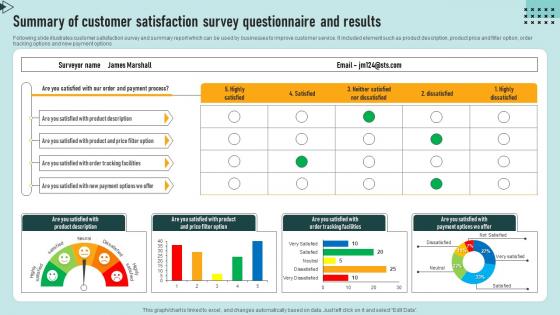
Following slide illustrates customer satisfaction survey and summary report which can be used by businesses to improve customer service. It included element such as product description, product price and filter option, order tracking options and new payment options
People who downloaded this PowerPoint presentation also viewed the following :
Summary Of Customer Satisfaction Survey Questionnaire And Results Survey SS with all 7 slides:
Use our Summary Of Customer Satisfaction Survey Questionnaire And Results Survey SS to effectively help you save your valuable time. They are readymade to fit into any presentation structure.






FAQs for Summary Of Customer Satisfaction Survey Questionnaire And
Honestly, just focus on the big three: NPS, CSAT, and CES. NPS shows if people would recommend you (everyone's obsessed with it for a reason). CSAT is straightforward - how happy are customers with specific interactions or your service overall? CES measures how easy you make things, which might matter most since nobody has patience anymore. Oh, and throw in retention rate if you want the complete picture. Complaint resolution time's useful too, but don't overcomplicate it at first. Start with NPS and CSAT - you'll get insights you can actually do something with right away.
Honestly, I'd go with quarterly surveys as your starting point. Monthly is way too much unless something's seriously broken - trust me, customers will let you know they're annoyed! We made that mistake once and the feedback wasn't pretty lol. Fast-moving industry? Maybe bump it up a bit. But if things are pretty stable, you could even get away with twice a year. The whole thing is just finding that sweet spot between getting useful data and not being that company that's always asking for feedback. Start quarterly, then see how people respond and adjust from there.
Honestly, skip the rating scales - they're kinda useless without context. What you really want are open-ended questions that get at the "why" stuff. Like "what made this experience stick with you?" or "if you could fix one thing about our service, what would it be?" I mean, ratings are okay for tracking trends I guess, but the good stuff comes from following up with "what specifically made you give us that score?" Oh and think about their whole journey - discovery, buying, support, all that. Mix 2-3 open questions with some targeted follow-ups and you'll actually get answers worth reading.
Honestly, I'd go with quantitative if I had to choose just one. Numbers make it way easier to track trends and show your boss actual data. But here's the thing - qualitative stuff is where you get the real gems. Like, people will tell you exactly what's broken instead of just giving you a "3 out of 5." My move? Just tack on one open-ended question at the end of your rating survey. Takes two seconds but gives you those juicy quotes that executives eat up. Best of both without making people hate filling it out.
Okay so demographics totally mess with survey results because different groups have completely different expectations. Like older customers care about totally different features than younger ones. Income matters too - and don't even get me started on how location changes everything. Rural vs urban customers? Night and day differences in what they expect from service. You've got to break down your data by these groups instead of just looking at the overall average, otherwise you'll miss what specific customer segments actually want. Pretty wild how much age and geography alone can shift responses.
Honestly, keep surveys stupid short - like 5-7 questions tops. People bail so fast if you hit them with some 20-question marathon about buying a sandwich. Mix rating scales with maybe one open-ended question for the good stuff. Put your most important question first since that's when you'll have everyone's attention. Oh, and send it within 24-48 hours while their experience is still fresh in their head. Write questions like you're actually talking to someone, not like some corporate robot. I always test mine on coworkers first - they'll catch the weird wording you missed.
Oh man, culture totally messes with survey results! Like, some customers from certain cultures will never give you a 1 or 10 rating - they stick to the middle even if you're amazing or terrible. Then you've got others who'll straight up roast you in the comments, which honestly can be more helpful. Language stuff gets tricky too, even with good translations. What works is tweaking your surveys by region. Different rating scales, rephrasing questions, maybe asking about things that actually matter in that culture. I'd definitely segment your data by cultural groups afterward - otherwise you're just looking at noise.
Dude, those open-ended comments are where the real insights hide. Rating scales just give you numbers, but when people actually write stuff out? That's when they tell you what's genuinely broken or surprisingly awesome. I swear, we've gotten some of our best ideas from random rants people left in feedback boxes. The patterns you'll find in those messy text responses are way different than what surveys show you. Just... actually read through them regularly instead of letting them pile up. There's seriously good stuff buried in there if you take the time to dig.
Try offering small incentives - discount codes work great, or maybe entry into a prize drawing. Cash is effective but gets pricey quick. Honestly, 10% off their next purchase is usually enough to get people to spend 2-3 minutes on your survey. Timing's huge though. Send them right after they've had a good experience with your brand when they're still feeling positive about you. Keep surveys short and mention the reward right in your subject line so they see it immediately. I'd start small and see how your response rates look.
Honestly, there are so many good survey tools now it's kinda overwhelming. SurveyMonkey and Typeform are really user-friendly for building surveys. Google Forms works fine too if you don't want to spend money. The real game-changer though? Get Tableau or Power BI for analyzing your data - their visualizations make Excel look ancient. Qualtrics is solid if you're dealing with tons of responses since it'll do sentiment analysis automatically. My advice: just pick one survey tool and one analysis tool to start. Don't go crazy trying to use everything at once or you'll burn yourself out.
Hit the stuff that keeps popping up AND actually makes customers bail - that's where you'll see real results. I sort everything into three piles: affects tons of people, makes them leave, or super easy wins. Honestly, the random one-off complaints? Those can wait a bit. Anything showing up across multiple surveys gets priority, especially if it messes with your main product. Make yourself a quick scoring thing - frequency vs how much it hurts business. You don't want to just chase whoever's yelling loudest, you know?
So basically, customer feedback is like getting the cheat codes for what needs fixing. When tons of people complain about the same thing - like your checkout being a mess - boom, that's where you start. Keep doing whatever gets praise, obviously. But pay attention to the weird random comments too, they're sometimes the most useful honestly. I'd group everything by topic first, then figure out which issues happen most and hurt your business worst. Oh and here's something people skip - actually tell customers when you fix stuff they mentioned. They love knowing you listened.
Okay so first thing - be upfront about everything. Tell people exactly what you're doing with their data and how long you're keeping it. Make opting out super easy too. Don't create those endless surveys nobody wants to finish. I once made a 50-question survey about toilet paper and people were NOT having it lol. Watch out for leading questions that basically force certain answers. Your demographic stuff should be inclusive and optional - some people get weird about personal details. Oh and test it yourself first. If you're already bored taking your own survey, that's your sign to cut it down.
Absolutely reach out to them! People get so annoyed when they take surveys and then... crickets. Within a month or so, send a quick email with the main findings and what you're actually gonna change because of their input. That's the part they really care about. Be straightforward about it: "This is what came up, here's our plan, expect to see changes by X date." Oh and if some feedback was harsh, don't try to sugarcoat everything - just own it. Makes a huge difference in whether people will help you out again next time.
Dude, you gotta actually follow up after people give feedback - don't just collect it and disappear. Send them something personal that shows you read their comments, then tell them what you're doing about it. Can't fix everything right away? Just explain your plan. Honestly, I've watched so many teams skip this part and then act shocked when nobody wants to respond anymore. Bad feedback needs a response within like 48 hours max. Good stuff just needs a quick thanks. The whole point is making people feel heard instead of just... surveyed to death, you know?
-
The customer care of SlideTeam is very responsive. I was having a payment issue and they fixed it for me in no time.
-
The team is highly dedicated and professional. They deliver their work on time and with perfection.