


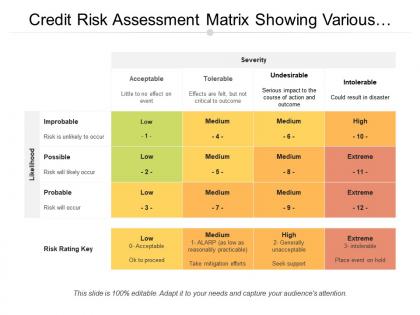
Credit risk assessment matrix showing various risks




Try Before you Buy Download Free Sample Product
 Impress Your
 Audience
 100%
100% Editable
 Save Hours
 of Time


Ensure the information gets around with our Credit Risk Assessment Matrix Showing Various Risks. It facilitates generating awareness.
People who downloaded this PowerPoint presentation also viewed the following :
Credit risk assessment matrix showing various risks with all 5 slides:
Disclose the dynamics of your new method. Decode it with our Credit Risk Assessment Matrix Showing Various Risks.





FAQs for Credit risk assessment matrix
So there's this thing called the 5 C's you gotta hit: Character (their credit history), Capacity (can they actually pay it back), Capital (how much they're putting in), Collateral (what backs the loan), and Conditions (economic stuff). Most people get obsessed with credit scores but honestly that's just scratching the surface. You'll want to dig into financial statements too, maybe industry trends if it's a business thing. Management quality matters way more than people think. Oh and definitely use some kind of checklist - I learned that the hard way after missing obvious red flags before.
Okay so macro factors are basically what shape the whole economic playing field for your borrowers. GDP slows down? Unemployment jumps? Interest rates go crazy? You'll see defaults spike across the board - it's pretty predictable honestly. Inflation's the worst because it hits borrowers from both sides - harder to pay debt while your own funding costs shoot up. Don't just look at individual borrower stats though. Build these macro indicators right into your risk models as early warning signals. Oh and definitely track sector-specific trends too since retail gets hammered differently than manufacturing when things go sideways.
Credit history is your best friend when sizing up borrowers - it's literally how they've handled money before, which tells you everything about what they'll do next. Look at payment patterns, how much credit they use, length of relationships with lenders. Red flags jump out fast: defaults, bankruptcies, that kind of mess. The credit score is handy for a quick glance, but honestly? Dig deeper into the full report to get the real story. Those three digits don't tell you everything. Then just add income verification and current finances on top of that.
Dude, ML is insane for credit risk stuff. You can throw in tons of weird data - social media behavior, how fast someone types their application, transaction habits, whatever. Traditional stats models hate non-linear relationships, but ML eats that up. The algorithms spot patterns we'd never catch and keep learning from new data instead of going stale. Honestly, gradient boosting is probably your best bet to start with - performs well but you can still explain the decisions to your boss. Way better than those black box neural networks that nobody understands.
Most places use logistic regression, random forests, neural networks - that kind of stuff. FICO scores are still huge obviously. What works best is mixing everything together: behavioral data, application info, bureau scores. Creates a fuller picture, you know? Some old-school scorecards are surprisingly solid for basic lending. Really depends on your data quality and how much risk you want. If you're starting fresh, go with logistic regression first. Regulators actually prefer it since they can see what's happening under the hood - which honestly saves you headaches later.
Different sectors have totally different risk profiles, so that's huge when you're doing credit assessment. Tech companies? Completely different evaluation than manufacturing or retail. Each one has its own cash flow patterns and how they react to economic changes. Healthcare tends to stay steady during recessions, but hospitality gets crushed - 2020 was brutal for that sector. You can't just use the same criteria across the board. Look at sector-specific metrics and compare against industry peers instead. Oh, and seasonal trends matter way more than people think.
So quantitative analysis is all the hard numbers - credit scores, debt ratios, cash flow data you can crunch in spreadsheets. Qualitative looks at the messy human stuff like how good management actually is or if the industry's heading downhill. Numbers are super easy to automate now, which is kinda scary honestly. But here's the thing - you can't just rely on one approach. I've seen companies with perfect ratios but absolutely terrible CEOs who torpedo everything. Start with quantitative to filter out obvious nos, then dig into the qualitative factors before making final calls.
So credit agencies basically judge you on five main things: payment history (that's the big one - like 35% of your score), how much debt you're carrying, how long you've had credit, what types you have, and recent inquiries. Payment history hurts the most when you mess up, honestly. Try keeping your credit card balances under 30% of the limit - that utilization ratio thing really matters. They run all your info through algorithms to spit out those scores. Oh, and definitely check your reports from all three bureaus yearly since they're never exactly the same for some reason.
So once you've got your risk assessment done, here's what I'd do. High-risk clients? Make them put up collateral or personal guarantees, bump up their rates, maybe cap their credit limits. Medium-risk ones need closer watching - get more financial docs from them, set up some covenants. Honestly, I've seen too many people go all-in on one risk level and get burned. Mix it up across different categories. Oh, and definitely tackle your worst exposures first since those'll hurt most if they go south. You can always adjust the approach as you learn what works.
Collateral's your backup plan when borrowers can't pay. Good collateral means you can approve riskier deals or give better rates. But honestly, don't lean on it too hard - I've seen lenders get burned that way. The borrower still needs solid income to repay you first. Always value it conservatively too. Real estate might look great on paper, but can you actually sell it quickly if needed? Some collateral sits around forever. Short answer: it helps reduce your risk, but never replace good underwriting with shiny collateral.
Honestly, the regulations make everything way more rigid than you'd probably want. Basel III forces you to document every little thing and keep bigger capital cushions for sketchy loans. Super annoying but I get why it exists. The stress-testing part is actually useful though - you'll catch stuff you'd totally miss otherwise. Different economic scenarios reveal weaknesses you didn't know were there. My advice? Don't try to slap compliance on later. Build your whole evaluation process around these rules from the start. Trust me, retrofitting is a nightmare and you'll thank yourself later for doing it right the first time.
So here's the deal with interest rates and credit risk - they're pretty tied together. Rising rates mean borrowers pay more to service their debt, which obviously makes defaults more likely. This hits hardest with variable rate stuff or companies that need to refinance soon. Plus higher rates tank asset values, so your collateral becomes worth less too. Kind of a nasty combo honestly. When rates drop though, borrowers get breathing room and asset values recover. You'll want to run some scenarios on your portfolio to figure out where you're most exposed. Different rate environments will show you the weak spots pretty quickly.
Fintech's changing everything about credit risk assessment. Instead of just credit scores and income docs, lenders now use AI to analyze your social media, spending habits, even how you use your phone - kinda wild honestly. Machine learning adapts constantly to catch new fraud patterns. Real-time processing means instant decisions too. Open banking lets them pull data straight from your accounts through APIs. Traditional methods won't cut it much longer if you're trying to compete in this space.
Honestly, most people totally skip the boring stuff but you gotta pull their credit reports first - Experian or D&B work fine. Actually call those trade references too, don't just collect them. Cash flow patterns tell you everything about how they really operate. Set credit limits based on what you find, and shorter payment terms for sketchy ones. I'd start conservative with new clients - way easier to give them more room later than chase down bad debt. Oh, and don't feel weird asking for deposits upfront. Their payment history with other vendors is usually the best predictor anyway.
Watch out for the obvious stuff first - no discrimination based on race, gender, age, religion. But here's where it gets tricky: proxy variables like zip codes can secretly introduce bias since they correlate with demographics. I've seen so many teams miss this. Your algorithms need to be transparent enough that you can actually explain decisions to applicants when they ask. Run bias audits regularly and document everything. Also think bigger picture - are you accidentally cutting off entire communities from getting credit? Keep your data sources clean and legit too.
-
Professional and unique presentations.
-
Awesome use of colors and designs in product templates.