Employee performance score meter infographic
Try Before you Buy Download Free Sample Product
Audience
Editable
of Time
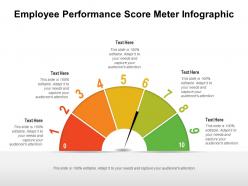
SlideTeam presents Employee Performance Score Meter Infographic. Employ this PPT slide to meet your staff capacity analysis needs. Rate your employee's working skills and productivity on a scale from one to ten by utilizing this PPT template. You can use this performance assessment PPT layout to appraise the highest-scoring worker and provide guidance to the lowest-scoring. Improve the input and output level in your enterprise by taking the aid of this PPT design. Select our PPT theme to depict the potential extent of each employee. This well-color coded PPT visual illustrates the highest personnel value on the top right side and lowest on the left with green and red color, respectively. Determine the field of areas that need to be worked upon and changed to improve the work quality by taking the aid of this PPT graphic. Create a transparent and accountable work environment with the assistance of our content-specific PowerPoint design. Click the download button and make this PowerPoint slide your source for effective workforce management.
People who downloaded this PowerPoint presentation also viewed the following :
Employee performance score meter infographic with all 2 slides:
Use our Employee Performance Score Meter Infographic to effectively help you save your valuable time. They are readymade to fit into any presentation structure.
FAQs for Employee performance
Employee performance metrics should include productivity measures, quality standards, goal achievement rates, customer satisfaction scores, and professional development progress. These KPIs enable organizations to streamline evaluation processes, enhance workforce efficiency, and deliver strategic outcomes, with many companies finding that comprehensive metrics ultimately drive both individual growth and competitive advantage.
Organizations balance qualitative and quantitative measures by combining measurable KPIs with behavioral assessments, 360-degree feedback, and goal-setting discussions during regular review cycles. This strategic approach enables managers to evaluate both numerical achievements and soft skills development, with many companies finding that integrated assessments deliver more comprehensive talent insights and enhanced employee engagement.
Employee feedback plays a crucial role in shaping performance metrics by providing insights into goal relevance, measurement accuracy, and organizational alignment across different departments and roles. This input enables companies to refine their evaluation frameworks, identify skill gaps, and create more meaningful benchmarks, with many organizations finding that employee-informed metrics ultimately deliver higher engagement and more strategic talent development outcomes.
Performance metrics should be reviewed quarterly for relevance and updated annually or when roles significantly change, ensuring alignment with evolving business objectives and market conditions. Many organizations find that quarterly reviews enable timely adjustments to key performance indicators, while annual updates incorporate strategic shifts, ultimately delivering more accurate performance assessments and enhanced employee development outcomes.
**INPUT**: What tools and software can enhance the tracking of employee performance metrics? **OUTPUT**: Performance tracking tools include HR analytics platforms, goal management systems, 360-degree feedback software, time tracking applications, and integrated performance dashboards. These technologies streamline evaluation processes by automating data collection, providing real-time insights, and enabling continuous feedback, with many organizations finding that comprehensive tracking ultimately enhances employee engagement and organizational productivity. [Word count: 54 words]
Performance metrics can be tailored by aligning specific KPIs with each role's core responsibilities, objectives, and impact areas, such as sales targets for revenue generators, quality scores for customer service, and project completion rates for operations. This strategic customization enables organizations to measure what truly matters for each position, ultimately driving targeted performance improvements, enhanced accountability, and better alignment with overall business goals.
SMART goals provide clear, measurable benchmarks that enhance employee focus, accountability, and performance tracking by establishing specific objectives, measurable outcomes, achievable targets, relevant priorities, and time-bound deadlines. This structured approach enables managers to deliver more effective feedback, streamline performance evaluations, and ultimately improve productivity, with many organizations finding that employees achieve significantly better results when working toward well-defined, strategic objectives.
Cultural differences significantly impact performance metrics through varying communication styles, individual versus collective achievement values, hierarchy expectations, and feedback reception preferences. Organizations operating globally find that adapting metrics to cultural contexts, such as emphasizing team accomplishments in collectivist cultures while maintaining individual recognition in individualistic environments, ultimately delivers more accurate assessments and enhanced employee engagement.
Employee performance metrics influence training and development by identifying skill gaps, measuring learning effectiveness, personalizing development paths, and tracking competency improvements across teams. Through data-driven insights, organizations streamline resource allocation, enhance targeted training initiatives, and accelerate employee growth, with many companies finding that metrics-based development programs deliver higher engagement and measurable performance improvements.
Organizations ensure transparency and fairness in performance metrics by establishing clear, measurable criteria, communicating expectations regularly, and implementing consistent evaluation processes across all departments. Through standardized assessment frameworks, companies enable objective reviews, minimize bias, and provide employees with actionable feedback, while many organizations find that transparent metrics ultimately enhance trust, accountability, and overall performance outcomes.
Best practices for communicating performance metrics include establishing clear expectations, providing regular feedback sessions, using visual dashboards, ensuring two-way dialogue, and connecting metrics to business goals. These approaches enhance transparency and accountability by making data accessible, encouraging employee engagement, and aligning individual performance with organizational objectives, ultimately delivering improved productivity and stronger employee satisfaction across teams.
Performance metrics assist in identifying potential leaders by evaluating communication skills, decision-making abilities, team collaboration effectiveness, goal achievement consistency, and adaptability under pressure. Through comprehensive assessment frameworks, organizations can spotlight employees who demonstrate strategic thinking, inspire peer performance, and drive cross-functional initiatives, ultimately building robust leadership pipelines while enhancing succession planning capabilities.
Performance metrics impact employee motivation by providing clear expectations, recognition opportunities, and career development pathways, while also creating potential stress through constant evaluation. When implemented thoughtfully with regular feedback and growth-focused goals, many organizations find that metrics enhance engagement by connecting individual contributions to company success, ultimately delivering improved performance and employee satisfaction.
Data analytics enables organizations to refine employee performance metrics by identifying patterns in productivity data, correlating performance indicators with business outcomes, and eliminating subjective biases from evaluations. Through predictive analytics and machine learning, companies can create more accurate, personalized performance measures that enhance employee development, streamline management decisions, and ultimately deliver improved organizational efficiency and competitive advantage.
Ethical considerations include employee privacy protection, bias prevention in measurement systems, transparency in evaluation criteria, fair data collection practices, and consent for monitoring activities. These principles help organizations balance performance optimization with worker rights, ensuring metrics enhance rather than exploit employee experiences, while building trust and maintaining compliance with evolving workplace privacy regulations.
No Reviews