

Employee Performance Evaluation Powerpoint Presentation Slides





Try Before you Buy Download Free Sample Product
 Impress Your
 Audience
 100%
100% Editable
 Save Hours
 of Time


Explore our Employee Performance Evaluation PowerPoint Presentation Slides to showcase methods of performance evaluation. Performance reviews are used to support decisions related to promotion and career development. Staff assessment and review Presentation slides allow you to provide employees with feedback to improve job performance. The employee assessment PowerPoint complete deck includes content ready slides such as employee assessment criteria table, employee assessment form, review card, scorecard, evaluation form, self-assessment form, employee performance analysis template, performance review table, cross-training analysis chart, employee competency analysis table to name a few. Additionally, the pre-made job performance evaluation PPT slides are completely customizable. You can add or delete the content if needed. Outline all important concepts without any hassle. Identify areas for employee development and set performance standards using employee evaluation presentation templates. Download this visually appealing employee work performance PPT visuals to recognize job-related accomplishments.
People who downloaded this PowerPoint presentation also viewed the following :
Content of this Powerpoint Presentation
Slide 1: This slide introduces Employee Performance Evaluation. State Your Company Name and begin.
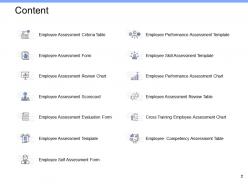
Slide 2: This slide shows Content of the presentation.
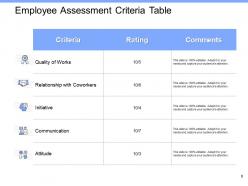
Slide 3: This slide presents Employee Assessment Criteria Table describing quality of works, relationship with coworkers, initiative, communication and attitude.
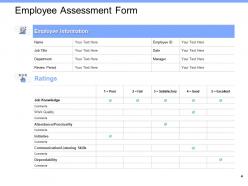
Slide 4: This slide displays Employee Assessment Form with employee information and ratings.
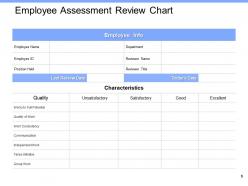
Slide 5: This slide represents Employee Assessment Review Chart with employee information and characteristics.
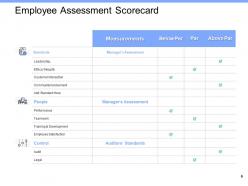
Slide 6: This slide showcases Employee Assessment Scorecard in a tabular form with categories as measurements, below par, par and above par.
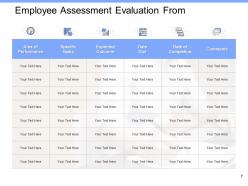
Slide 7: This slide shows Employee Assessment Evaluation From with categories as- area of performance, specific tasks, expected outcome, date due, date of completion and comments.
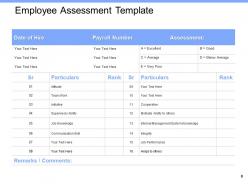
Slide 8: This slide presents Employee Assessment Template with date of hire, payroll number and assessment.
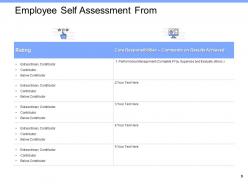
Slide 9: This slide displays Employee Self Assessment From describing ratings.
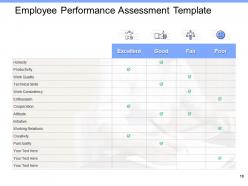
Slide 10: This slide represents Employee Performance Assessment Template.
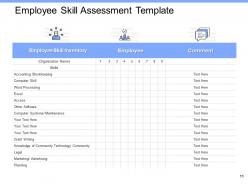
Slide 11: This slide showcases Employee Skill Assessment Template with categories as employee skill inventory, employee and comments.
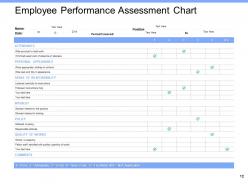
Slide 12: This slide shows Employee Performance Assessment Chart with attendance, personal appearance, sense of responsibility, interest, policy, quality of works and comments.
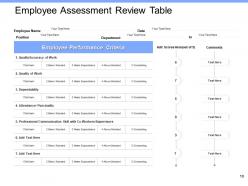
Slide 13: This slide presents Employee Assessment Review Table. You can add or edit data as per requirements.
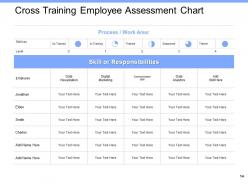
Slide 14: This slide displays Cross Training Employee Assessment Chart with process/work area and skills/responsibilities.
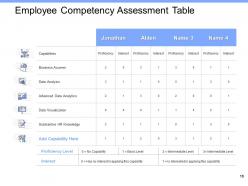
Slide 15: This slide represents Employee Competency Assessment Table with categories as- capabilities, business acumen, data analysis, advanced data analysis, data visualization and substantive Hr knowledge.
Slide 16: This slide showcases Employee Performance Evaluation Icons.
Slide 17: This slide is titled as Additional Slides for moving forward.
Slide 18: This is Our Team slide with names and designation.
Slide 19: This is Our Mission slide with related icons and text boxes.
Slide 20: This is About Us slide to show company specifications etc.
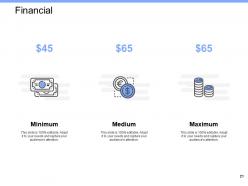
Slide 21: This is a Financial slide. Show your finance related stuff here.
Slide 22: This is a Timeline slide. Show information related with time period here.
Slide 23: This is a Quotes slide to convey message, beliefs etc.
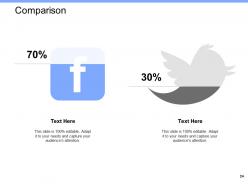
Slide 24: This is a Comparison slide to state comparison between commodities, entities etc.
Slide 25: This is Idea or Bulb slide to state a new idea or highlight information, specifications etc.
Slide 26: This slide is titled as Post it. Post your important notes here.
Slide 27: This is a Thank You slide with address, contact numbers and email address.
Employee Performance Evaluation Powerpoint Presentation Slides with all 27 slides:
Get enduring assistance from our Employee Performance Evaluation Powerpoint Presentation Slides. They have a habit of ensuring happy endings.


FAQs for Employee Performance Evaluation
Honestly, just focus on the basics that actually matter - goal achievement, work quality, and how well they collaborate with the team. Project completion rates and customer feedback are way more useful than those weird 1-10 rating scales nobody understands anyway. Don't forget peer reviews and self-assessments too, since people know their own work better than we think. Attendance and professional growth are obvious ones to track. Pick maybe 4-5 things that really matter for each role and build from there. Keep it simple though - I've seen too many companies overcomplicate this stuff.
Okay so basically you gotta break down your big company goals into actual measurable stuff for each role. Map out how everyone's job connects to the bigger picture, then create metrics around that. Honestly, most companies just use these cookie-cutter performance reviews that are completely useless. Update your criteria when priorities change - I'd say quarterly check-ins are solid for this. Be really specific about what winning looks like at every level. If you don't, you'll end up judging people on random things that don't actually help your business grow. It's way more work upfront but totally worth it.
Look, feedback is what separates real performance reviews from those pointless annual meetings we all hate. Don't wait until review time to bring stuff up - that's just setting everyone up for awkward conversations. I learned this the hard way when I had a boss who never said anything until my review, then suddenly had a laundry list of issues. Give feedback as things happen so there's actual dialogue happening. During reviews, you'll have specific examples instead of vague "you need to improve" nonsense. Make sure they can give you feedback too about what roadblocks they're hitting. Start keeping notes now - future you will thank you.
Quarterly evaluations work best, honestly. Do monthly check-ins too though - keeps everyone on the same page. Annual reviews? Total waste of time. Nobody remembers what happened six months ago, let alone last January. You'll want to catch problems early and celebrate the good stuff while it still matters. Those monthly one-on-ones help you pivot quickly when needed. The formal quarterly ones give you enough time to spot real patterns in how someone's performing. I'd start there and see how it goes - some of your rock stars might only need reviews twice a year anyway.
Honestly, you've gotta get multiple people involved - like 360 feedback from peers, reports, other managers. Don't just rely on your own take. Set up the same rating criteria for everyone so it's fair across the board. Train your managers on unconscious bias (we're all guilty of it). Focus on actual behaviors and results, not whether someone's personality clicks with you. Oh, and document stuff throughout the year instead of scrambling at review time. The calibration thing is huge - have managers compare notes before finalizing ratings.
Honestly, just get some performance management software - it'll change your life. Instead of trying to remember what happened months ago (impossible), you can track everything year-round. BambooHR and 15Five are solid options. The 360-degree feedback thing is clutch too. Analytics help you spot patterns you'd totally miss otherwise. Everything gets stored digitally so you're not digging through old emails like a detective. I know it sounds like extra work upfront, but trust me - it saves hours during review season.
Honestly, annual reviews are kinda pointless. You end up only remembering what happened last month anyway - recency bias is so real. By the time you're sitting down to evaluate someone, half the stuff that actually mattered is ancient history. The worst part? People save up all their feedback instead of just telling you when something's actually happening. It's like getting relationship advice a year too late, you know? Try monthly check-ins instead. Way less awkward, and your team won't get blindsided by mystery issues they could've fixed months ago.
Oh man, performance reviews? They can totally make or break how engaged your team feels. Most of them suck though - just stressful paperwork that nobody wants to deal with. The trick is making them feel like real conversations about growth instead of some corporate checklist thing. I always focus on specific examples of what they did well and actually ask what kind of support they need. Follow through matters too. When people see you're genuinely invested in helping them grow, they'll be way more motivated. It's honestly one of the best tools you have as a manager.
Get your employees to fill out a self-assessment first - same criteria you're using for their review. Give them like a week to actually think about it though, not just the night before. Have them reflect on goals, wins, areas they want to improve. Then use that as your jumping off point during the actual meeting. People are usually way harder on themselves than you'd expect, which is kind of wild. Compare what they wrote with what you observed. Those gaps become perfect conversation starters and honestly make the whole thing less awkward since they're already thinking about their own development.
Honestly, I'd skip the whole "here's what you messed up" approach. Try something like "What's been working well for you?" instead. Way less awkward. Share one of your own screw-ups first - people relax when they realize you're not perfect either. Then actually have a conversation about it, don't just lecture them. Use real examples, talk about what they want to achieve going forward. The whole thing shouldn't feel like a performance review from hell. Oh, and definitely check in with them later - shows you actually care about helping, not just checking a box.
Oh man, yes - train your managers! Most of them are terrified of doing reviews because they've never learned how. Start with bias awareness workshops, then teach them to observe behaviors and document stuff year-round instead of panicking at review time. Honestly, the difference is night and day when they know what they're doing. Focus on specific examples over vague feedback and help them calibrate their standards. Your reviews will actually be consistent and fair for once. I learned this the hard way at my last job - untrained managers are a disaster.
Honestly, the SMART goal thing actually works - specific, measurable, achievable, relevant, time-bound. Don't just dump goals on them though. I learned that the hard way. Ask what they think makes sense and what help they'll need. Keep it to 3-5 goals max or they'll just stress out. Oh, and definitely connect each goal to where they want their career to go, plus how it fits the team's bigger picture. Then check in regularly instead of waiting months to see if anything's working. Way better than those awful year-end surprises.
Just talk to them directly - don't put it off like most managers do. Be specific about what's not working and give actual examples, not vague feedback. Work out an improvement plan together with clear goals and deadlines that actually make sense. Honestly, half the time people don't even realize they're underperforming. Offer whatever support they need - training, resources, more frequent check-ins. Document all of it though. If they don't improve after you've given them a real chance, then you can start the formal discipline stuff. Be straight with them but don't be a jerk about it.
Dude, peer feedback is gold because your coworkers see stuff you totally miss as a manager. They know who actually pulls their weight on team projects and who flakes when things get stressful. Plus they're way more likely to be brutally honest about someone's attitude or work habits - sometimes painfully so, lol. It's huge for roles where people need to collaborate or deal with clients regularly. Just don't ask those generic "how's working with them" questions. Get specific about behaviors and actual situations, otherwise you'll get useless fluff that doesn't help anyone.
Don't just drop a form on their desk and run! Block out real time to sit down together and actually talk through everything. I'd start with their wins - use specific examples, not vague stuff. Then cover what needs work, but again, be concrete about it. Honestly, the worst managers spring surprises during these conversations. Let them respond, ask questions, maybe push back a little. That's totally normal. The written part should back up your discussion, not BE the discussion. Wrap up with clear goals and when you'll check in again. Otherwise they'll leave confused about what you actually want from them.
No Reviews