


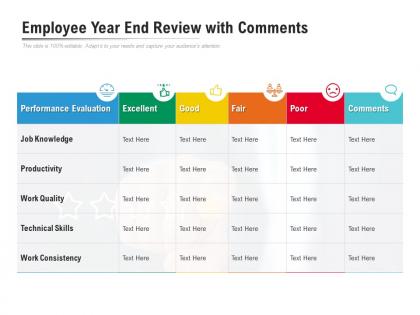
Employee year end review with comments




Try Before you Buy Download Free Sample Product
 Impress Your
 Audience
 100%
100% Editable
 Save Hours
 of Time


Presenting our employee year-end review with comments PowerPoint template to showcase methods of performance evaluation criteria. Performance reviews are used to support decisions related to promotion and career development. This staff assessment and review presentation diagram will allow you to provide your employees with feedback and help improve their job performance. This employee assessment PowerPoint slide is suitable for various topics like assessment criteria table, employee assessment form, review card, scorecard, evaluation form, self-assessment form, employee performance analysis template, performance review table, cross-training analysis chart, and employee competency analysis table. Additionally, this pre-made job performance evaluation PPT slide is completely customizable. So you can download this presentation slide to add or delete the content, outline all important concepts without any hassle, identify areas for employee development, and set performance standards. Grab this visually appealing employee work performance PPT theme to recognize job-related accomplishments.
People who downloaded this PowerPoint presentation also viewed the following :
Employee year end review with comments with all 2 slides:
Presenting our employee year-end review with comments PowerPoint template to showcase methods of performance evaluation criteria. Performance reviews are used to support decisions related to promotion and career development. This staff assessment and review presentation diagram will allow you to provide your employees with feedback and help improve their job performance. This employee assessment PowerPoint slide is suitable for various topics like assessment criteria table, employee assessment form, review card, scorecard, evaluation form, self-assessment form, employee performance analysis template, performance review table, cross-training analysis chart, and employee competency analysis table. Additionally, this pre-made job performance evaluation PPT slide is completely customizable. So you can download this presentation slide to add or delete the content, outline all important concepts without any hassle, identify areas for employee development, and set performance standards. Grab this visually appealing employee work performance PPT theme to recognize job-related accomplishments.
FAQs for Employee year end
Honestly? It comes down to three big things: skill level, motivation, and work environment. Your people need proper tools and training, plus they've got to know what you actually expect from them. Bad managers will kill performance faster than you'd believe - I've seen it happen so many times. Also check if someone's drowning in work or feels totally isolated from the team. Even super talented people struggle when they're overwhelmed or working in a vacuum. Before you judge anyone's output, figure out if they actually have what they need to succeed first.
Honestly, 360 reviews are where it's at - they show if someone's actually good to work with or just looks good on paper. I've worked with "top performers" who were absolute nightmares lol. Look at peer feedback and how they collaborate across teams. Monthly peer nominations work great too, they highlight those quiet people who make everyone's job easier. Check how they mentor others and adapt when things get crazy. Client feedback tells you way more than sales numbers sometimes. Problem-solving approach matters too - do they just fix things or actually think through solutions? Project retrospectives reveal a ton about real impact vs what sounds impressive in meetings.
Honestly, feedback makes or breaks the whole performance review thing. Without it, you're just going through the motions. I try to give feedback regularly - not just during formal reviews, though I'll admit I'm not perfect at this either. Your team needs to know what they're crushing and what needs work. Otherwise you'll blindside them come review time, which sucks for everyone. The trick is being specific. "Nice work" doesn't actually help anyone improve. Schedule those check-ins now before you forget again.
Dude, performance management software is a game changer - you can track goals as they happen instead of scrambling at review time. The 360 feedback stuff happens automatically, which saves so much hassle. What really surprised me was how analytics pick up on productivity patterns you'd never notice manually. Oh, and some AI tools will actually call out biased language in your reviews, which... yeah, that's needed. Just make sure whatever you pick doesn't turn into another time-suck for your team. Been there, done that.
The worst ones I see all the time are halo effect - one amazing project suddenly makes someone look perfect at everything. Then there's recency bias where you totally forget the first 10 months and only focus on December. Confirmation bias is sneaky too, you'll unconsciously hunt for proof that backs up whatever you already think about someone. Honestly, the "mini-me" thing gets everyone - we just naturally like people similar to us. My advice? Use structured forms with real examples, jot down notes monthly instead of scrambling to remember stuff later. Before you submit anything, force yourself to think of contradicting evidence. Sounds annoying but it works.
Look, the trick is flipping your whole approach - don't just rehash what already happened. I'd say spend at least half the meeting talking about where they actually want to go next. Ask them straight up "what do you want to get better at?" because honestly, they usually know. Then you can build real development goals together and work those into next year's targets. Oh, and don't wait a whole year to circle back - check in every few months or so. Makes development feel way more natural instead of this big scary annual thing.
First thing - create a standard rubric and stick to it for everyone. Document stuff as it happens instead of scrambling to remember what people did 6 months ago (I'm terrible at this tbh). Get your managers trained on bias because we all have blind spots. Having multiple people review before finalizing helps catch things too. Regular check-ins throughout the year are clutch - nobody should be blindsided during review time. Honestly, consistency is everything here. Same process, timeline, standards across the board. I'd start by looking at your current setup to spot where things might go sideways.
Honestly? Quarterly is the sweet spot. Annual reviews are kinda useless - by then everyone's forgotten half the stuff that happened. Fresh feedback actually helps people improve instead of just being a formality. For new hires or crazy busy periods, monthly check-ins work great too. The main thing is picking something you'll actually do consistently. There's nothing worse than setting up some ambitious review schedule and then letting it slide for months. I'd definitely try quarterly first and adjust from there based on how your team handles it.
Oh man, culture is huge for this stuff. What one workplace celebrates as a top performer might be totally different elsewhere - like some places are all about individual wins while others care way more about keeping the team happy. The feedback thing gets tricky too since people communicate so differently (I've seen managers completely bomb giving direct criticism to employees who expect more subtle hints). Your own cultural background sneaks into how you judge people without you even noticing. Honestly? Write down your standards clearly and train your managers to check their biases.
Honestly, just make it feel like you're actually talking TO them, not AT them. Ask how they think things are going first - gets them opening up instead of you doing all the talking. Coffee shops work way better than those sterile conference rooms, trust me on that one. Lead with what they're crushing before jumping into the messy stuff. When you do hit problem areas, make it about solving together rather than pointing fingers. Listen more than you ramble, and don't leave without concrete next steps you both actually buy into.
Honestly, messing up performance reviews will bite you in the ass later. Your good employees get demoralized, and you're basically setting yourself up for legal trouble if anything looks biased. Trust me, HR will throw you under the bus if someone challenges a firing and your documentation is garbage. Also missed chances to actually coach people who are struggling - which sucks for everyone. The whole thing falls apart without consistency and being specific about what people did wrong or right. I learned this the hard way at my last job. Just document everything fairly and you'll save yourself major headaches.
Yeah, totally make collaboration part of your actual review criteria. Track stuff like cross-functional projects, knowledge sharing, how people help each other hit goals. Set these as real objectives at the start of the year, not just wishful thinking. 360-degree feedback is clutch here - let team members rate each other's teamwork so you get honest data on who's actually contributing vs. just talking a good game. The trick is making sure collaboration feels genuinely rewarded, not just something you pay lip service to. I've seen this backfire when it's done half-heartedly though.
Oh, self-assessments are actually pretty useful! They let you get your side of the story out there before your manager forms their opinion. I always use mine to brag about my wins (within reason lol) and explain any messy situations I dealt with. Plus you can flag what you want to work on next year. Honestly? Writing them forces you to remember all the stuff you actually accomplished - I forget half of it otherwise. Your manager will probably use yours as a conversation starter, so don't stress too much. Just be real about your performance but don't sell yourself short either.
Honestly, you've gotta tailor this stuff to what each role actually does. Sales people? Focus on revenue numbers and how they handle client relationships. For developers, look at code quality and whether they hit project deadlines. Using the same boring template for everyone is basically useless - I learned that the hard way at my last job. Work with each department to figure out what really moves the needle for them. Pick 2-3 different roles first and build specific evaluation forms from there. Way more work upfront, but it'll actually mean something.
Dude, consistency is everything when doing performance reviews. Document the hell out of everything and stick to actual work performance - don't get into personal stuff or protected characteristics like age or race. The thing that screws companies over the most? Having different standards for people doing the same job. Use specific examples and measurable stuff, not vague feelings. Keep detailed records - honestly, it's kind of a pain but you'll thank yourself later. Your feedback has to connect directly to their actual job duties. Can't defend it with concrete proof and consistent application? You're asking for legal trouble.
No Reviews