


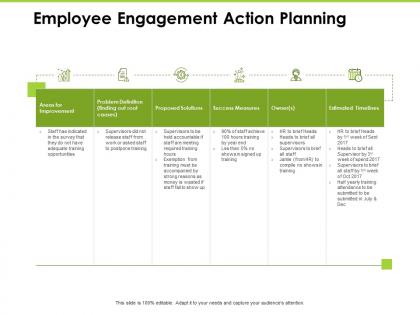
Employee engagement action planning measures ppt powerpoint presentation graphics




Try Before you Buy Download Free Sample Product
 Impress Your
 Audience
 100%
100% Editable
 Save Hours
 of Time


Our Employee Engagement Action Planning Measures Ppt Powerpoint Presentation Graphics are topically designed to provide an attractive backdrop to any subject. Use them to look like a presentation pro.
People who downloaded this PowerPoint presentation also viewed the following :
Employee engagement action planning measures ppt powerpoint presentation graphics with all 2 slides:
Use our Employee Engagement Action Planning Measures Ppt Powerpoint Presentation Graphics to effectively help you save your valuable time. They are readymade to fit into any presentation structure.
FAQs for Employee engagement action planning measures ppt
Honestly? The biggest giveaway is when people actually stick around - like, retention rates don't lie. You'll also notice productivity going up naturally, not because you're cracking the whip but because they care. People start throwing out ideas in meetings instead of just sitting there. They collaborate more, take on stuff without being asked. Oh, and here's something I learned the hard way - when your team starts bringing their friends in for job openings, that's gold. It means they actually want to work there. I'd check these things every few months to see where you're headed.
Dude, your leadership style makes or breaks team engagement. Micromanagers kill morale - nobody wants to feel like they're not trusted. Meanwhile, transformational leaders who actually inspire people? Their teams are way more engaged. It's crazy how big the difference is. Democratic leaders do well too because they involve everyone in decisions. People love feeling heard, you know? Laissez-faire works if your team's super self-motivated, but otherwise people just feel lost. My advice? Give them autonomy, be supportive, and listen to what they're saying.
Your culture is literally the make-or-break factor for engagement. When people's values actually match what the company rewards (not just what's on the wall posters), that's when you see real connection happen. Trust, growth ops, feeling safe to speak up - all that good stuff flows from there. Honestly, I've seen companies throw money at engagement surveys while their culture was completely toxic. Total waste. The "culture eats strategy for breakfast" thing is so true though. Start by figuring out what behaviors you're actually rewarding vs. what you think you're rewarding. That gap will tell you everything.
Honestly, feedback systems work because people just want to feel heard. Set up regular check-ins - could be quick surveys, one-on-ones, whatever works for your team. Most managers (myself included sometimes) are pretty bad at reading what people actually need. The trick though? You can't just collect all this input and then... nothing. That's worse than not asking at all. Tell people what you learned, what you're gonna change, or at least why certain things can't happen right now. Monthly touchpoints are a good starting point without being annoying.
Dude, the numbers are wild - engaged employees boost profitability by 23% and productivity by 18%. They actually stick around instead of bouncing after six months. What really got me though? Customer satisfaction jumps 12% because that positive energy spreads like crazy. Your engaged people become walking advertisements for your company, plus they're the ones coming up with creative solutions when stuff hits the fan. Honestly, if you're dealing with performance problems, I'd check engagement first. It's usually the root of everything else falling apart.
Honestly, remote work's a double-edged sword for engagement. Your people get way more flexibility, which they'll love. But isolation hits hard - working from home can feel pretty lonely sometimes. Communication gets weird too, and you lose those random hallway conversations that actually matter. The trick? Be crazy intentional about connection. Regular one-on-ones are clutch. Set up virtual hangout spaces where people can just chat. And don't let your remote folks become second-class citizens in meetings and decisions - that kills morale fast.
Honestly, pulse surveys are your best bet - just 2-3 quick questions weekly through something like Officevibe. Anonymous feedback platforms work really well too since people actually speak up when they're not worried about backlash. Some teams are doing sentiment analysis on Slack messages now, which feels weird but apparently works? Daily stand-ups help you catch vibes immediately. Don't overthink it though - everyone's already survey-fatigued. I'd start with monthly pulse checks first, see what trends pop up, then maybe add more if you need it. Keep things super lightweight or people will just ignore them.
Honestly, people just want to feel seen at work. When you acknowledge good work consistently, it creates this whole positive cycle where employees actually start caring about their jobs beyond just collecting a paycheck. Sure, bonuses are nice, but the real magic happens when someone feels genuinely appreciated. That emotional connection? Way more powerful than throwing money at people. Don't wait for annual reviews either - that's too infrequent. Weekly shoutouts work better. Even peer recognition can be surprisingly effective. It's wild how much intrinsic motivation builds up when you make recognition a regular thing instead of an afterthought.
Yeah, there's definitely a connection there - engaged people just don't quit as much. The stats are wild actually, like 87% less likely to leave when they're really into their job. Makes sense though, right? If you feel valued and connected to what you're doing, why would you bail? Your manager plays a huge role too - when they actually care about your growth, it changes everything. Oh, and if you're dealing with high turnover on your team, I'd honestly start by asking people what's bugging them. Sometimes it's not what you'd expect.
Honestly, the biggest thing is connecting new people to their team right away - don't let them sit in HR hell for a week filling out forms. Get them a buddy system going and show them how their actual job ties into what the company's trying to do. A solid 30-60-90 day plan helps too, but make it realistic. Give them real work early on (not just training modules, ugh). Check in with them regularly because most people are too polite to say they're totally lost. Oh, and definitely look at where your current process is confusing - that's usually where you'll find the biggest wins.
Honestly, just sit down and talk to them one-on-one first. You'll probably find out stuff that surprises you about why they've checked out. Give them more control over their work and be clear about where they can grow. Regular feedback helps too - not just the quarterly review BS. Recognition matters, but it has to be real, not some cookie-cutter "great work!" nonsense. Sometimes people disengage because they're just in the wrong role for their skills. The trick is sticking with it consistently instead of doing some big engagement initiative that fizzles out. Set up those check-ins and actually follow through.
Honestly, when people feel like they can actually be themselves at work, they're gonna be way more engaged. It's not rocket science - if you're constantly worried about fitting in or being judged, you're not gonna speak up or share good ideas. Diverse teams are also just better at solving problems because you get different viewpoints instead of everyone thinking the same way. I've seen this play out so many times. Start by really listening to people who don't always get heard and make sure advancement opportunities aren't just going to the usual suspects. People notice that stuff.
Oh man, there's so much stuff out there! Survey tools like Glint or Culture Amp are solid for getting real feedback. Bonusly and 15Five work great for recognition - people love getting called out for good work. You've probably got Slack already, but Workplace or Yammer can shake things up communication-wise. Learning platforms like Coursera for Business are pretty sweet too. Even basic polling in Teams does the trick sometimes. Honestly though? Pick whatever fixes your biggest pain point first. You can always add more later - I learned that the hard way trying to do everything at once.
Honestly, people just want to feel like they matter beyond being employee
No Reviews