

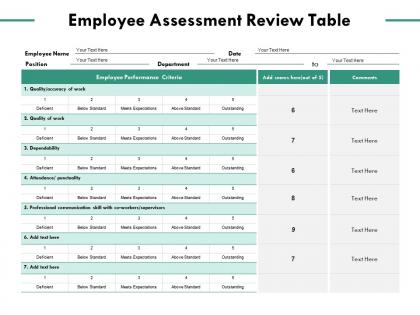
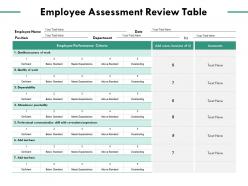
Employee assessment review table employee performance management ppt powerpoint presentation summary master slide




Try Before you Buy Download Free Sample Product
 Impress Your
 Audience
 100%
100% Editable
 Save Hours
 of Time


Give a good account of each individual with our Employee Assessment Review Table Employee Performance Management Ppt Powerpoint Presentation Summary Master Slide. It helps introduce your group.
People who downloaded this PowerPoint presentation also viewed the following :
Employee assessment review table employee performance management ppt powerpoint presentation summary master slide with all 5 slides:
Employ our Employee Assessment Review Table Employee Performance Management Ppt Powerpoint Presentation Summary Master Slide for any introduction. It ensures instant interest.

FAQs for Employee assessment review table employee performance management ppt powerpoint presentation
You need four key things: clear goals upfront, regular check-ins, solid feedback documentation, and development planning. Most managers completely blow this by doing one annual review and calling it good - drives me crazy. Set measurable objectives from day one, then actually talk throughout the year instead of waiting for problems. Oh, and don't forget behavioral stuff alongside performance metrics. Document everything so nobody's blindsided later. Always connect it back to growth opportunities too. If you're not doing quarterly reviews yet, that's probably the best place to start.
So basically, when your team knows exactly what they're shooting for, they actually give a damn about their work. Nobody wants to feel like they're just wasting time on random stuff, you know? Clear goals help people figure out what to focus on first instead of spinning their wheels. Plus you'll probably notice productivity goes up because there's way less "wait, what am I supposed to be doing?" moments. Just make sure the goals aren't totally unrealistic or super vague - that's honestly worse than having no goals at all.
Dude, continuous feedback is a game changer for managing people. No more awkward year-end bombshells where someone finds out they've been screwing up for months. Regular check-ins let people fix stuff as they go and actually improve at their job. Way less stressful than those dreaded annual reviews everyone hates. You'll catch issues early, give props when they deserve it, and honestly just connect better with your team. Start with quick weekly or bi-weekly one-on-ones - even 15 minutes helps tons. Trust me on this one.
Honestly, going digital with appraisals is a game changer. Your scheduling headaches disappear since everything auto-reminds people. All the performance stuff lives in one spot instead of random spreadsheets everywhere. Goal tracking happens year-round so you're not frantically trying to recall February's wins in December (been there!). The analytics are pretty sweet too - you'll actually see patterns and spot who's crushing it or needs help. Oh, and collecting feedback becomes stupid easy. I'd just grab one tool that plays nice with whatever HR system you're already stuck with. Even basic automation saves tons of time.
Honestly, prep is everything here. Gather examples ahead of time - wins AND stuff that needs work - so you're not blanking during the actual conversation. I always ask them to self-assess first because it makes things way less awkward. Start with "how do you think this quarter went?" Focus on what they did, not who they are as a person. Give specific examples. Oh, and definitely talk about where they want their career to go - people eat that up. But real talk? Don't dump everything on review day. Have these chats regularly so nobody's blindsided.
Break down your big company goals into actual measurable stuff each person can own. Instead of vague performance metrics (you know, the "team player" nonsense), tie everything back to real outcomes that matter. Here's what works - in every 1:1 and review, spell out exactly how someone's daily work connects to the bigger picture. People need to see that line clearly, otherwise they're just going through the motions. Make it super explicit so there's no guessing about whether what they're doing actually moves things forward for the company.
Talk to them first - like actually sit down and figure out what's going on. Maybe they're confused about expectations or need more training, who knows. Then set up a performance plan with clear goals and deadlines. I know, sounds boring but it works. Give them coaching or whatever resources they need. Document all of it (trust me on this one). If they still don't improve after you've given them a real shot, then you can consider next steps. But honestly? Start with that conversation - people surprise you sometimes.
Think of performance management as your GPS for developing people. Regular check-ins reveal skill gaps and show who's actually ready to level up. I've seen too many managers skip this step and wonder why their development programs fall flat. You'll spot who needs training, who can handle bigger projects, and honestly - who's promotion-ready. Those performance conversations? Turn them into real development plans. Otherwise you're just throwing darts in the dark. The data from reviews gives you everything you need to create targeted growth paths that actually work.
Pick like 3-5 metrics that actually connect to what they do day-to-day. Goal completion rates are solid, plus how well they work with others. Customer satisfaction if that's part of their thing. Sales people? Yeah, obviously track revenue. But honestly, skip the BS vanity metrics - I've seen too many companies obsess over stuff that doesn't matter. Growth stuff is huge too, like are they learning new skills or stepping up on their own? Just make sure you can measure it consistently and - this is key - tell your team upfront how they're being judged. Nothing worse than surprise evaluation criteria.
Honestly, just be super specific right from the start. None of that "do better" nonsense - give them actual measurable goals they can work toward. I'm big on writing stuff down because let's face it, we all forget what was said in meetings. Monthly check-ins work way better than those awful yearly reviews everyone dreads. Also ask what they need from you to actually succeed. The whole thing falls apart if you're not consistent with follow-through though. Start simple - one page per role, go over it together every month. Trust me, it saves so much drama later.
Dude, getting managers on board is gonna be your biggest headache. Plus people will totally see it as just more busy work at first. Setting goals that aren't either super vague or weirdly specific? Yeah, that's tricky too. Most managers suck at giving feedback because nobody taught them how. Honestly, I'd pilot it with one small team first - like, actually get their input before you roll it out everywhere. The whole "seeing it as growth instead of paperwork" thing takes time. Oh, and don't expect people to use it consistently right away. That part's always a mess initially.
Your coworkers see stuff your manager never will - like how you actually handle problems when things get messy, or if you're genuinely helping in meetings vs just talking to sound smart. Honestly, peers give way better feedback than those formal top-down reviews half the time. Getting input from several people also cancels out personal biases, which is clutch. One thing though - push for real examples when you ask for feedback. Vague stuff like "good team player" won't help you get better at anything specific.
Honestly, self-assessment changes everything. Your people actually think about their work before you meet - makes them way more invested in the conversation instead of just sitting there getting lectured. You'll also catch some interesting gaps between how they see their performance vs. how you do. Sometimes they're harder on themselves than you'd be! The whole thing feels less like a judgment session and more collaborative. I'd send out a quick form maybe a week ahead - just ask about wins, challenges, what they want to work on next. Even those basic questions make reviews so much better.
Honestly, the biggest thing is being super clear upfront about what you expect - like, write it down clear. Then you actually have to stick to consequences when people don't deliver (and rewards when they do). I learned this the hard way lol. Regular check-ins are clutch because you can fix stuff before it gets messy. Also, don't play favorites - that'll kill any accountability culture real quick. When someone screws up but owns it and improves? Make a big deal about that. Oh, and you gotta model it yourself first. People won't buy into accountability if you're making excuses left and right.
Just document everything objectively - no comments about personality or anything that could seem discriminatory. Stick to actual job performance and numbers you can measure. I swear, managers get burned for the most random comments they think are innocent. Make sure you're judging everyone by the same standards too. The whole point is having solid evidence backing up what you write. That way if someone questions it later, you've got specific examples instead of just "well, I had a feeling about them," you know? Oh and definitely avoid gut-feeling territory - that's where things get messy legally.
No Reviews