

Employee skills matrix ppt table





Try Before you Buy Download Free Sample Product
 Impress Your
 Audience
 100%
100% Editable
 Save Hours
 of Time


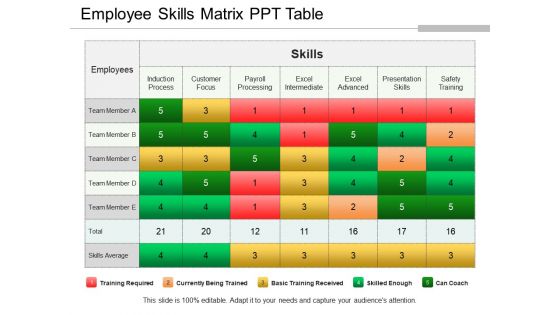
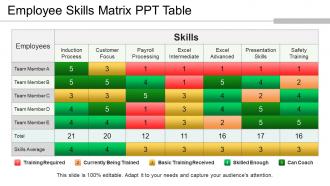
Here is a great product for you to understand the skills of your employees effectively, Employee Skills Matrix PPT Table. Use this PowerPoint table to understand, deployment and tracking of people and their skills. With the help of the skills matrix PowerPoint slide show, a business operator can examine gaps, where the team is lacking skills and experience and make the team aware of the same. The matrix present in the PPT table includes a grid illustrating various kinds of skills focusing on which you can restructure your team to improve its effectiveness. Using the employee skills matrix PPT table you can explain your team about the new skills you wish to introduce. The ready to use grid allows you to save time by just adding the required content in the blank matrix. Therefore, this PowerPoint presentation is a great product for strategic management. Download it now and comprehend the skills and competence of your employees.
People who downloaded this PowerPoint presentation also viewed the following :
Employee skills matrix ppt table with all 5 slides:
Address any indication of fear with our Employee Skills Matrix Ppt Table. It helps handle the jitters.
FAQs for Employee skills
So basically it's a grid showing who on your team has what skills and how good they are at each one. Picture a spreadsheet - employees down one side, skills across the top. Super handy for spotting where you're missing expertise or figuring out who to ask about specific stuff. You can plan training better too, plus it's clutch for succession planning when people inevitably leave. Honestly, we should've started ours way earlier. Just list out your main skills first, then have everyone rate themselves on each one.
So basically you map out what skills your team actually has vs what you need for different roles. Makes the gaps super clear right away. It's like a heat map showing where you're covered and where you're screwed - honestly way more useful than I expected when I first tried it. You can spot weird patterns too, like if your whole team sucks at the same thing or missing crucial skills entirely. Then just use that info to figure out training priorities and who to hire next. Pretty straightforward but saves you from guessing what's actually broken.
So you'll need employee names obviously, plus the specific skills that matter for your team's actual work. I'd rate each skill - maybe beginner/intermediate/advanced or just 1-5, whatever doesn't feel weird to use. Track both where people are now AND where you need them to be so the gaps jump out at you. Don't just do technical stuff either - throw in soft skills like communication. Honestly, the simpler you make it, the more likely people will actually keep it updated instead of letting it collect digital dust. Start with your most critical skills and build from there.
Skip the generic templates and figure out what actually matters in your field first. Healthcare? Certifications and how you handle patients. Tech focuses on programming languages and frameworks. Safety protocols are huge in manufacturing - obviously. Map out both technical stuff and soft skills that make people successful there. Oh, and compliance requirements if that's a thing for you. Here's what really works though - ask your best performers what skills they think are most important. That's where you'll find the good stuff. They know what actually moves the needle vs what just looks nice on paper.
So basically, map out what skills your current team has first - the gaps will jump out at you right away. Then you'll know exactly what to hire for instead of just throwing up random job posts and hoping for the best. During interviews, you can ask way better questions too since you know what you actually need. Honestly, it's kind of like having a grocery list vs wandering the aisles aimlessly (though I still forget half the stuff on my list anyway). But yeah, it makes recruiting so much more targeted and less of a guessing game.
Skills matrices are honestly a game changer for this stuff. Map out what everyone knows vs what you actually need - it's basically a heat map of your team. Way better than guessing who's good at what. I started with just 5-6 key skills instead of going crazy trying to track everything (learned that the hard way). You'll quickly spot who's ready for bigger challenges and who needs more foundation work first. Perfect for setting up mentoring pairs too since you can see your experts right next to people wanting to grow.
Honestly, I'd focus on whether people are actually closing those skill gaps you mapped out - that's the big one. Training completion rates matter too, plus how long it takes someone to get competent at new stuff. Employee engagement with their development plans is huge (nobody grows when they're just going through the motions). Retention in key roles tells you a lot - people stay when they see where they're headed. Project success rates and internal promotions show if you're building the right capabilities. Don't try tracking everything though. Pick 2-3 metrics that actually align with what your team needs right now.
Oh man, you'll love this! A skills matrix is basically your team cheat sheet - shows who's good at what without all the awkward "hey does anyone know React?" messages. Super handy for figuring out project assignments quickly. You can spot skill gaps right away and stop accidentally dumping everything on the same poor person (we've all been there). Plus you'll probably find out Sarah secretly knows Python or whatever. Just start by writing down what everyone can actually do - not what their job title says they should do, if you know what I mean.
Don't try tracking every skill imaginable - you'll create a monster spreadsheet nobody touches. Seriously, I've seen teams do this and it's painful. Pick skills that actually move the needle for your people's growth and daily work. Keep your rating simple too, like 1-4 max. Trust me, people will debate forever whether they're a 6 vs 7 out of 10. The other big mistake? Treating it like a "set it and forget it" thing. Skills evolve, people learn stuff, roles shift. An outdated matrix is basically useless. Start small with core competencies first. You can always add more later once everyone's comfortable with the process.
Honestly? Every 3-4 months or you'll regret it. I learned this the hard way when our team's matrix was so outdated people just stopped looking at it altogether. After performance reviews is perfect timing, or whenever someone finishes training or switches roles. The trick is picking someone who actually gives a damn about updating it - otherwise it becomes another forgotten spreadsheet. Oh, and definitely set a calendar reminder because you will forget. Trust me, if people see stale info even once, they'll never take it seriously again.
Ugh, those Excel spreadsheets are the worst for tracking skills. Get some actual HR software or project management tools instead – they'll auto-update when people finish training. The visual aspect is honestly my favorite part; you can actually see skill gaps across teams and watch everyone improve over time. Let your employees update their own profiles too. Saves you from doing all that manual entry (which nobody has time for anyway). Oh, and check what tools your company already uses first – might already have features you didn't know about.
Don't just dump a skills matrix on people - that never works. Get them involved in building it from the start. Let employees tell you what skills actually matter for their jobs, then have them rate themselves first. Nobody wants competencies shoved down their throat, trust me on this one. Be super upfront about how you'll use the data and connect it to stuff they actually want, like development opportunities or training money. Oh, and definitely start with volunteers who are already bought in. They'll become your success stories and help sell it to everyone else.
Honestly, skills matrices are game-changers for reviews and career planning. Instead of those awkward "you need better communication skills" conversations, you can actually point to specific gaps or wins. For career stuff, it maps out exactly what someone needs to hit their next level. I've seen managers create really clear development paths by comparing current skills to future role requirements. The trick is updating it regularly though - otherwise you're working with stale data from months ago. Way better than just winging performance discussions.
Look at Microsoft - they use skills matrices so employees know exactly what to learn for promotions. Pretty smart, right? Salesforce went further and built auto-suggestions for training based on your gaps. IBM focuses theirs on succession planning, which honestly makes total sense given how much turnover there is these days. What works across all of them? They connect skills to actual business problems instead of just making fancy charts. My advice: pick one small team first, show some quick wins to get people excited, then expand from there. Don't try to boil the ocean right away.
So basically, a skills matrix strips away all the "gut feeling" BS about who belongs where and just focuses on what people can actually do. You'll start noticing patterns - like maybe you keep promoting the same type of person over and over. It's wild how obvious the blind spots become once you see everything mapped out. Plus it helps you find hidden talent you might've missed otherwise. I'd definitely use it to set some real diversity targets for training programs. Oh, and it makes succession planning way more fair since you're basing decisions on actual skills instead of whoever comes to mind first.
-
Informative design.
-
Content of slide is easy to understand and edit.