

Skill matrix report presentation slide ppt diagrams





Try Before you Buy Download Free Sample Product
 Impress Your
 Audience
 100%
100% Editable
 Save Hours
 of Time


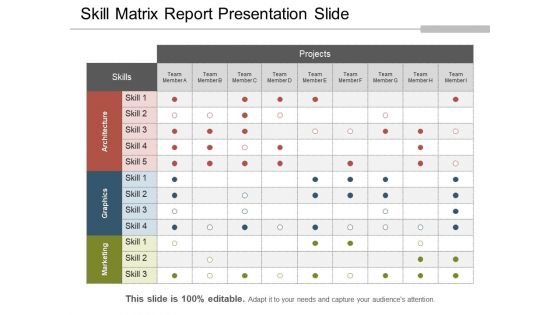
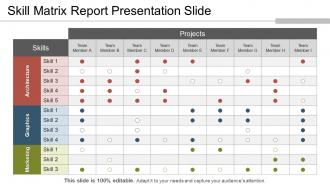
If you are looking for a professionally designed Skill Matrix Report PowerPoint Presentation Slide, then you are at the right place. A skill management report is an essential part of managing your company’s human resources. Getting the best from the team is the biggest challenge faced by a business organization. Here, a skill matrix report comes to your rescue. Through this specially designed matrix format template, you can present your analysis effectively and get the message across easily. You can present assessment of the company’s workforce in areas like communication, leadership, job knowledge, organizational culture, self development, critical thinking, decision making, initiations etc. in this PPT diagram. This skill matrix report design covers a nine-stage process. The stages in this process are skill matrix, skill mapping, intelligence, etc. As skill matrix is a simple and visual tool to show who has training and experience in what skill, this exceptional visual graphic design gives your report a cutting edge. You can assess the workforce in both critical skills as well as non – critical skills easily through this presentation slide. This professionally designed PPT diagram will definitely help you achieve the benchmark of productivity of your organization. Make competitors feel envious with our Skill Matrix Report Presentation Slide Ppt Diagrams. They will begin to eat their hearts out.
People who downloaded this PowerPoint presentation also viewed the following :
Skill matrix report presentation slide ppt diagrams with all 5 slides:
Illustrate it in a jiffy with our Skill Matrix Report Presentation Slide Ppt Diagrams. Generate the correct image with a click.



FAQs for Skill matrix report presentation
A skill matrix is a visual tool that maps team members' current competencies against required skills for projects or roles, identifying strengths, gaps, and development opportunities. Organizations use these matrices to strategically assign tasks, plan targeted training programs, and build cross-functional capabilities, ultimately enhancing team performance and ensuring projects have the right expertise while creating clear career development pathways.
A skill matrix helps identify training needs by comparing current employee competencies against required skills for each role, revealing gaps through visual assessment, performance evaluation, and competency mapping. Through systematic analysis, organizations streamline workforce development planning, enhance targeted learning programs, and optimize resource allocation, with many companies finding that structured skill assessments ultimately deliver faster employee advancement and improved operational efficiency.
Key components include employee names and roles, specific technical and soft skills relevant to your industry, current proficiency levels using standardized rating scales, desired competency targets, and skill gap identification areas. These elements work together by enabling strategic workforce planning, targeted training initiatives, and optimized project assignments, with many organizations finding that comprehensive matrices significantly enhance resource allocation and competitive positioning.
A skill matrix improves project management by providing clear visibility into team capabilities, enabling precise task assignments, identifying skill gaps, and optimizing resource deployment across multiple projects simultaneously. Through strategic talent mapping, project managers can streamline team formation, reduce project timelines, and enhance delivery quality, while organizations achieve better resource utilization and competitive advantage in increasingly complex project environments.
A skill matrix identifies current team capabilities and skill gaps, enabling organizations to develop targeted succession plans for critical roles. By mapping essential competencies against existing talent, companies can strategically prepare high-potential employees through focused training and development programs, ultimately ensuring smoother leadership transitions and maintaining operational continuity.
Organizations can ensure their skill matrix remains current through regular quarterly reviews, continuous feedback from managers and employees, integration with performance evaluations, and alignment with industry trends and emerging technologies. By incorporating real-time project outcomes, training completions, and evolving role requirements, companies can maintain accurate skill assessments that support strategic workforce planning, ultimately delivering enhanced resource allocation and competitive advantage in dynamic markets.
Best practices for implementing a skill matrix in remote work include establishing clear digital documentation, conducting virtual skill assessments, creating transparent competency frameworks, and maintaining regular online check-ins for updates. These approaches streamline remote talent management by enabling distributed teams to identify expertise gaps, facilitate cross-functional collaboration, and optimize project assignments, ultimately delivering enhanced productivity and strategic workforce development across geographically dispersed organizations.
A skill matrix facilitates better cross-functional collaboration by identifying complementary expertise across departments, revealing knowledge gaps that teams can fill together, and enabling strategic resource sharing for complex projects. Through transparent skill visibility, organizations streamline team formation, enhance knowledge transfer between functions, and ultimately deliver more integrated solutions, with many companies finding that cross-departmental collaboration increases significantly.
Skill matrices generate metrics including skill gap percentages, competency distribution across teams, skill development velocity, training ROI, and resource allocation efficiency. These measurements enable organizations to track workforce capabilities, identify critical skill shortages, optimize training investments, and make strategic hiring decisions, with many companies finding that regular skill matrix analysis delivers improved project outcomes and enhanced competitive positioning.
Employees can use a skill matrix to identify their current competencies, pinpoint skill gaps, and create targeted development plans aligned with career goals. By comparing their abilities against role requirements and industry standards, professionals can prioritize training opportunities, seek relevant certifications, and strategically build expertise that enhances their value proposition and advancement potential within organizations.
**INPUT**: What tools or software are best suited for creating and maintaining a skill matrix? **OUTPUT**: Effective skill matrix tools include Excel, Google Sheets, specialized HR platforms like BambooHR, project management software such as Monday.com, and enterprise solutions like SAP SuccessFactors. These platforms streamline workforce planning by enabling real-time updates, visual competency mapping, and automated gap analysis, with many organizations finding that integrated systems ultimately deliver enhanced resource allocation and strategic talent development. [Word count: 60]
A skill matrix supports diversity and inclusion by identifying skill gaps across diverse teams, highlighting underrepresented talents, and ensuring equitable development opportunities through transparent competency mapping. By systematically tracking abilities across different demographics, organizations can strategically address bias in promotions, create targeted mentorship programs, and build more inclusive leadership pipelines, ultimately fostering workplace equity.
Challenges when introducing a skill matrix include employee resistance to assessment, inaccurate self-evaluations, time-intensive data collection, and maintaining updated information across growing teams. Organizations overcome these obstacles by implementing transparent communication about benefits, combining self-assessments with manager reviews, using automated tracking tools, and establishing regular update cycles, ultimately delivering improved talent allocation and strategic workforce planning.
Feedback plays a crucial role in maintaining accurate skill matrices by providing real-time insights into employee competencies, identifying skill gaps, and validating training effectiveness. Through performance reviews, peer assessments, and project outcomes, organizations continuously refine their matrices, ensuring they reflect current capabilities and emerging needs, ultimately enabling more strategic workforce planning and targeted development initiatives.
Organizations utilize skill matrices during recruitment by mapping required competencies against candidate qualifications, identifying skill gaps in existing teams, and creating targeted job descriptions that attract suitable talent. This strategic approach streamlines candidate evaluation, enables more objective hiring decisions, and helps HR teams assess cultural fit alongside technical capabilities, ultimately reducing time-to-hire while improving recruitment quality and long-term employee success.
-
The content is very helpful from business point of view.
-
Good research work and creative work done on every template.