


Skill matrix analysis for hr department powerpoint slide




Try Before you Buy Download Free Sample Product
 Impress Your
 Audience
 100%
100% Editable
 Save Hours
 of Time


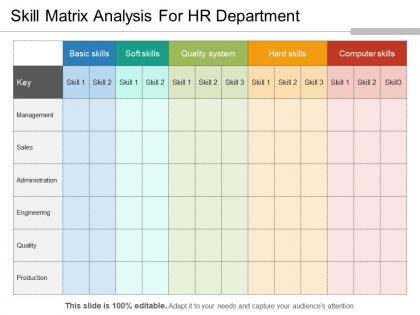
Understand the people and their skills with our Skill Matrix Analysis For HR Department PowerPoint Slide. This skill matrix template will assist you in mapping the required and the desired skills for a team. With this matrix template, also known as competency matrix, you can clearly visualize the skills needed to complete a project in an organisation. The skill and competency held by the individual of the organization can be depicted using this matrix analysis template. Using this PPT slide you can easily analyze the skills of an individual to know where they are lagging behind. With this PPT presentation, you will be able to do a skill gap analysis. This is a five stage skill analysis matrix that aids you in understanding and developing the skills of individuals within the organization. You can divide the skills in 5 categories including basic skills, hard skills, soft skills and so on and rank different departments on the basis of skills possessed. Download this template now get a clear idea of the skills that are required for completing a project.
People who downloaded this PowerPoint presentation also viewed the following :
Skill matrix analysis for hr department powerpoint slide with all 5 slides:
Bring an end to any adverse influences on the group with our Skill Matrix Analysis For Hr Department Powerpoint Slide. Identify demoralising elements.
FAQs for Skill matrix analysis for hr
You need four main things: skill categories (technical + soft skills), proficiency levels, current assessments of your team, and target goals. Most people totally botch the proficiency part - make it specific and measurable, not some vague "good at communication" nonsense. Don't forget timelines and who can mentor who. Visual format works best since you'll update it constantly. Start with a basic spreadsheet first. I know it's boring, but trust me - figure out your process before you go buying some fancy software. Once you've got the hang of it, then upgrade to better tools.
So basically, skill matrix analysis shows you who's actually good at what on your team. No more guessing games. You can see everyone's strengths and weak spots laid out visually - honestly beats flying blind on assignments. Project planning becomes way smoother when you're not putting people in roles they'll struggle with. Plus you'll catch training needs early instead of scrambling later (learned that one the hard way). Just map out what skills your team has versus what your projects actually need. The difference is pretty dramatic once you get it going.
Dude, definitely go for the heavily regulated stuff first - healthcare, manufacturing, aviation. Those industries are obsessed with tracking who's certified for what because they literally can't mess around with compliance gaps. Financial services is another big one since they're drowning in regulatory requirements. Tech companies use them too, though more for mapping technical skills than safety stuff. Really though, any place where it's not super obvious who has what skills will benefit. I'd just start with wherever gaps could actually hurt you - safety issues, quality problems, that kind of thing. You'll spot training needs way faster.
Start by figuring out what skills you'll actually need for your strategic goals over the next 1-3 years. Map those against what your team can do right now - that gap analysis is everything. Honestly, most companies just throw random training at people and wonder why nothing changes. Focus on the biggest gaps first, the ones that'll actually impact your business. Your skill development plan should connect directly to where you're going strategically. Otherwise you're just wasting time and budget on feel-good professional development that doesn't move anything forward.
Honestly? Just start with Excel or Google Sheets. Most people already know how to use them and you can do color coding, rating scales, all that stuff. There are fancier tools like Cognology or AG5 that'll handle the analytics for you, but I've literally watched teams waste weeks researching software when a good spreadsheet does like 90% of what they need. My old manager was obsessed with finding the "perfect" platform - total time sink. Start simple, see what works. You can always upgrade later if you need automated gap analysis or want it talking to your HR system.
Update them quarterly minimum, but honestly that's barely enough. Anytime someone gets hired, switches roles, or finishes training? Update immediately. Otherwise you're planning with old info and that'll bite you later. I watched a team assume their guy still knew Python after he moved to sales - spoiler alert, he didn't. Build it into your regular HR stuff so it happens automatically. Don't be like me forgetting for eight months straight. Set reminders and make someone own it specifically.
You definitely need employee feedback for skill matrices - otherwise you're just guessing. Their input shows you what skills they actually have vs what's in your outdated HR system (which let's be honest, is probably wrong anyway). Employees know about recent certifications or hidden talents that never made it into official records. They'll tell you what skill gaps are hurting them daily and what training they'd actually want. Without their voice, your matrix is basically fiction. Oh, and build this into regular reviews so it doesn't become another annoying survey people ignore.
So basically a skill matrix maps out everyone's current abilities against what each role actually needs. Super helpful for spotting training gaps without having to keep track of everything in your head (which honestly never works anyway). You'll see exactly who needs development in what areas - think of it like a visual snapshot of where you're most vulnerable. Then you can decide whether to train people up internally or if you need to hire from outside. I'd start with your most critical skills first and build your training plan around the biggest holes you find.
Honestly, the biggest pain is gonna be getting people to rate themselves accurately. Half your team will say they suck at everything, the other half thinks they're rockstars. Defining skill levels is weirdly hard too - like what's "intermediate" even mean? People will probably push back because it feels like busywork or they're worried you're secretly evaluating them. The manual spreadsheet thing takes forever (learned that one the hard way). Start with just one small team first. Keep your definitions super simple and sell it as career growth, not Big Brother watching. Makes all the difference in buy-in.
So skill matrices are actually pretty genius - basically you map out what everyone on your team is good at. No more of that awkward "does anyone know Python?" in Slack channels. You'll spot knowledge gaps super fast, and honestly, people love sharing what they're experts in once you ask. The cool part is pairing teammates who complement each other well. Like, Sarah's amazing at data viz but hates SQL, while Mike's the opposite. I'd definitely try sketching one out this week - even something rough will show you collaboration opportunities you're probably missing.
Here's what I'd do - track four main things for each skill. Current ability (I use 1-5), years they've actually worked with it, and whether they can teach others. That last one is seriously underrated for planning who can train people. Also add if they want to learn more in that area. Short sentences work better than cramming everything together. Update it every few months since tech moves so fast these days. Honestly, starting with just those four columns will give you way more insight than most companies have about their team's capabilities.
Start with 3-5 levels for each skill - beginner, intermediate, advanced, expert works well. But here's the thing: you've gotta define what each level actually means with specific criteria. Can't tell you how many times I've seen "intermediate" that could mean literally anything! Cover both technical skills and soft skills (people always forget those). Get input from folks at different experience levels when you're building it - they'll catch stuff you missed. Oh, and make sure the progression paths actually make sense for how people grow in your org. Short sentences mixed with longer ones help break things up naturally.
Honestly, skill matrices are a game-changer for succession planning. They lay out who's got what skills and where you're missing pieces. You can spot your high-potential people who are already close to being ready for bigger roles. Then figure out what specific training they need. The visual aspect is clutch - makes comparing candidates way easier than digging through performance reviews or whatever. I'd start with your most critical positions first, then see which current people are closest to filling them. Creates a clear development path instead of just hoping someone magically becomes ready.
Get your team involved in building this thing from scratch - don't just lock yourself in a room and emerge with some framework nobody asked for. Be upfront about what you're doing with the data (career stuff, not sneaky performance tracking). Three or four skill levels tops, and honestly? Update it pretty often since everything changes so fast now. Don't rely on people just rating themselves - get peer input or look at actual work samples. The key part is connecting it to real development opportunities and career paths. Otherwise people will fill it out once and it'll just sit there forever in some forgotten spreadsheet.
Honestly, skill matrices are game-changers because they make those annoying knowledge gaps impossible to ignore. You map everyone's current abilities against what you actually need, and boom - clear picture of who needs to learn what. No more awkward "so... where do you see yourself growing?" meetings that go nowhere. People get competitive when they see their teammates leveling up skills, which is weirdly motivating. The trick is keeping it updated though - I've seen too many companies build these things then forget they exist. Use it for real career planning and you'll actually see people improving instead of just talking about it.
-
Excellent Designs.
-
Qualitative and comprehensive slides.