


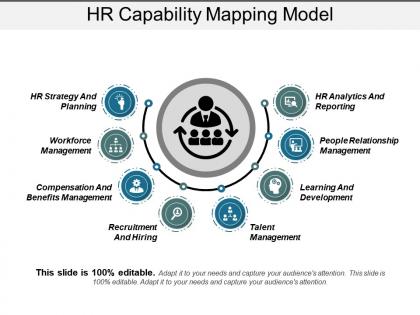
Hr capability mapping model





Try Before you Buy Download Free Sample Product
 Impress Your
 Audience
 100%
100% Editable
 Save Hours
 of Time


Drum up the desired degree of enthusiasm with our Hr Capability Mapping Model. You will be able to create the beat.
People who downloaded this PowerPoint presentation also viewed the following :
Hr capability mapping model with all 5 slides:
Will you make an impression with your next presentation? Our high quality Hr Capability Mapping Model are ready to make your next project memorable.


FAQs for Hr
Effective HR capability mapping models include competency frameworks, skill gap analysis, performance metrics, succession planning matrices, and development pathway templates. These components work together by identifying current talent strengths, pinpointing areas for improvement, and creating strategic development plans, with many organizations finding that comprehensive mapping ultimately delivers enhanced workforce planning and competitive talent advantage.
Organizations effectively assess their current HR capabilities through comprehensive skills audits, performance analytics, competency gap analysis, employee feedback surveys, and benchmarking against industry standards. These assessment methods enable HR leaders to identify strengths, pinpoint development areas, and create strategic workforce plans, with many companies finding that systematic capability mapping ultimately delivers improved talent retention and enhanced organizational performance.
Technology revolutionizes HR capability mapping through AI-driven analytics, automated skill assessments, predictive modeling, and real-time data visualization platforms. These digital solutions streamline talent identification, enhance workforce planning accuracy, and enable strategic resource allocation, with many organizations finding that integrated HR tech delivers faster decision-making and significantly improved competitive advantage.
HR capability mapping aligns with business strategy by identifying skill gaps, forecasting future talent needs, and connecting workforce capabilities to strategic objectives. Through systematic assessment and strategic workforce planning, organizations can prioritize training investments, guide recruitment decisions, and ensure talent development directly supports business goals, ultimately delivering competitive advantage and organizational agility.
Methods for gathering HR capability mapping data include employee self-assessments, 360-degree feedback, performance reviews, skills inventories, and competency-based interviews. These approaches enable organizations to systematically evaluate current capabilities, identify skill gaps, and align talent development with strategic objectives, with many companies finding that combining multiple methods delivers more comprehensive insights and enhanced workforce planning accuracy.
HR capability mapping supports talent management initiatives by identifying skill gaps, aligning competencies with strategic goals, informing succession planning decisions, and enabling targeted development programs. Through systematic assessment of current capabilities against future needs, organizations can optimize recruitment strategies, enhance performance management processes, and create personalized career pathways, ultimately delivering improved retention rates and stronger leadership pipelines across all organizational levels.
Organizations face challenges including resistance to change from employees, difficulty in accurately assessing current capabilities, lack of standardized measurement criteria, and resource constraints for comprehensive mapping initiatives. While these obstacles can initially slow implementation, many companies find that investing in proper change management, stakeholder training, and phased rollouts ultimately delivers enhanced talent visibility, strategic workforce planning, and competitive advantage in increasingly dynamic business environments.
Organizations should revisit HR capability mapping quarterly for tactical adjustments and conduct comprehensive annual reviews for strategic realignment. This frequency enables companies to respond to evolving business needs, emerging skill requirements, and market changes, while many organizations find that regular updates enhance workforce planning, identify development opportunities more effectively, and maintain competitive advantage in talent management.
Key metrics for evaluating HR capabilities include employee engagement scores, time-to-fill positions, retention rates, training effectiveness measures, and performance management outcomes. These metrics enable organizations to assess recruitment efficiency, talent development success, and workforce satisfaction, with many companies finding that comprehensive capability measurement ultimately delivers improved operational performance and strategic competitive advantage.
HR capability mapping assists in identifying skill gaps by systematically comparing current employee competencies against required role specifications, strategic business objectives, and future organizational needs. Through detailed skills assessments and competency frameworks, organizations can pinpoint specific deficiencies across departments, prioritize training investments, and develop targeted development programs, ultimately enabling more strategic workforce planning and competitive advantage.
**INPUT**: What are some best practices for visualizing HR capability maps? **OUTPUT**: Best practices for visualizing HR capability maps include using color-coded matrices, interactive dashboards, skill heat maps, competency radar charts, and role-based capability frameworks. These visualization techniques streamline talent assessment by highlighting skill gaps, tracking development progress, and enabling strategic workforce planning, with many organizations finding that clear visual representations enhance decision-making and accelerate capability development initiatives. [Word count: 58 words]
HR capability mapping contributes to employee engagement by identifying individual strengths, development opportunities, and career pathways, while aligning personal growth with organizational goals. Through systematic skill assessment and strategic planning, companies enhance job satisfaction, increase retention rates, and create personalized development journeys, with many organizations finding that employees become more motivated when they clearly understand their potential advancement opportunities.
Yes, HR capability mapping significantly facilitates succession planning by identifying skill gaps, assessing leadership readiness, and creating development pathways for high-potential employees. Through systematic talent assessment, organizations can pinpoint critical competencies, map internal candidates to future roles, and design targeted training programs, ultimately ensuring seamless leadership transitions and reduced recruitment costs.
HR capability mapping differs from traditional HR assessments by focusing on future-oriented strategic capabilities rather than past performance evaluations, emphasizing organizational alignment with business objectives, and identifying capability gaps for workforce planning. While traditional assessments measure individual competencies retrospectively, capability mapping enables proactive talent development, strategic resource allocation, and competitive positioning, with many organizations finding that this approach delivers enhanced workforce agility and measurable business outcomes.
Cross-functional collaboration enhances HR capability mapping by incorporating diverse departmental perspectives, identifying skill gaps across organizational boundaries, and ensuring alignment between HR strategies and operational needs. When HR teams collaborate with finance, operations, and technology departments, they gain comprehensive insights into capability requirements, enabling more accurate talent assessments and strategic workforce planning that drives competitive advantage.
-
Qualitative and comprehensive slides.
-
Informative presentations that are easily editable.