

Hr swot analysis for human resource practises






Try Before you Buy Download Free Sample Product
 Impress Your
 Audience
 100%
100% Editable
 Save Hours
 of Time


Get behind your team with our Hr Swot Analysis For Human Resource Practises. Encourage them in any difficulty.
People who downloaded this PowerPoint presentation also viewed the following :
Content of this Powerpoint Presentation
Picture yourself on an exciting journey deep into the wilderness, gearing up to face challenging topographies and stretching into the unknown. As you get ready for the tasks at hand, you crop all your equipment carefully to see that you have all that you need to achieve the goal. But at the same time, you are aware of your limitations as you see the height issue or the fact that you lose your way easily. Such is the case, however, with the risk of the unknown nature of weather and a safe route through that lurk in the dark. Despite all those challenges, you look forward to discovering new perspectives and reaching those hidden treasures your soul is waiting for. The exact strategic HR SWOT analysis roadmap gives the organization a sturdy base in the rough waters of staff management by revealing strengths, weaknesses, opportunities, and threats.
Take a plunge in "HR SWOT Analysis for Effective Human Resource" to master your HR aspect and function.
Our presentation weaves the synopsis of these five key aspects into one highly interactive slide for your ready reference to get a bird's eye view of your complete human resource (HR) scenario. While providing you with actionable strategies and innovative solutions, we will give you a better chance of using your strengths wisely, being well organized in realizing weaknesses, streamlining the management of opportunities, and navigating threats.
Go beyond "HR SWOT Analysis In The Form Of Identification Of Issues And Conducting Search For Solutions" and be more elaborative through an in-depth HR issue-solving approach.
Template 1: HR SWOT Analysis for Human Resources Practices
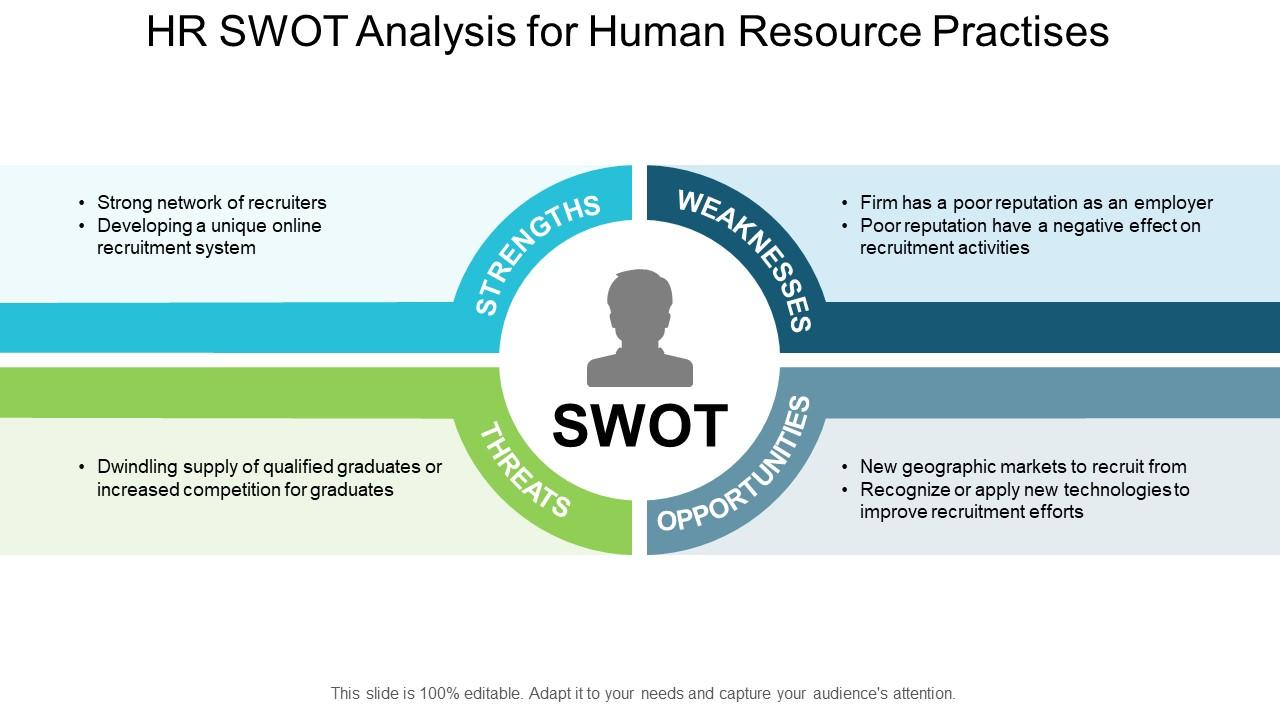
This PPT Template on the product's SWOT analysis will be valuable for strategic decision-making and planning. It is a complete breakdown of both internal and external factors. The competitive environment is divided into four sections. In each part, the SWOT (strengths, weaknesses, opportunities, and threats) is described, which allows you to use the tools to navigate the market confidently. Utilizing both sides of a two-quadrant diagram offers an opportunity to develop a strategy in which the business can address both strengths and weaknesses, recognize opportunities, neutralize threats, and inform its competitive advantage in the long run.
Conclusion
This HR SWOT Analysis of Human Resource Practices PowerPoint Presentation provides you with the tools to maneuver the intricacies of HR management confidently. Identifying strengths, eliminating weaknesses, taking steps for opportunities, forming steps for threats work, and preparing for HR excellence
should be your motto for future progress.
Grab the tools for SWOT analysis for the "Human Resource SWOT Analysis for Recruitment and Training Head" to make recruitment and training effective.
Hr swot analysis for human resource practises with all 5 slides:
Encourage employees to feel free with our Hr Swot Analysis For Human Resource Practises. They generate better feedback.

FAQs for Hr swot analysis for
Honestly, you guys are crushing it with employee development and retention - like 15% above industry average, which is pretty impressive. The team's super quick to respond when I need policy answers, makes everything smoother. Your recruitment game is strong too - filling spots in 30 days consistently and new hires actually seem happy with onboarding (rare these days!). Employee engagement keeps going up each quarter. I'd totally use these wins when you're pitching for more HR budget or trying new stuff. Wait, did I mention retention already? Anyway, you've got solid data to back up whatever you're planning.
Company culture is basically everything when it comes to engagement. When people feel heard and appreciated, they actually care about their work. Makes sense, right? But throw in a micromanaging boss or zero career development? Yeah, they're mentally gone. Check your turnover numbers and really listen during team meetings - that stuff tells the real story. I'd honestly start small though. Pick one thing you're already doing well and double down on it, then tackle whatever's obviously not working. You don't need to fix everything at once.
Honestly? You're probably losing candidates because you take forever to get back to them. Your interview process sounds pretty cookie-cutter too - nothing that makes candidates think "wow, this place is different." Those job descriptions could literally be copy-pasted between any company, which is kind of a red flag. Plus you're missing tons of good people who aren't actively looking but might be interested. I mean, posting jobs and crossing your fingers isn't really a strategy anymore. Start by tracking how long your process actually takes and ask candidates what turned them off.
Honestly, tech can save your sanity in HR. Get an HRIS system first - automates payroll, benefits, all that tedious record-keeping stuff. AI recruiting tools will screen resumes way faster than you can. Self-service portals are clutch because employees can update their own info and request PTO without constantly hitting you up (trust me on this one). Video interviews streamline hiring big time. Analytics dashboards catch turnover issues before they blow up. Oh, and don't try to fix everything at once - just pick whatever's currently driving you crazy and start there.
Honestly, you've got room to grow here. Your training programs are pretty bare-bones right now - people keep bugging about tech certs and leadership stuff. I'd add some cross-department skill sharing too. The good news? You're actually underspending on learning compared to other companies, so budget shouldn't be an issue. Remote work opens up tons of online platforms and virtual mentoring that weren't really viable before. Oh, and definitely survey people first about what they actually want to learn - saves you from guessing wrong.
Honestly, you've gotta stay ahead of market trends or you're screwed. COVID proved that overnight - flexible work went from "nice perk" to absolute must-have. Remote expectations, tech skill gaps, Gen Z wanting different things... all of it changes how you hire and keep people. I'd build trend analysis into your regular planning instead of scrambling to catch up later. Check industry reports, see what competitors are doing. Economic shifts hit fast and you don't want to be the company still posting "must work in office" when everyone else adapted months ago.
Start with your strengths - if people love your flexible schedule or training programs, shout about it more. Fix the obvious problems too, like crappy pay or bad managers. Companies ignore this stuff way too long honestly. Remote work is huge right now, so jump on trends like that. Also, if competitors keep stealing your people with better offers, you gotta fight back fast. I've watched places lose half their team because they thought everyone would just... stay? Make those SWOT threats into actual plans you can execute.
Oh man, regulatory changes are such a headache for HR. Labor laws shift and suddenly you're updating systems, retraining people, maybe even overhauling your whole pay structure. GDPR stuff is the worst though - mess that up and you'll get slammed with massive fines. Employment laws change constantly too, so you're always revising policies and retraining managers. Don't get me started on healthcare regs... Set up some Google alerts for HR news and join an association if you can. Honestly, staying ahead of this stuff is half the battle.
Honestly? Most HR teams are pretty average at cross-departmental stuff - not awful, but could definitely be better. The thing is, other departments often see you guys as the "policy police" instead of actual partners, which sucks but is super common. I'd do a quick survey asking department heads to rate how well HR collaborates on hiring, performance reviews, that kind of thing. Way better than just guessing. Also check if you're being proactive or just putting out fires all the time. Are department heads actually looping you into their planning conversations? That's usually a good tell.
Honestly, I'd focus on just 3-4 solid metrics instead of going crazy with data collection. Turnover rates and time-to-hire are your bread and butter numbers. Employee satisfaction scores from surveys give you the real tea on how people actually feel. Internal promotion rates are clutch too - shows if you're actually developing talent or just talking about it. Oh, and definitely break down retention by department because some managers are... well, you know. Training completion percentages work if that's your thing. The trick is picking what directly connects to whatever you're trying to fix. Start simple with data you can actually get without jumping through hoops.
So we're basically right in the middle compared to everyone else. Base pay is solid - within like 5% of what's normal. Health benefits are actually pretty good, better than most places which is awesome since that's what you notice every day. But man, our retirement matching sucks and so does PTO - we're behind by maybe 15-20% there. That retirement thing is huge for keeping people around. I'd say check what 3-4 competitors are doing every few months and fix the retirement stuff first.
Yeah, definitely include D&I in your SWOT - it's become way too strategic to ignore. Look at your current diversity programs and talent pipeline as strengths. Be brutally honest about representation gaps for weaknesses (nobody likes doing this part, but it's necessary). The research on diverse teams crushing it performance-wise is pretty solid at this point. For opportunities, think untapped talent pools or new partnerships. Threats? Your competitors probably doing D&I better and poaching your people. Just make sure you're actually tracking real metrics, not just feel-good stuff.
Honestly, start by asking your team what's actually broken - bet you'll get some surprising answers. Your tech setup might be trash and people are just dealing with it (seriously, nothing's worse than constant Zoom crashes). Figure out response time expectations too, especially if you've got different time zones. The big thing though? Stop tracking hours and start looking at what people actually get done. Most managers mess this up by trying to recreate the office vibe remotely, which is kinda backwards. Oh, and make sure everyone knows when they're supposed to be available - that confusion kills everything.
Honestly, skipping HR policy updates is asking for trouble. Labor laws shift constantly, so you'll get hit with compliance issues. Outdated harassment policies? That's lawsuit territory right there. Your employees won't know what's expected anymore either - creates total chaos. Company culture starts going sideways without clear guidelines too. I've watched it happen and wow, what a nightmare to fix later. Smart candidates can smell a stale 2015-era handbook from miles away, which kills your recruiting. Just audit everything yearly and flag the sketchy stuff before it bites you.
Just ask your people directly - surveys, quick chats, whatever works. They'll tell you stuff like "our training rocks" or "promotions take forever" that you'd never see from your desk. Honestly, they usually catch external threats way before management does, like when competitors start poaching talent. Focus groups work great too. But here's the thing - don't do those boring generic surveys. Ask specific questions that actually feed into your SWOT analysis. And seriously, if you don't act on what they say, they'll just start giving you BS answers next time.
No Reviews