

Hr Model Powerpoint Presentation Slides





Try Before you Buy Download Free Sample Product
 Impress Your
 Audience
 100%
100% Editable
 Save Hours
 of Time


Select Hr Model PowerPoint Presentation Slides to define features of HRM. This comprehensive presentation showcase critical components of human resource management. The HR Framework PowerPoint complete deck includes content ready slides such as employee lifecycle framework, talent acquisition, current vacancies, job descriptions, candidate assessment, employee management, attendance tracker, payroll template, skills matrix, performance evaluation, employee review and feedback, exit formality, employee termination form, full and final statement etc. Showcase the strategies of human resource using this HR lifecycle PPT slides. These ready to use employee management PowerPoint templates are designed by our team of experts after an in-depth study of the topic. All slides of Human resource lifecycle presentation are easy to customize as per specifications of the users. Users can combine text and graphics to create professional presentations. Download workforce management framework presentation slides to illustrate your message and engage your audience. Our Hr Model Powerpoint Presentation Slides are a reliable ally. They will come to your aid whatever the situation.
People who downloaded this PowerPoint presentation also viewed the following :
Content of this Powerpoint Presentation
Slide 1: This slide introduces HR Model. State your company name here and proceed.
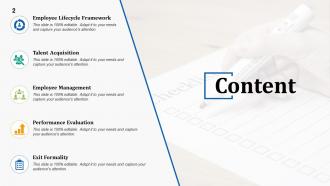
Slide 2: This slide is titled as Content to present the following- Employee Lifecycle Framework, Performance Evaluation, Employee Management, Exit Formality, Talent Acquisition.
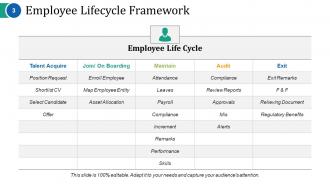
Slide 3: This slide showcases Employee Lifecycle Framework in a tabular form.
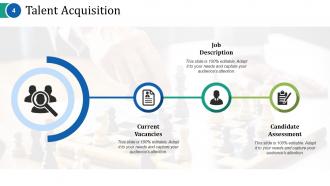
Slide 4: This slide shows Talent Acquisition with respect to- Current Vacancies, Job Description, Candidate Assessment.
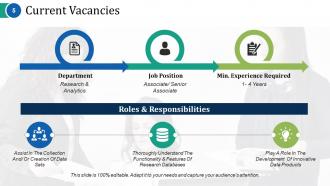
Slide 5: This is Current Vacancies slide with icons and arrow imagery. It shows- Department, Job Position, Min. Experience Required, It also shows the Roles and Responsibilities.
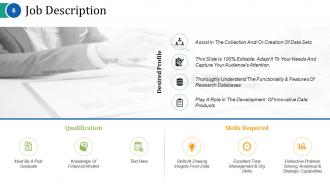
Slide 6: This is Job Description slide with- Qualification, Skills Required, Desied Profile.
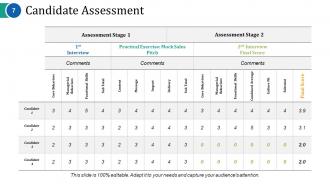
Slide 7: This is Candidate Assessment slide.
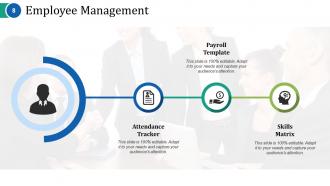
Slide 8: This slide shows Employee Management with- Attendance Tracker, Payroll Template, Skills Matrix.
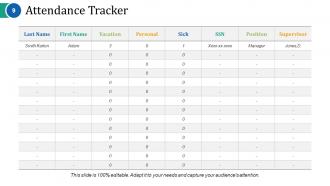
Slide 9: This slide showcases Attendance Tracker in a tabular form.
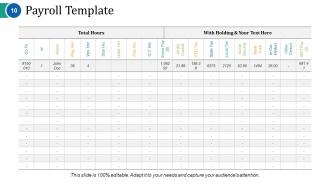
Slide 10: This slide presents the Payroll Template.
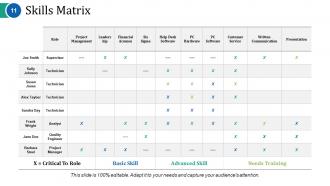
Slide 11: This is Skills Matrix slide. Present your skills here in a matrix form.
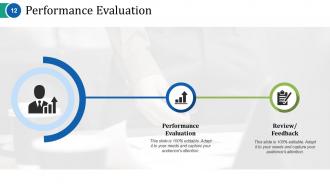
Slide 12: This is Performance Evaluation slide showing- Review/ Feedback, Performance Evaluation.
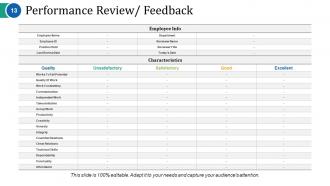
Slide 13: This is Performance Review/ Feedback slide. State Employee Info and Characterstics here.
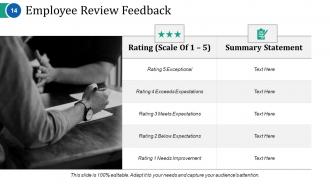
Slide 14: This slide presenst Employee Review Feedback.
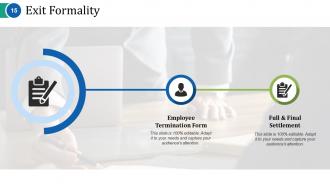
Slide 15: This slide shows Exit Formality with- Employee Termination Form, Full & Final Settlement.
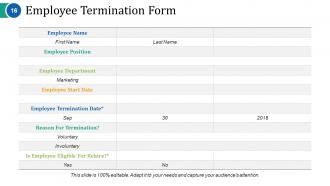
Slide 16: This slide displays Employee Termination Form with details.
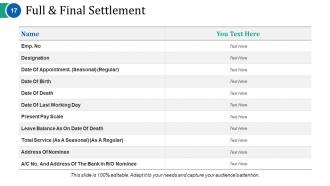
Slide 17: This slide shows Full & Final Settlement in a tabular form.
Slide 18: This is HR Model Icons Slide. Use/ alter the icons as per your business requirement.
Slide 19: This slide is titled Additional Slides to move forward. You can change the slide content as per need.
Slide 20: This slide is a Coffee Break image for a halt. You can change/ alter image on the basis of your requirement.
Slide 21: This is Vision & Mission slide. State mission, vision etc. here.
Slide 22: This slide showcases Our Main Team with name and designation.
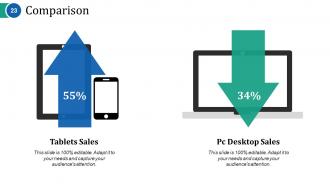
Slide 23: This is a Comparison slide to compare two products/ entities etc.
Slide 24: This is an About Us slide showing Our Company, Value Client, and Premium services as examples.
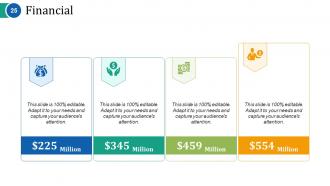
Slide 25: This is a Financial Score slide to show financial aspects here.
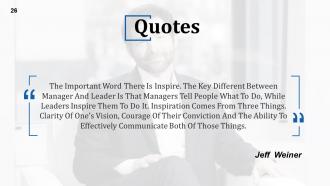
Slide 26: This is a Quotes slide to convey message, beliefs etc.
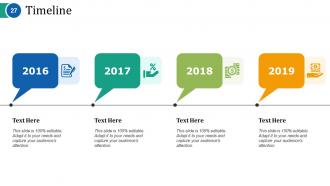
Slide 27: This slide presents a Timeline to show growth, milestones etc.
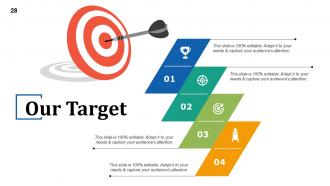
Slide 28: This is Our Target slide with imagery. State your targets, goals etc. here.
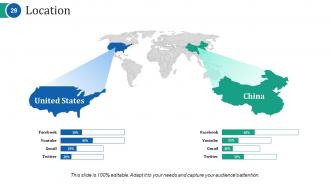
Slide 29: This is a Location slide on a World map image to show global presence, growth etc.
Slide 30: This is a Puzzle slide with creative imagery to show information, specifications etc.
Slide 31: This is a Venn diagram slide to show information etc.
Slide 32: This is a LEGO slide with text boxes to show information, specifications etc.
Slide 33: This is Silhouttes slide to state people specific information etc.
Slide 34: This is a Mind map image slide to show information, specifications etc.
Slide 35: This is an Idea or Bulb image slide to show information, innovative aspects etc.
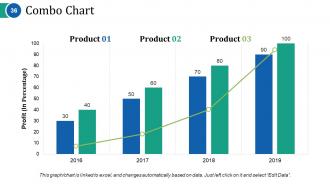
Slide 36: This is a Combo Chart to present product/entity comparison, specifications etc.
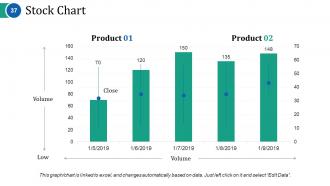
Slide 37: This slide showcases a Stock Chart to present product/entity comparison, specifications etc.
Slide 38: This is a Thank You slide with Address# street number, city, state, Contact Numbers, Email Address.
Hr Model Powerpoint Presentation Slides with all 38 slides:
Highlight the contribution of important elements with our Hr Model Powerpoint Presentation Slides. Identify the integral elements.

FAQs for Hr Model
Honestly, you need the basics first - talent acquisition, performance management, learning stuff, and keeping people engaged. Cover the whole employee journey, you know? HR analytics are huge too because numbers don't lie like our hunches do. Obviously compensation and benefits matter, plus culture and diversity work. But here's what I've noticed - the companies killing it focus on what employees actually want instead of just following some rigid process playbook. I'd start by figuring out what you're already doing right versus what you're just doing to say you did it.
Okay so here's the thing - your HR stuff has to actually match what the business wants to do. Growth mode? Go hard on recruiting and keeping people around. Cutting costs? Focus on making things more efficient. Most HR teams honestly just do their own thing and then get confused when executives don't care about their initiatives. It's kinda obvious when you think about it. Talk to your business leaders first. Figure out their top priorities - like maybe 3 to 5 things they're really focused on. Then rebuild your whole HR plan around those goals instead.
Dude, HR tech has completely exploded lately. AI tools now screen resumes automatically, and there's software that can actually predict which employees might quit. Most companies use HRIS platforms for payroll and benefits stuff, plus chatbots handle basic questions around the clock. Learning management systems are huge for training too. Oh, and those employee engagement apps that constantly survey people about their feelings? Those are everywhere now - though honestly some feel a bit much. The trick isn't grabbing every new shiny tool. Focus on what'll actually fix your real problems first.
Your company culture is basically the blueprint for everything HR does. Hierarchical places? They'll have tons of approval layers and rigid policies. Startups usually go the opposite way - loose and fast, though honestly that sometimes comes back to haunt them later. Team-focused cultures do group performance reviews and let people bounce between departments. Competitive environments are all about individual numbers and rankings. The trick is matching your HR stuff to what your culture actually rewards. Otherwise you're just fighting yourself, which is exhausting for everyone.
So you'll need both people stuff and business impact numbers to really see what's working. Employee retention, how long it takes to fill roles, satisfaction surveys - that kind of thing. Then track revenue per employee and productivity too. Honestly though, it totally depends what you're actually trying to fix. Scaling issues? Retention problems? Pick like 3-4 metrics that match your biggest headaches and stick with those. I'd probably start with retention since that's usually where the money bleeds out first, but you know your situation better than I do.
Honestly, just weave D&I straight into your existing HR processes instead of treating it as some separate thing. Build diverse sourcing and bias training right into hiring. Do the same for performance reviews and promotions - make it automatic. Way better than crossing your fingers that managers will remember to be inclusive (spoiler: they won't). Track metrics at every step so you can spot problems early. The whole point is making it systematic rather than relying on good vibes. It actually works when it's built into the foundation instead of slapped on top.
Honestly, getting people to actually use the new system is the hardest part. Everyone says they want change until it messes with their daily routine - then suddenly they're "too busy" to learn it. Leadership buy-in is huge too, because without it you're basically screwed from day one. Data migration always takes twice as long as planned (learned that the hard way), and training? Forget whatever timeline you had in mind. Oh, and if you don't explain the "why" really well, people will find creative ways to work around your shiny new process. Start small with a pilot group and celebrate the early wins loudly.
Look, feedback is literally your cheat sheet for fixing whatever's busted in HR. Run surveys, do exit interviews, just chat with people - you'll start seeing patterns everywhere. Like when everyone keeps griping about the same terrible performance review process or new people getting lost trying to figure out benefits (seriously, why is benefits enrollment always so confusing?). The trick isn't collecting feedback though. It's actually doing something with it. Pick one thing that comes up over and over, then rebuild that whole piece around what people told you they need. Don't just gather input to check a box.
Look, your HR setup basically controls whether people give a damn about their jobs or not. It touches everything - hiring, promotions, pay, feedback, the whole nine yards. Good HR creates clear paths forward and fair systems that actually make sense. Bad HR? People mentally check out faster than you'd think. I've watched companies with garbage HR practices scratch their heads wondering why morale sucks. The trick is figuring out what your people actually want, not just copying what sounds impressive. Take a hard look at your current stuff - is it motivating people or slowly crushing their souls?
Honestly, it depends what you're measuring efficiency against. Centralized HR rocks for stuff like payroll and compliance - way more consistent and uses fewer people. Decentralized works better locally though. Those HR folks actually know what each department needs, so they don't have to ask permission for every little thing. I always think of it like... centralized is this smooth machine, but decentralized is more like having a bunch of quick boats that can pivot fast. Company size matters a ton here. How different are your teams from each other? That'll tell you which way to go.
Honestly, three big things are changing everything: AI doing the grunt work, hybrid setups being the new normal, and companies finally caring more about skills than fancy degrees. Most places I know are already using bots for first-round interviews - saves so much time. What's wild is how employee experience is suddenly getting the same attention as customer stuff. HR departments are going crazy with feedback tools and personalized learning paths. Oh, and internal mobility is massive now. People want to grow within companies instead of job-hopping constantly. You should probably look at what you're already doing versus what you're missing.
So basically, HR models help you stop panicking every time someone good leaves. You can actually plan ahead - map out who's ready for what role, figure out skill gaps before they bite you. Instead of scrambling when your best person quits (ugh, the worst), you'll have people in the pipeline already. Start by looking at what talent you've got now and which positions absolutely can't be empty. Then build development programs around your high-potential folks. Honestly, it beats the whole "promote whoever's left standing" approach most places use. Career pathing becomes way less of a guessing game too.
Honestly, remote work flips HR on its head. Forget about those casual coffee machine chats - you're building culture through screens now. The upside? You can hire talent from anywhere. Downside? Onboarding gets weird when everyone's in different time zones. Performance reviews need a complete overhaul since you can't just pop by someone's desk. Communication strategies have to be way more intentional. Oh, and don't get me started on compliance issues when your team spans multiple states. My advice? Look at what you're doing now and figure out what actually needs people in the same room. Spoiler: it's less than you think.
Honestly, you've gotta bake flexibility into your HR setup from day one. Make job roles that can stretch and shift when business changes - and cross-train people so they're not stuck in one box. Rigid hierarchies are the worst, I've watched companies completely freeze up because they can't adapt fast enough. Remote work policies, performance reviews, pay structures - all of it needs room to evolve. Oh, and set up regular check-ins with both employees and leadership to catch changes early. Start by looking at your current processes. What's creating the biggest slowdowns when you try to pivot?
Honestly, start by telling people WHY you're doing this - nobody likes surprises at work. Get your managers on board early since they'll be the ones selling it to their teams. I'd definitely test it with a small group first because trust me, you'll find problems you never saw coming. The training part is huge - don't skimp on support during the switch. Oh, and whatever timeline you think it'll take? Add like 30% more time lol. Set up regular feedback sessions too. Your original plan will probably need tweaks once reality hits.
No Reviews