Human Resource Team Performance Evaluation Matrix
Try Before you Buy Download Free Sample Product
Audience
Editable
of Time
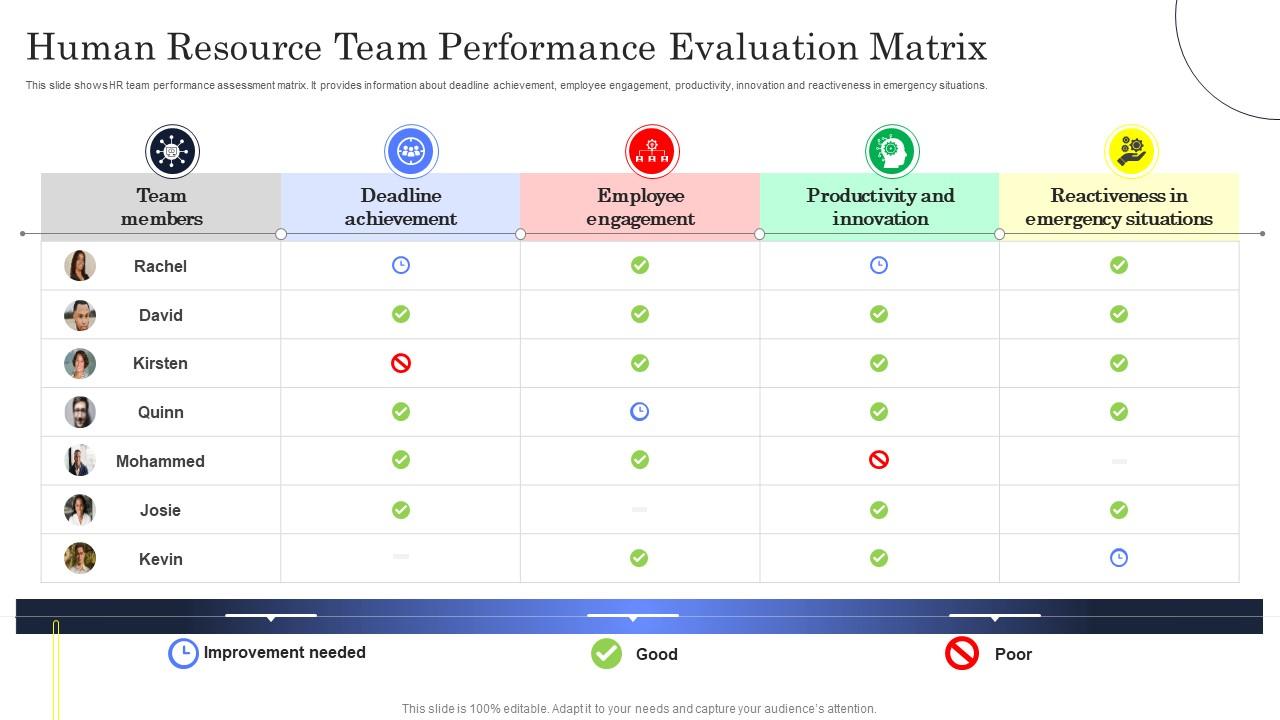
This slide shows HR team performance assessment matrix. It provides information about deadline achievement, employee engagement, productivity, innovation and reactiveness in emergency situations.
People who downloaded this PowerPoint presentation also viewed the following :
Human Resource Team Performance Evaluation Matrix with all 6 slides:
Use our Human Resource Team Performance Evaluation Matrix to effectively help you save your valuable time. They are readymade to fit into any presentation structure.
FAQs for Human Resource Team
Key metrics should include goal achievement, quality of work, communication skills, teamwork collaboration, problem-solving abilities, and professional development progress. These comprehensive indicators enable managers to assess both quantitative results and qualitative behaviors, with many organizations finding that combining productivity measures with soft skills evaluation delivers more balanced employee assessments and strategic talent development outcomes.
A performance evaluation matrix identifies skill gaps by systematically mapping individual competencies against required role standards, benchmarks, and organizational expectations across multiple performance dimensions. This structured assessment enables managers to pinpoint specific development areas, create targeted training programs, and strategically allocate resources, with many organizations finding that regular matrix-based evaluations enhance team capabilities and competitive advantage.
Feedback serves as the foundation for creating accurate performance criteria, calibrating rating scales, and ensuring evaluation relevance across different roles and departments. Through continuous feedback loops, organizations refine their matrix parameters, address scoring inconsistencies, and enhance manager-employee alignment, with many companies finding that regular feedback integration ultimately delivers more objective assessments and stronger performance outcomes.
Organizations can tailor their performance evaluation matrix by customizing metrics, weighting criteria differently, and incorporating department-specific KPIs that align with unique operational goals. Through flexible frameworks, companies enable HR to focus on employee development, sales teams on revenue targets, and IT departments on system reliability, while maintaining consistent evaluation standards that ultimately deliver comprehensive performance insights and strategic workforce optimization.
Common pitfalls include unclear criteria definitions, subjective rating scales, insufficient employee input, overlooking individual role differences, and focusing solely on quantitative metrics while ignoring qualitative contributions. These design flaws create inconsistent evaluations across departments, with many organizations finding that overly complex matrices reduce manager adoption rates, ultimately undermining employee development and strategic talent management initiatives.
Technology enhances performance evaluation matrix effectiveness by automating data collection, providing real-time analytics, and enabling continuous feedback loops through integrated dashboards and AI-powered insights. Through cloud-based platforms and mobile applications, organizations streamline assessment processes, reduce bias with objective metrics, and deliver immediate performance insights, ultimately enabling managers to make data-driven decisions and improve employee development outcomes.
Aligning performance evaluation matrices with organizational goals and values ensures employee efforts directly contribute to strategic objectives, creates consistency in measuring success across departments, and reinforces desired behaviors and cultural standards. This strategic alignment enables organizations to drive focused performance, improve resource allocation, and accelerate goal achievement, with many companies finding that aligned evaluations significantly enhance overall organizational effectiveness and employee engagement.
A performance evaluation matrix fosters continuous improvement by establishing clear benchmarks, identifying skill gaps, tracking progress over time, and creating structured feedback loops that guide professional development. Through systematic assessment criteria, organizations can highlight growth opportunities, recognize achievements, and align individual goals with strategic objectives, with many companies finding that regular matrix-based evaluations drive employee engagement while ultimately delivering enhanced performance and competitive advantage.
Managers can ensure fairness by establishing clear, measurable criteria, using multiple evaluation sources, providing regular feedback throughout review periods, and implementing standardized scoring rubrics across all employees. These strategies minimize bias while enhancing transparency, with many organizations finding that combining self-assessments, peer reviews, and objective metrics delivers more accurate evaluations, ultimately strengthening employee trust and organizational credibility.
A performance evaluation matrix should be reviewed quarterly and comprehensively updated annually to maintain relevance, with additional adjustments following organizational changes, role evolution, or strategic shifts. Regular reviews enable organizations to align performance metrics with current business objectives, incorporate employee feedback, and adapt to market conditions, ultimately delivering more accurate assessments and enhanced employee development outcomes.
Performance evaluation matrix tools include BambooHR, Workday, 15Five, Lattice, and Culture Amp, along with customizable spreadsheet templates and specialized HR platforms. These solutions streamline the evaluation process by automating data collection, enabling real-time feedback tracking, and generating comprehensive performance analytics, with many organizations finding that integrated platforms significantly reduce administrative overhead while enhancing employee development insights.
A performance evaluation matrix supports succession planning by identifying high-potential employees through consistent competency assessments, skill gap analysis, and leadership readiness indicators. These systematic evaluations enable organizations to create targeted development pathways, accelerate internal promotions, and build robust talent pipelines, with many companies finding that structured matrices reduce external hiring costs while enhancing employee retention.
Cross-departmental collaboration significantly enhances performance evaluation matrix effectiveness by ensuring comprehensive perspective integration, reducing evaluation biases, and aligning assessment criteria with organizational objectives. When departments collaborate on performance frameworks, companies achieve more accurate employee assessments, streamlined feedback processes, and enhanced strategic alignment, with many organizations finding that collaborative evaluation approaches ultimately deliver improved talent development and stronger cross-functional working relationships.
**INPUT**: What methods can be used to train employees on the performance evaluation matrix to ensure clarity and buy-in? **OUTPUT**: Training methods include interactive workshops, role-playing exercises, case study analysis, peer-to-peer sessions, and digital learning modules that demonstrate real evaluation scenarios. These approaches enhance understanding by providing hands-on practice, addressing common concerns, and showcasing success stories from similar organizations, ultimately delivering greater transparency and employee engagement across the performance management process.
Organizations can measure performance evaluation matrix impact through productivity metrics like output per employee, quality scores, project completion rates, and revenue per team member. These measurements enable tracking correlations between evaluation insights and operational efficiency, with many companies finding that structured matrix-based assessments streamline goal alignment, enhance resource allocation, and ultimately deliver measurable improvements in workforce productivity and competitive advantage.
-
The designs are super attractive. Me and my team love using SlideTeam’s presentations.
-
The designs are very attractive and easy to edit. Looking forward to downloading more of your PowerPoint Presentations.