


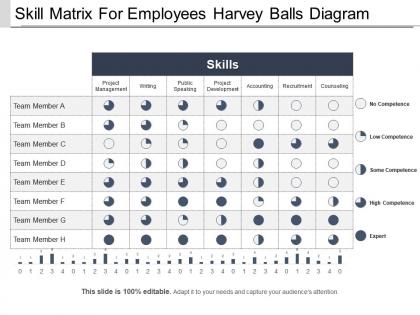
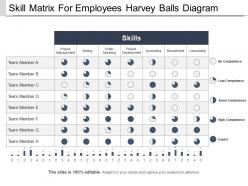
Skill matrix for employees harvey balls diagram ppt background
You must be logged in to download this presentation.




Try Before you Buy Download Free Sample Product
 Impress Your
 Audience
 100%
100% Editable
 Save Hours
 of Time


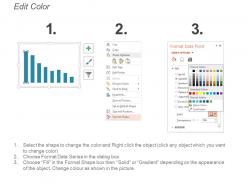
Compare your employees' competencies using Skill Matrix for employees Harvey Balls Diagram PPT Background. Competency is the integrated knowledge, skills, judgment, and attributes that people need to perform a job effectively. Measure the performance of each team member on a given attribute using Harvey Balls PowerPoint table. Encourage your team members to work more effectively and achieve their potential. Identify skill and competency gaps more efficiently using this employee skill matrix PPT chart. Motivate them to assess and link personal performance with corporate goals and values. Collect and combine competency information in this skill matrix PPT diagram to create a standardized approach to performance that's clear and accessible to everyone in the company. Use this Harvey Balls in Excel to make the skill management process easy and effective. Convey qualitative information in an easy to understand yet visually appealing form. Impress your audience with an engaging PowerPoint presentation made in less time.
People who downloaded this PowerPoint presentation also viewed the following :
Skill matrix for employees harvey balls diagram ppt background with all 5 slides:
Handle any inspection with our Skill Matrix For Employees Harvey Balls Diagram Ppt Background. Impress the bosses with your efficiency.
FAQs for Skill matrix for employees harvey balls
Okay so you'll want four main things. Start by listing out all the skills your team needs - technical stuff plus soft skills. Define what beginner through expert actually means so there's no confusion. Have everyone rate themselves, but fair warning - some people are way too humble while others think they're coding gods when they can barely write a function! Map out what skill level each role should have so you can see the gaps. Oh, and update it every few months or it becomes totally useless. That's when you can figure out who needs training or if you need to hire someone new.
So a skill matrix is basically your cheat sheet for figuring out team strengths and weaknesses. Map out like 5-6 core skills per role, then rate where everyone stands. Honestly, it's pretty eye-opening - you'll spot gaps you didn't even know existed. Instead of throwing random training at people, you can actually target what they need. Your team will dig it too since they can see exactly what skills get them promoted. I started doing this last year and it's been a game-changer for development planning.
So a skill matrix is basically your cheat sheet for hiring - shows exactly what gaps you need to fill. Map out what your current team can do vs what projects actually need. Honestly, it's weirdly satisfying once you see it all laid out like that. Job descriptions become way more targeted instead of just listing random requirements. You might even discover someone internal who's ready to step up before posting externally. Oh, and definitely start by figuring out what skills your current people actually have first - that's the foundation for everything else.
Honestly, just make a simple grid - team members down one side, skills you need across the top. Rate everyone's abilities and boom, the gaps become super obvious. I did this last year and was shocked at how many holes we had that I hadn't noticed. Focus on your most critical skills first though, don't go crazy trying to map everything. Once you see the weak spots, you can figure out if it's worth training people up, hiring someone new, or just shuffling responsibilities around. The visual layout really makes it click.
Keep it simple - focus on skills that actually matter for your team's day-to-day work. Define clear levels like beginner/intermediate/advanced so people aren't left wondering where they fit. Cover both technical stuff and soft skills, but honestly? Don't go crazy with categories or you'll hate updating it later. Make it visual so you can scan it quickly. The key thing is using it for real decisions - project assignments, who needs training, that kind of stuff. I've seen too many teams create these fancy matrices that just collect digital dust. Update it regularly or it's pointless.
Honestly, a skill matrix is a game changer - you'll finally know who can actually do what instead of just assuming Dave knows JavaScript because he mentioned it once. No more overloading one person while others sit around twiddling their thumbs. You can spot gaps early, balance workloads properly, and make hiring decisions that actually make sense. Plus it's super helpful for planning training. Way better than playing favorites or going with your gut. Just start with like 5-10 key skills your team needs right now and build from there.
Skill matrices are honestly game-changers for reviews. Instead of that useless "needs improvement" feedback, you get actual data on where people stand with specific skills. Way better than those awful generic forms we used to do! Employees can see their exact gaps and what to work on next. The conversations become so much less awkward too - probably because everyone knows what they're talking about. You can track progress over months and set real goals instead of just pointing out what's wrong. People stay way more engaged when they actually see their growth path mapped out.
Honestly, quarterly is the bare minimum but you'll want to update it whenever big stuff happens - new people, someone leaves, training gets finished. Monthly works better if your team moves fast or you're in crunch mode. Don't do it annually though, that's a nightmare and everyone will hate it. The trick is keeping it simple - like a 15-minute calendar reminder where you just check what actually changed. I used to overthink this whole thing, but really it's just about not letting the data get stale. Make it routine instead of some formal process nobody wants to deal with.
Honestly, the self-assessment part is brutal - people either think they're total beginners or coding gods, rarely anything in between. Keeping it updated is another nightmare since skills change constantly. Most teams build these things and then... nobody uses them. Managers love turning them into performance review ammo too, which defeats the whole point. I'd say start with just one team first, get them actually invested in it. Oh, and you'll definitely need someone responsible for regular updates or it'll be outdated within months. Defining skill levels consistently across different teams is trickier than you'd think too.
Yeah, definitely customize them for each department. Sales teams need negotiation and CRM stuff, while IT guys care more about programming languages and system architecture. HR's totally different - they need conflict resolution and compliance knowledge. Start by looking at your best performers and figure out what actually makes them good at their jobs. That's way better than some generic template. Oh, and don't make every skill use the same rating scale - technical stuff might need 5 levels but soft skills could just be 3. Really depends on what you're measuring.
Honestly? Just start with Excel or Google Sheets - they're cheap and you probably already know how to use them. If you want something fancier later, check out Skills Base or AG5 since they're made specifically for this stuff. BambooHR and Workday have skill tracking too if you're using those already. I've seen companies do surprisingly well with basic spreadsheets for way longer than you'd think. Don't overthink it at first - you can always upgrade when your team gets bigger and you need better reporting.
Honestly, skill matrices are game-changers for teams. They make everyone's abilities super visible, which weirdly motivates people to improve once they see gaps. Your team starts finding mentors internally instead of looking outside. Development becomes way less random too - people follow actual paths rather than just hoping for the best. Managers love them because they can finally give targeted training that makes sense. Oh, and people get oddly competitive tracking their progress! Start small though - maybe 5-6 core skills max. You'll just overwhelm everyone if you go crazy with it initially.
Honestly, the skill matrix data is pretty useful once you dig into it. Check your skill coverage ratios first - they'll show you any obvious gaps. Then look at competency distribution to see where teams are over or under-skilled. Succession readiness scores are huge too, especially if someone leaves unexpectedly. My favorite metric though? Development velocity - basically how fast people are actually learning new stuff. Also worth identifying those single points of failure where only one person knows something critical (always sketchy). The real win is comparing what you have now against what you actually need. Run a gap analysis on your top 3 priorities and you'll know exactly where to focus.
Honestly, skill matrices are game-changers for succession planning. Map out what skills each leadership role actually needs, then see how your current team stacks up against those requirements. You'll instantly spot who's ready for promotion and who needs more development time. Plus - and this part's crucial - you'll catch those dangerous situations where only one person knows something critical. I've seen companies get burned by that before. The whole thing becomes your talent pipeline roadmap. Short version: it shows you exactly where your knowledge gaps are and who can fill future leadership spots.
Honestly, the trick is keeping it updated as you actually learn stuff - not just when HR bugs you about it once a year. I'd jump into those team planning meetings and help spot where we're missing skills. That's when it gets useful instead of just... existing somewhere in a folder. Mentor people where you're solid, but also hunt down training or cross-team projects for your weak spots. The matrix should feel like it's actually guiding what you do next, you know? Make it work for you instead of the other way around.
-
Much better than the original! Thanks for the quick turnaround.
-
Designs have enough space to add content.