


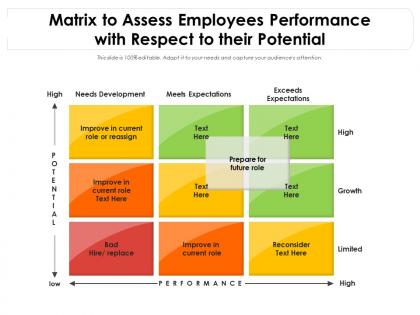
Matrix to assess employees performance with respect to their potential




Try Before you Buy Download Free Sample Product
 Impress Your
 Audience
 100%
100% Editable
 Save Hours
 of Time


Our Matrix To Assess Employees Performance With Respect To Their Potential are topically designed to provide an attractive backdrop to any subject. Use them to look like a presentation pro.
People who downloaded this PowerPoint presentation also viewed the following :
Matrix to assess employees performance with respect to their potential with all 2 slides:
Use our Matrix To Assess Employees Performance With Respect To Their Potential to effectively help you save your valuable time. They are readymade to fit into any presentation structure.
FAQs for Matrix to assess employees performance with respect
So basically you take everyone on your team and plot them on this 3x3 grid thing - current performance on one side, future potential on the other. Creates this visual map of who's crushing it, who's solid, and who might need help or a role change. Honestly sounds more complicated than it actually is. Once you've got everyone placed (and be real about the ratings), you can spot your succession planning gaps way easier. Perfect for those awkward development convos too. I mean, it beats just guessing who should get promoted or extra training, right? The 9-box version works great if you want more detail.
So basically you map everyone on two axes - current performance vs future potential. Creates four boxes. Top-right are your stars (high performance, high potential) - obvious picks for succession planning. But honestly? Don't sleep on the top-left quadrant. Those are high-potential people who just aren't performing yet. Maybe they need better coaching or they're in the wrong role entirely. First step is figuring out who lands where, then you can build development plans that actually make sense for each group.
So you've got two things to figure out: how they're doing now versus how far they could go. Current performance is pretty straightforward - check their results, whether they hit goals, quality of work, all that. The potential side is trickier though. I'd look at how fast they pick up new stuff, if they show any leadership qualities, how they handle when things get messy. Don't just go with your gut either - grab some examples and maybe ask people who actually work with them day-to-day. Once you map both out, you'll see where they really land. Makes the whole thing way clearer honestly.
So this Performance Potential Matrix thing is actually pretty smart - you plot people on two axes: how well they're doing now vs. their future leadership potential. Makes it super obvious who your rising stars are versus the solid workers who maybe shouldn't manage people (we all know that type, right?). Way better than promoting whoever's been there forever or just going with your gut. You can see exactly where you'll have gaps when people leave and figure out who needs what kind of development. Honestly wish more companies used this before panicking about succession planning.
Look, you really can't skip feedback when building your Performance Potential Matrix. Get input from managers, peers, maybe direct reports too - basically anyone who actually works with the person. Otherwise you're just making educated guesses, which kinda ruins the whole point. I mean, we all have blind spots, right? The feedback helps you double-check your gut reactions and spot things you missed. Mix formal review stuff with casual observations you've picked up. Trust me, multiple perspectives make these ratings way more solid than going it alone.
Honestly, the biggest thing is framing it right from the start. Don't make it about labeling people - that's where most managers screw up big time. I've watched people absolutely crush someone's confidence by being too direct about the "low potential" stuff. Instead, go with "here's where you stand today and here's how we move forward." Have real conversations about specific behaviors they can see and touch. Show examples, build development plans together - make it feel like you're both figuring it out, not like you're handing down some verdict. Always wrap up with actual steps they can take. Way less awkward that way.
Honestly, the worst mistake is using crappy or biased data when you're plotting people. Don't just rely on performance reviews - those are super subjective anyway. Here's the thing that drives me nuts: companies automatically assume their top performers have high potential. Wrong! Being great at your current job doesn't mean you'll be a good leader. You need to actually look at leadership skills, how they handle change, growth mindset - that stuff matters way more than just crushing their numbers. Oh, and define what "potential" even means at your company first. Otherwise you're just guessing.
Honestly, tech is a game-changer for this stuff. HR analytics platforms can automatically pull all your performance data, feedback scores, and assessments - way better than chasing down a million spreadsheets from different departments. AI tools are pretty good at spotting patterns you'd probably miss, and the visualization software makes everything so much cleaner when you're presenting to managers. Real-time updates through your HRIS beat those outdated quarterly snapshots any day. I'd start by figuring out which data sources you can connect first - that's where you'll save the most time upfront.
Look at their current numbers first - goals hit, quality of work, productivity stuff. The tricky part? Figuring out future potential. Most managers honestly suck at this. Watch how they learn new things, adapt when stuff changes, show leadership qualities. Their skill growth over time tells you a lot. Skip just doing annual reviews - get 360 feedback, see what peers think, throw them challenging projects. Oh and definitely make some kind of scoring system so you're not just winging it based on feelings when you map everyone out.
Honestly, I'd do it twice a year if possible - once a year feels too slow. People's performance can shift pretty dramatically in just a few months, you know? Like someone bombs a major project or suddenly becomes your star player. Your business priorities change too, so what mattered in January might be totally different by summer. I always sync mine with performance reviews so it doesn't become this separate headache. The whole point is keeping it fresh enough that you're not making talent decisions based on how someone was doing ages ago.
So basically, traditional appraisals just look at what someone did last year - like a report card. The matrix thing is way smarter because it considers current performance AND future potential. You'll spot people differently this way. Maybe someone's crushing it now but has hit their ceiling, versus someone who's decent but could really grow. Makes succession planning so much easier. Honestly, I'd just grab a whiteboard and plot your whole team on both axes. You might discover some people you totally overlooked for bigger roles. We did this last quarter and found three sleepers.
Honestly, you've gotta bake this stuff right into your calibration process from the start. Train your managers on inclusive evaluation before the next review cycle - and I mean really train them, not just some HR slideshow. Mix up your review panels so you're getting different perspectives when evaluating people. Here's the thing that bugs me: bias always sneaks into those "potential" assessments, so question that hard. Also worth checking your performance data by demographic groups to catch any weird patterns. Don't make D&I some annual thing you check off. Build it into your regular process.
You'll need training on performance assessment and evaluation techniques first - that's the foundation. Calibration sessions are huge too, where managers practice rating people together. Honestly, everyone thinks they're unbiased until they see how differently they rate compared to others lol. Get familiar with whatever competency frameworks your company uses for measuring potential. Internal guides on your review process will help, plus any behavioral interviewing training they offer. But honestly? Shadow an experienced manager during their matrix reviews. You'll pick up more in one real session than reading manuals for hours.
Honestly, it's like having a cheat sheet for every person on your team. You'll spot your rising stars who are ready for bigger challenges right away. Then there are the solid workers who just need some extra training to level up. Some people might need that awkward "let's talk about your future here" conversation - which nobody loves but whatever. The visual part is what really gets you - seeing everyone mapped out makes patterns super obvious. Don't blow your training budget on someone who's mentally already out the door. Focus on the high-potential folks instead. It gives you actual talking points for those development meetings too, which is nice since those can feel pretty forced otherwise.
Honestly, these matrices work because people finally know where they stand instead of guessing. Your team gets clarity on their development path - no more career limbo (which is the worst). Higher engagement happens when employees see you're being transparent about their potential. The trick is treating it like a growth tool, not just another evaluation thing. Regular check-ins about moving within the matrix help tons. Oh, and create specific action plans for each quadrant - that's where the real magic happens. People actually feel valued when they can see a clear path forward.
-
I discovered this website through a google search, the services matched my needs perfectly and the pricing was very reasonable. I was thrilled with the product and the customer service. I will definitely use their slides again for my presentations and recommend them to other colleagues.
-
Excellent design and quick turnaround.
-
Qualitative and comprehensive slides.
-
Commendable slides with attractive designs. Extremely pleased with the fact that they are easy to modify. Great work!