

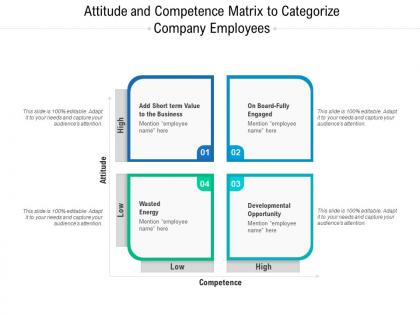
Attitude and competence matrix to categorize company employees




Try Before you Buy Download Free Sample Product
 Impress Your
 Audience
 100%
100% Editable
 Save Hours
 of Time


Our Attitude And Competence Matrix To Categorize Company Employees are topically designed to provide an attractive backdrop to any subject. Use them to look like a presentation pro.
People who downloaded this PowerPoint presentation also viewed the following :
Attitude and competence matrix to categorize company employees with all 2 slides:
Use our Attitude And Competence Matrix To Categorize Company Employees to effectively help you save your valuable time. They are readymade to fit into any presentation structure.
FAQs for Attitude and competence matrix to
The Attitude-Competence Matrix is a strategic employee assessment tool that categorizes team members based on their skill levels and workplace attitudes, creating four distinct quadrants for targeted management approaches. Organizations apply this framework to optimize talent management by identifying high-performers for leadership development, coaching employees with skills gaps, addressing attitude issues, and making informed decisions about resource allocation, ultimately enhancing team productivity and organizational effectiveness.
Managers can utilize the Attitude-Competence Matrix by plotting each team member across competence and attitude dimensions to identify targeted development strategies, skills gaps, and motivational challenges. Through this strategic assessment, organizations streamline resource allocation for training programs, mentoring initiatives, and performance coaching, with many companies finding that this systematic approach enhances employee engagement and accelerates career progression.
Categorizing team members using the Attitude-Competence Matrix delivers targeted development strategies, improved resource allocation, enhanced team dynamics, and strategic succession planning. This framework enables managers to identify high performers, guide struggling employees, and optimize project assignments, with many organizations finding that it streamlines performance reviews while ultimately enhancing overall team productivity and engagement.
The Attitude-Competence Matrix helps align team goals with individual capabilities by mapping each team member's skill level against their motivation and engagement, enabling managers to assign roles strategically, identify development opportunities, and optimize task distribution. This framework streamlines project planning by matching high-stakes responsibilities with high-attitude, high-competence individuals while providing targeted support pathways for others, ultimately delivering enhanced team performance and goal achievement.
Self-assessment enables employees to evaluate their own skills, knowledge, and workplace behaviors, providing valuable insights that complement managerial evaluations within the Attitude-Competence Matrix. This dual perspective approach enhances accuracy in employee positioning, identifies development gaps more effectively, and fosters greater ownership of professional growth, with many organizations finding that self-aware employees demonstrate higher engagement and faster skill advancement.
The Attitude-Competence Matrix serves as a powerful succession planning tool by systematically evaluating employees across both performance capability and cultural alignment, helping identify high-potential candidates who possess strong competencies and positive attitudes. Organizations use this framework to map talent pools, prioritize leadership development investments, and create targeted growth pathways, with many companies finding that this dual-axis assessment delivers more strategic succession decisions and stronger long-term leadership outcomes.
Employee attitude significantly influences competence by affecting learning receptivity, skill development motivation, and problem-solving persistence, with positive attitudes enhancing knowledge acquisition and application capabilities. Across organizations, employees with constructive attitudes demonstrate accelerated competence growth, stronger collaborative skills, and superior performance outcomes, while negative attitudes often create barriers to skill enhancement and limit professional advancement opportunities.
The Attitude-Competence Matrix enhances workplace culture by identifying employee strengths, addressing skill gaps, and aligning team members with appropriate roles and development opportunities. Through strategic placement of high-attitude individuals in mentoring roles and targeted training for competent but disengaged employees, organizations streamline team dynamics, reduce workplace conflicts, and ultimately foster collaborative environments where both performance and morale improve significantly.
Strategies include comprehensive coaching programs, mentorship pairings, structured skill development training, performance improvement plans, and regular feedback sessions. Through targeted interventions, organizations can address both competence gaps and attitude challenges simultaneously, with many finding that combining technical training with motivational support, clear expectations, and incremental goal-setting ultimately delivers improved employee performance and engagement.
The Attitude-Competence Matrix integrates into performance appraisal systems by providing structured evaluation criteria, standardized scoring frameworks, and clear development pathways for employee assessment. Through systematic rating scales, managers can objectively measure both behavioral attitudes and technical competencies, while identifying specific improvement areas and career advancement opportunities, ultimately delivering more comprehensive performance reviews and strategic talent management across organizations.
Tools that enhance the Attitude-Competence Matrix include performance management software, 360-degree feedback platforms, competency assessment systems, employee engagement surveys, and learning management systems. These technologies streamline evaluation processes by automating data collection, providing real-time insights, and tracking development progress, with many organizations finding that integrated platforms deliver more accurate employee positioning and targeted development strategies, ultimately enhancing talent management decisions.
Leaders can foster positive attitudes by providing regular recognition, creating psychological safety for learning, offering growth opportunities, and maintaining transparent communication about goals and expectations. Through mentoring programs, skill development initiatives, and celebrating both successes and learning from failures, organizations enhance team competencies while building confidence, with many finding that supportive leadership environments ultimately deliver higher performance and employee engagement.
Organizations may encounter resistance from employees who feel judged or categorized, difficulty in objectively measuring attitudes and soft skills, and potential biases in assessment processes. Implementation also requires significant training for managers, clear communication about the matrix's purpose, and ongoing calibration to ensure consistency across departments, with many companies finding that success depends on transparent criteria and regular feedback mechanisms.
Employee training programs can be tailored by identifying each quadrant's specific needs: high-attitude, low-competence employees need skill development, while low-attitude, high-competence workers require motivation and engagement strategies. Organizations across industries like healthcare and finance use this strategic approach to customize learning paths, allocate resources efficiently, and ultimately enhance performance outcomes and retention rates.
Organizations using the Attitude-Competence Matrix have seen significant improvements in team performance, employee retention, and operational efficiency. Companies like Google and Microsoft leverage this framework to identify high-potential employees, strategically reassign underperforming staff, and develop targeted coaching programs, ultimately delivering enhanced productivity, reduced turnover costs, and stronger competitive advantage.
-
It saves your time and decrease your efforts in half.