


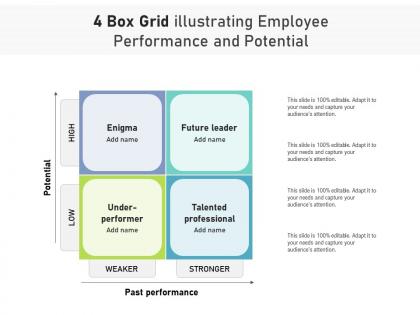
4 box grid illustrating employee performance and potential




Try Before you Buy Download Free Sample Product
 Impress Your
 Audience
 100%
100% Editable
 Save Hours
 of Time


Our 4 Box Grid Illustrating Employee Performance And Potential are topically designed to provide an attractive backdrop to any subject. Use them to look like a presentation pro.
People who downloaded this PowerPoint presentation also viewed the following :
4 box grid illustrating employee performance and potential with all 2 slides:
Use our 4 Box Grid Illustrating Employee Performance And Potential to effectively help you save your valuable time. They are readymade to fit into any presentation structure.

FAQs for 4 box grid illustrating employee
You need clear performance criteria and measurable goals - that's your foundation. Include both hard numbers (sales, project completion) and soft skills like communication. Most companies make this way too complicated honestly. Keep it simple but cover your bases. Build in space for employee self-assessment plus manager feedback. Should align with company values and what each role actually requires. I'd start with maybe 4-6 core areas, then work out the specific criteria from there. Oh, and make sure your rating scale isn't confusing - I've seen some real disasters there.
So basically you want to swap out the standard metrics for stuff that actually matters in your field. Tech companies should focus on innovation and technical chops. Retail? Customer service and hitting sales numbers. Healthcare needs patient care quality - you get the idea. Pick 4-6 things that really drive success, then figure out what "crushing it" vs "needs work" looks like for each. Oh, and definitely talk to your best people first. They'll tell you what actually separates good from great performers way better than any generic template will.
Focus on stuff that actually moves the needle - goal hitting, work quality, how well they play with others, and whether they're growing their skills. Revenue impact is clutch if it's relevant to what they do. Skip the wishy-washy "cultural fit" garbage since that's just asking for bias issues. Mix hard numbers (sales figures, project timelines) with softer stuff like peer reviews and how they tackle problems. Each metric needs to tie back to what winning looks like in their specific job. Honestly, I'd start with maybe 4-6 metrics tops. You can always pile on more once you've got the basics down.
I love using performance matrices because you can actually see where everyone's at instead of guessing. Makes goal-setting so much easier - like instead of just saying "do better," you're targeting the exact skills that need work. Your one-on-ones become way more productive too. Honestly, updating it regularly is kinda addictive because you get to watch people move up the grid over time. Those visual improvements hit different than just talking about progress. Plus it gives you something concrete to point to during reviews instead of relying on memory.
You definitely need employee feedback for your Performance Matrix - it's like your reality check. Managers can't see everything happening on the ground, so you're basically guessing without it. Get their input on which metrics actually make sense to them and what roadblocks they're hitting daily. They'll spot things you totally missed in your framework. Also ask how they think performance should be measured - sometimes their ideas are way better than what leadership comes up with. Just make sure you're asking early on, not scrambling to get their thoughts at the end when it's too late to change anything meaningful.
Honestly, ditch those ancient spreadsheets - they're the worst. Modern HR tools like BambooHR or 15Five automatically pull all your performance data and create dashboards that don't look like garbage. Real-time goal tracking is a game changer too. You'll get automated review reminders (thank god, because who remembers that stuff?), and spotting team trends becomes super easy. Everything updates itself, so no more copying data around like some kind of digital caveman. Worth checking if they'll play nice with whatever systems you're already using.
Honestly, the worst thing you can do is overcomplicate it right off the bat. Like, I've watched companies build these crazy elaborate systems that just sit there collecting digital dust because nobody gets it. Keep it simple - maybe 3-4 clear performance areas max. Don't skip training your managers either, because inconsistent scoring will torch your credibility so fast. Oh, and resist the urge to copy-paste someone else's framework without tweaking it for your team's vibe. Regular check-ins beat the hell out of those dreaded annual reviews too. Start basic and add complexity later once people actually use the thing.
Don't save the Matrix for the end - use it as your guide for the whole conversation. Show them where they are right now, then back it up with real examples. Honestly, if you've been managing well, this shouldn't be a shock to them. They'll already have a sense of where they stand. Spend most of your time talking through the gap between where they are and where they need to be. Then work together on actual steps to close it. The Matrix becomes this shared language you can both use when talking about their growth going forward.
So engagement is basically what makes people actually move up in your Performance Matrix. High engagement = they'll shift from "potential risk" into better quadrants. I've noticed it's honestly the best way to predict if someone will develop or not. The matrix shows you who needs help - underperformers usually have engagement problems lurking underneath. Your top performers? Yeah, they're almost always your most engaged people too. Spot the red flags early and you can focus your retention efforts where they'll actually matter. Pretty straightforward once you see the pattern.
Quarterly reviews are your best bet - don't be like most companies that set it once and never touch it again. Business priorities change constantly, so your metrics need to keep up. Get your department heads involved since they actually know what's happening day-to-day. Oh, and definitely explain any changes to your team clearly - people work better when they get how their job fits the big picture. Honestly, just set a recurring calendar reminder right now or you'll forget. Trust me on this one.
Oh man, you're gonna want training on assessing performance and plotting people without all your biases getting in the way - most managers are terrible at this part. The actual plotting is pretty straightforward though. What's brutal is the conversations after! Figure out which quadrant you dread managing most and start there. Communication training is huge too since these things are useless if you can't give decent feedback. I'd mess around with some fake employee profiles first to get the hang of it. Each quadrant needs different development approaches, so make sure you actually understand what works for each type of person.
Honestly, the Performance Matrix is a game-changer for getting real clarity on your team. Plot everyone based on their performance and potential - suddenly you can see who's crushing it and ready for promotion, who needs more development, and yeah... who probably isn't working out. Takes all those random thoughts floating in your head about people and turns them into something concrete you can actually discuss with your boss. I've found it way easier than just going on gut feelings all the time. Just map out your current team first and see what jumps out - bet you'll spot some obvious moves right away.
Definitely do one-on-ones for this - don't just email them the results, that's brutal. Go through each category and explain how you got to those ratings. Start with what they're crushing, then move to areas where they can grow. Be specific about behaviors you observed, not just vague feedback. Honestly, the best part is making it a real conversation where they can push back or ask questions. Oh, and tie any weak spots to actual development opportunities they can work on. Way better than just pointing out problems without solutions, you know?
Quarterly updates are the bare minimum, but honestly? Monthly is way better if you can swing it. Just depends how organized your team is. Whenever someone gets promoted or switches roles, update it immediately - don't wait around. Same goes for big new projects. The whole thing becomes useless if it's outdated, which happens faster than you'd think. I'd probably do a quick monthly check, then go deeper every quarter. Set those calendar reminders though, or you'll totally forget. Trust me on that one.
Dude, check out Microsoft's switch from stack ranking to their growth mindset thing - collaboration went way up. Google did Project Oxygen to figure out what makes managers actually good, which helped teams perform better. Adobe dropped annual reviews completely for ongoing check-ins using matrices. That Adobe case is probably your best bet since it sounds closest to what you're doing. Oh and their white paper breaks down the whole rollout process - super useful. Start there honestly.
-
Great experience, I would definitely use your services further.
-
I discovered this website through a google search, the services matched my needs perfectly and the pricing was very reasonable. I was thrilled with the product and the customer service. I will definitely use their slides again for my presentations and recommend them to other colleagues.
-
Great designs, really helpful.