

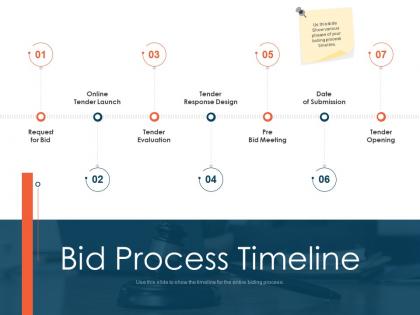
Bid process timeline tender management ppt template




Try Before you Buy Download Free Sample Product
 Impress Your
 Audience
 100%
100% Editable
 Save Hours
 of Time


Our Bid Process Timeline Tender Management Ppt Template are topically designed to provide an attractive backdrop to any subject. Use them to look like a presentation pro.
People who downloaded this PowerPoint presentation also viewed the following :
Bid process timeline tender management ppt template with all 2 slides:
Use our Bid Process Timeline Tender Management Ppt Template to effectively help you save your valuable time. They are readymade to fit into any presentation structure.

FAQs for Bid process timeline tender
Okay so the main phases are pre-bid planning, RFP release, vendor response period, evaluation, then contract award. During planning you really need to nail down requirements and budget - saves so many headaches later. Release your RFP with clear deadlines, give vendors 2-4 weeks to respond (they'll complain if it's less, trust me). Then evaluate everything against your criteria and award the contract. Buffer time is huge because something always drags on longer than you think. Oh and definitely map out your hard deadlines first, then work backwards from there.
Honestly, start with daily check-ins right away - or every other day when things get crazy. I've watched too many proposals crash because teams just disappeared into their own corners for weeks. Make sure everyone knows exactly what they're responsible for upfront. Shared docs are your lifesaver here so people can track progress and shout about problems immediately. Yeah, assign section owners but have others review their work too. Your bid manager needs to actually manage though - like, be the person making decisions. Oh, and finish everything 48 hours early because something always goes wrong at the last minute.
Honestly, PandaDoc or Proposify are game-changers for proposals - way better than wrestling with Word docs all day. They do templates, e-signatures, the whole thing. For keeping your team on track, Monday.com or Asana work great for deadlines and stuff. Oh, and definitely get a decent CRM to track all your client convos and requirements. That part's huge. I'd probably test out free trials of like 2-3 tools first though - see what actually clicks with how you guys work. Some of these platforms are weirdly clunky despite looking polished.
Ugh, the worst mistake is thinking reviews happen fast. Stakeholders will ghost you for days because they're "busy" or whatever. Two-day tasks become week-long nightmares. Don't save all your prep for the end either - that's suicide. Technical stuff breaks. Clients change their minds last minute. Your boss wants three more rounds of edits. Work backwards from your deadline instead of forward. Seriously, double whatever timeline you first think of. Maybe even triple it if you're dealing with multiple approval layers. Buffer time isn't optional, it's survival.
Oh man, that deadline is literally everything - you'll be working backwards from it for the whole project. Map out your timeline right after you decide to bid, seriously. Writing the proposal, getting tech reviews, waiting for legal and finance approvals... it all takes forever. I always add extra buffer time because something always goes sideways (learned that one the hard way). Start at least 6-8 weeks out for anything complex. Also check if key people are going on vacation - that'll mess you up too. Share your timeline with everyone upfront so nobody can claim they didn't know.
Look, stakeholder communication can totally make or break your bidding timeline. Map out who needs what info and when - trust me on this. Last-minute requests for clarifications will absolutely crush your deadlines. I've watched teams completely scramble because they didn't get finance involved early enough for pricing approval (which honestly should be obvious but here we are). Build in buffer time for reviews. Be super clear about response deadlines upfront too. Regular check-ins work way better than crossing your fingers and hoping everyone responds when you need them.
Right after you submit each bid, block out 30 minutes for a team debrief - do this within a week or everyone forgets the messy details. Write down what took way longer than planned, where things got stuck, which approval steps were nightmares. Then pad your timelines for next time based on reality, not wishful thinking. I learned this the hard way after missing deadlines because I kept estimating best-case scenarios. Track it all in a basic spreadsheet so you'll start seeing patterns. Trust me, being honest about how long stuff actually takes will save you so much stress down the road.
Get yourself a spreadsheet or some project management thing to track everything - deadlines, requirements, who's doing what. Trust me, it turns into a nightmare without it. Each bid needs one person in charge, otherwise nobody owns it. Block out chunks of time for this stuff because jumping between proposals will fry your brain. Templates are your friend - company overview, team bios, all that standard stuff you always rewrite. Oh, and always pad your timeline because literally everything takes twice as long as you think. Start by writing down all your current deadlines this week.
So you want to see if your bidding is actually working, right? Win rate's the obvious one - what percentage are you landing? But also track how long each cycle takes and what you're spending per bid (time + money). I'd throw in quality stuff too, like are you at least hitting top 3 when you lose? Oh, and this might sound weird but check how those won projects actually perform later - tells you if you're chasing the right work. My advice? Pick maybe 2-3 metrics that match your biggest headaches and stick with tracking those consistently.
Dude, don't save risk stuff for the end - that's where teams totally lose it. Build checkpoints right into your timeline at 25%, 50%, and 75% completion. Each review should cover technical, commercial, and delivery risks with actual owners assigned to fix things. Honestly, I've watched way too many people pull all-nighters trying to slap together risk analysis at the last minute. Total disaster every time. The whole thing works way better when it's an ongoing conversation throughout development rather than some checklist item. Oh, and block out time slots now before everything gets hectic - you'll thank me later.
Regulatory deadlines will absolutely crush your bid if you mess them up - there's literally no wiggle room. Miss one filing and you're done. I found this out the hard way last year, ugh. The worst part? They create this domino effect where one missed deadline screws up everything else down the line. Honestly, I think half of bid management is just regulatory timeline juggling. Start by mapping every single regulatory checkpoint first. Don't even touch your internal schedule until you know those dates cold, then build everything else around them with tons of buffer time.
Look, you really need other people reading your proposal before it goes out. Get someone technical to double-check if what you're promising actually works, plus someone who knows the business side to make sure your pricing isn't completely off. Honestly, the best reviewer is someone who wasn't knee-deep in writing the thing - they'll spot stuff you can't see anymore. I've watched teams submit proposals that seemed brilliant to them but totally whiffed on what the client wanted. Don't jam this into the last two days either. Plan for two solid review rounds so you can actually fix things.
Honestly, tack on at least 2-4 extra weeks for anything complex. Standard bids? Maybe 4-6 weeks total. But complex ones turn into 8-12 week marathons because suddenly everyone's a technical expert who needs input time. The worst part is stakeholder reviews that just... never end. Then you've got technical evaluations, reference checks, the whole nine yards. I swear there's always that one department that waits until the last minute to ask for "just two more weeks to assess everything properly." Start planning way earlier than you think and build in serious buffer time. Trust me on this one.
Honestly, market chaos totally messes with your bidding schedule. When prices are tanking, speed things up to grab those better rates before they bounce back. Rising costs though? Maybe drag your feet a bit and hope things chill out - risky move but sometimes it works. Supply chain issues are the worst because vendors suddenly need like twice as long to even give you a decent quote. Oh and definitely pad your timeline from day one, especially when everything's all over the place. You'll thank yourself later when things inevitably get weird.
Start with your deadline and work backwards - that's honestly the only way I stay sane during bid season. Build in 2-3 days of buffer time because trust me, something will break at the last second. I just use a basic spreadsheet to track everything with owners and dates. Way less complicated than those fancy PM tools everyone raves about. Weekly team check-ins help catch problems early, and pick someone to be the document wrangler who'll hunt down the procrastinators. Oh, and grab your standard stuff like certs and references the moment you decide to bid, not during crunch time.
-
Innovative and Colorful designs.
-
Presentation Design is very nice, good work with the content as well.
-
Commendable slides with attractive designs. Extremely pleased with the fact that they are easy to modify. Great work!