

Bid Management Powerpoint Presentation Slides




Try Before you Buy Download Free Sample Product
 Impress Your
 Audience
 100%
100% Editable
 Save Hours
 of Time


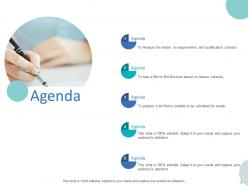
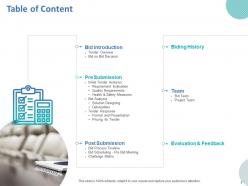
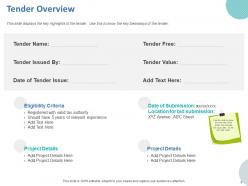
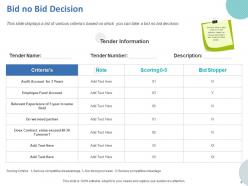
Create an understanding of the proposal management process with the help of this professionally designed Bid Management PowerPoint Presentation Slides. Display the highlights and key takeaways of the tender by using the visually appealing proposal management PPT slideshow. Take advantage of the content ready tender management processes PowerPoint complete deck to list down various criteria based on which you take a bid no-bid decision. The well-researched tender management and analysis PowerPoint presentation contains thirty-four editable slides that help you to represent complete bid solution design based on the requirements. Utilize the ready-to-use tender management PPT slides to evaluate the bid requirements, create solutions and develop strategies. You can also use the topic-specific tendering and bid management PPT graphics to display health and safety measures. Thus, download our ready-to-use proposal process management PowerPoint presentation to demonstrate various phases and their details in the project execution. Foster business alliances with our Bid Management Powerpoint Presentation Slides. Forge bonds that last forever.
People who downloaded this PowerPoint presentation also viewed the following :
Bid Management Powerpoint Presentation Slides with all 34 slides:
Use our Bid Management Powerpoint Presentation Slides to effectively help you save your valuable time. They are readymade to fit into any presentation structure.



FAQs for Bid Management
Start with keyword research and bid optimization - those are your bread and butter. Track your CPC and conversion rates religiously. Budget allocation is where most people mess up though. Don't spread money evenly across everything like you're buttering toast (learned that the hard way). Focus spend on campaigns that actually convert. Automated bidding works great for most stuff, but I'd keep manual control on your top-performing keywords. You'll want to audit what you've got first. Some campaigns are probably just burning cash for no reason.
Dude, automation is a game changer for bid stuff. Start with the boring tasks - proposal formatting, tracking deadlines, compliance checks. Saves you tons of time. AI can analyze competitor pricing too, though honestly I'd take those suggestions with a grain of salt and trust your gut. The collaboration tools are clutch - no more confusion about which version everyone's working on. Real-time updates keep the whole team on the same page. Don't go crazy and change everything at once though. Pick one tool, get comfortable with it, then add more. Way less overwhelming that way.
Win rate's huge - tells you if your bidding actually works or not. Also watch your average CPC, conversion rate, and ROAS so you know you're getting decent traffic that converts. Cost per acquisition matters too because who cares about cheap clicks if nobody buys anything, right? Impression share and quality score are worth tracking since they show how competitive your bids are. I'd check these weekly to start - honestly, there's like a million other metrics but these cover the basics. Then just focus on whichever ones actually matter for what you're trying to do.
Honestly, most people blow it on the basics. Missing deadlines is huge. Wrong file formats will kill you instantly - I've seen great proposals tossed for that alone. Generic copy-paste jobs are terrible too, especially when they don't match what the client actually wants. Oh, and incomplete submissions? That's just lazy. Read every single question, even the tedious compliance ones. Answer all of them. I always make a checklist now because I used to miss stuff constantly. Get someone else to look it over before you submit - you'll be blind to your own mistakes by that point.
Honestly, collaboration is a game-changer for winning bids. You're basically combining everyone's brain power instead of people working alone and missing stuff. Your tech team spots feasibility issues, sales knows what the client really wants, and proposal writers make it all sound good. I've seen so many bids fail because one person missed something obvious that someone else would've caught instantly. Different perspectives are huge - like when someone realizes you're pricing way off or targeting the wrong pain point. Oh, and don't wait until the last second to loop everyone in. Regular check-ins throughout the whole process actually work.
Honestly, data analysis is like having a crystal ball for your bids. Look at your historical win rates and competitor pricing - the patterns will blow your mind. I used to go with gut feeling and wow, that was a mistake. Numbers show you the sweet spot between actually winning jobs and keeping decent profit margins. Past performance tells you which clients are worth chasing too. Oh, and don't sleep on tracking profit margins by project type - some jobs just aren't worth the headache. Start simple: grab your last 20 bids and see what jumps out. You'll probably notice trends you never saw before.
Go after the bids where you've got the best shot at winning AND decent profit margins. Check your track record with similar clients - that'll tell you a lot. I know it's tempting to chase every huge contract, but honestly? You'll burn through resources fast that way. Better to nail 3 out of 5 smart picks than bomb on 8 out of 10 random shots. Set up a basic scoring system - win probability, profit potential, how it fits your strengths. Then actually stick to it when you have to say no to stuff. Trust me, passing on the wrong opportunities is just as important as spotting the right ones.
Here's the thing - you gotta actually listen to their problem first instead of just pitching your usual stuff. Show them you get it by mentioning specific ways you've handled similar situations before. Make your proposal flow logically: what's broken, how you'll fix it, when it'll happen, what they'll get. Don't make it a novel, but give enough detail so they know you're not just winging it. Oh, and mention what could go wrong (there's always something) plus how you'd handle it. Honestly, most people send these cookie-cutter proposals that scream "I didn't even read your brief." End with clear next steps.
Dude, most people totally phone it in on the research part and wonder why they don't win bids. First thing - actually dig into their specific problems, not just what your company does well. Look up their industry headaches, what they're trying to achieve, where past projects went sideways. Then write your proposal like you're talking directly to them about *their* mess, not some random client. Use their actual situation in examples. Show relevant case studies that match their world. Price it realistically for their budget too. Honestly, ditch those cookie-cutter templates - they're so obvious and boring.
Focus on three big things: compliance, confidentiality, and contract terms. Don't miss any procurement deadlines - that'll kill your bid instantly. Keep your mouth shut about bid details until everything's wrapped up. I've literally watched companies torpedo themselves by talking too much. Document everything as you go because you might need proof later. Oh, and double-check any conflict of interest stuff - that's where things get messy fast. Your pricing needs to match what's legally allowed in your area too. Honestly, the paperwork side is almost as important as your actual proposal.
Look, market research is basically your secret weapon for pricing and positioning. You'll want to dig into what competitors are charging and figure out what's actually bugging your potential clients. I always try to spot trends that might mess with my proposal too. Honestly, it does feel like spy work sometimes - maybe I watch too many action movies. The whole point is deciding if you should be aggressive with pricing or play up certain strengths. Sometimes the data tells you to just walk away from a crappy opportunity. Grab at least three similar projects first though.
Honestly, client feedback is like gold for your future bids. You'll learn what actually matters to them - maybe your timeline was too vague or the pricing scared them off. Win or lose, there's always something useful buried in there. Some clients suck at giving feedback (you'll get those one-word responses that tell you nothing), but even that tells you something about working with them. I'd definitely ask for it if they don't volunteer anything. The real trick is spotting patterns after a few bids so you can tweak your approach and stop making the same mistakes.
So basically, bid/no-bid decisions are your sanity saver. You're figuring out if a project actually matches what you can do, your budget, timeline - all that stuff - before you waste time writing proposals. I've watched teams spend literally weeks chasing contracts they had zero chance of getting. Pretty painful to watch, honestly. Look at your competition, what resources you'd need, and be real about your odds. Create some kind of scoring system with your must-haves and stick to it. Don't get distracted by shiny opportunities that'll just drain your energy.
Honestly, you just need everything in one spot - shared drive, project management thing, whatever works. Set up folders that make sense and name stuff consistently so you're not hunting around like crazy. Version control will save your butt when someone almost submits the wrong draft (been there!). Templates are your friend for the boring repetitive sections. Keep a master contact list updated and get someone else to eyeball finals before they go out. Oh, and set reminders for deadlines because time flies. Start by looking at where you're currently losing docs or making duplicates - that'll show you the biggest pain points.
Honestly, bid management software is a game changer - saves you so much time and cuts down on those annoying errors. No more spreadsheet hell or trying to track down the latest version in some endless email thread (I swear, version control is the worst). You'll get automated tracking for deadlines, document management, better team coordination. Plus the analytics are actually useful - you can see your win rates and what's working in your proposals. Most of them play nice with CRM systems too, so no double data entry. Figure out what's driving you crazy in your current process first - that'll point you toward the right solution.
-
Graphics are very appealing to eyes.
-
Easily Editable.
-
Easily Editable.
-
Content of slide is easy to understand and edit.