


Brand Management Powerpoint Presentation Slides





Try Before you Buy Download Free Sample Product
 Impress Your
 Audience
 100%
100% Editable
 Save Hours
 of Time


If you are looking for a presentation slide to represent your brand management, plans and strategy then this brand management PowerPoint presentation slide is for you. A marketing team can easily explain the details of the brand management using these slides. The slides of this brand strategic presentation slide make the report easier to understand. This management of brand PowerPoint slide can be customized in any order you can rearrange elements and edit the text placeholders that were prepared for this purpose. Brand management is a long-term plan for the development of a successful brand therefore, you can use these slides to achieve goals and improve the performance of your brand. Our strategic brand management PowerPoint template is perfect for marketing plans. You can download this brand management PPT template by just a click of a button as it directly connects to the consumer needs, competitive emotions, and environment. Enthrall your fraternity with our Brand Management Powerpoint Presentation Slides. Demonstrate your comprehension of current trends.
People who downloaded this PowerPoint presentation also viewed the following :
Content of this Powerpoint Presentation
Slide 1: This slide introduces Brand Management. State Your Company Name and begin.
Slide 2: This is an Agenda slide. State your agendas here.
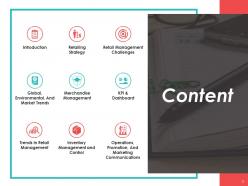
Slide 3: This slide shows Content of the presentation.
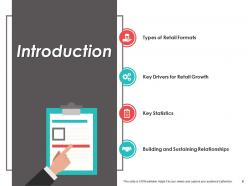
Slide 4: This slide presents Introduction describing- Building and Sustaining Relationships, Types of Retail Formats, Key Drivers for Retail Growth, Key Statistics.
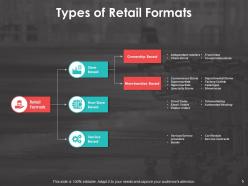
Slide 5: This slide displays Types of Retail Formats describing- Service Based, Store Based, Non-Store Based, Ownership Based, Merchandise Based.
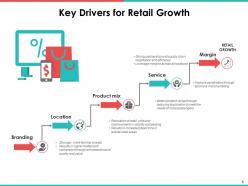
Slide 6: This slide represents Key Drivers for Retail Growth which includes- Branding, Location, Product mix, Service, Margin.
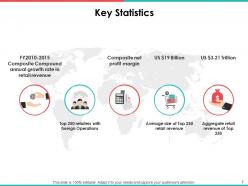
Slide 7: This slide showcases Key Statistics describing- Composite Compound annual growth rate in retail revenue, Top 250 retailers with foreign Operations, Composite net profit margin, Average size of Top 250 retail revenue, Aggregate retail revenue of Top 250.
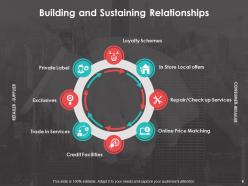
Slide 8: This slide shows Building and Sustaining Relationships with- Loyalty Schemes, In Store Local offers, Repair/Check up Services, Online Price Matching, Credit Facilities, Private Label, Exclusives, Trade in Services.
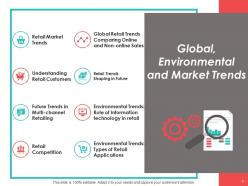
Slide 9: This slide presents Global, Environmental and Market Trends describing- Global Retail Trends Comparing Online and Non-online Sales, Retail Trends Shaping in Future, Retail Market Trends, Environmental Trends: Role of Information technology in retail, Environmental Trends: Types of Retail Applications, Understanding Retail Customers, Future Trends in Multi-channel Retailing, Retail Competition.
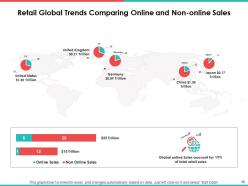
Slide 10: This slide displays Retail Global Trends Comparing Online and Non-online sales.
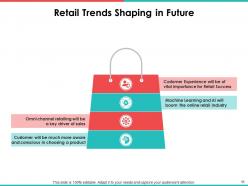
Slide 11: This slide represents Retail Trends Shaping In Future describing- Customer Experience will be of vital importance for Retail Success, Machine Learning and AI will boom the online retail industry, Customer will be much more aware and conscious in choosing a product, Omnichannel retailing will be a key driver of sales.
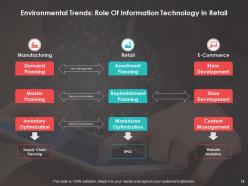
Slide 12: This slide showcases Environmental Trends: Role Of Information Technology in Retail with parameters as- E-Commerce, Retail, Manufacturing.
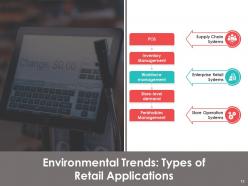
Slide 13: This slide shows Environmental Trends: Types of Retail Applications describing- Store Operation systems, Supply Chain systems, Enterprise Retail Systems.
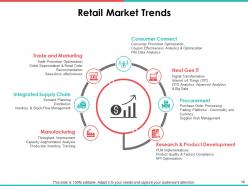
Slide 14: This slide presents Retail Market Trends as- Consumer Connect, Research & Product Development, Procurement, Integrated Supply Chain, Trade and Marketing, Next Gen IT, Manufacturing.
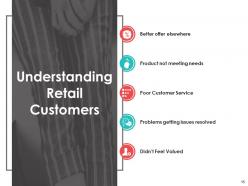
Slide 15: This slide displays Understanding Retail Customers describing- Better offer elsewhere, Product not meeting needs, Poor customer service, Problems getting issues resolved, Didn’t feel valued.
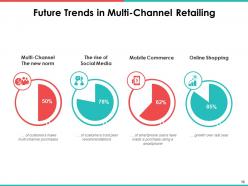
Slide 16: This slide represents Future Trends in Multi-Channel Retailing with parameters as- Online Shopping, Mobile Commerce, Multi-Channel The new norm.
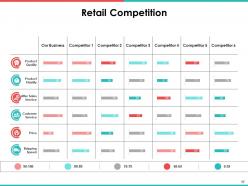
Slide 17: This slide showcases Retail Competition describing- After Sales Service, Product Fidelity, Product Quality, Customer Service, Price, Shipping Speed.
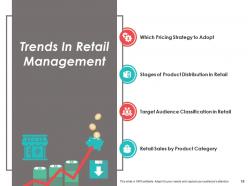
Slide 18: This slide shows Trends In Retail Management describing- Target Audience Classification in Retail, Retail Sales by Product Category, Which Pricing Strategy to Adopt, Stages of Product Distribution in Retail.
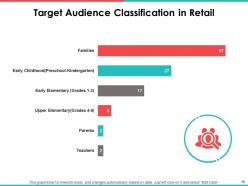
Slide 19: This slide presents Target Audience Classification In Retail in a graphical form with related information.
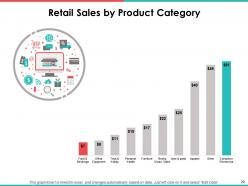
Slide 20: This slide displays Retail Sales By Product Category as- Food and beverage, furniture, office equipment, personal health, apparel etc. You can add or change products as per needs.
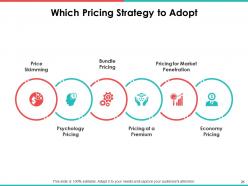
Slide 21: This slide represents Which Pricing Strategy To Adopt describing- Pricing at a Premium, Price Skimming, Pricing for Market Penetration, Psychology Pricing, Economy Pricing, Bundle Pricing.
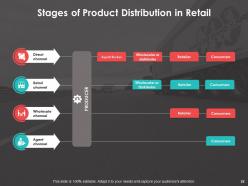
Slide 22: This slide showcases Stages of Product Distribution In Retail with categories as- Direct Channel, Wholesale Channel, Agent Channel, Retail Channel.
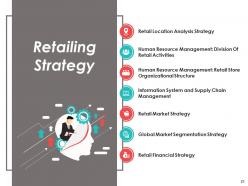
Slide 23: This slide shows Retailing Strategy describing- Retail Market Strategy, Global Market Segmentation Strategy, Retail Financial Strategy, Retail Location Analysis Strategy, Human Resource Management: Division Of Retail Activities, Human Resource Management: Retail Store Organizational Structure, Information System and Supply Chain Management.
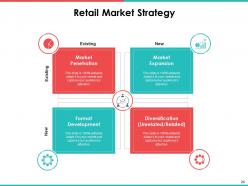
Slide 24: This slide presents Retail Market Strategy describing- Format Development, Diversification, Market Penetration, Market Expansion.
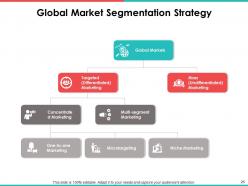
Slide 25: This slide displays Global Market Segmentation Strategy describing- Niche Marketing, One-to-one Marketing, Microtargeting, Concentrated Marketing, Multisegment Marketing, Mass (Undifferentiated) Marketing, Targeted (Differentiated) Marketing.
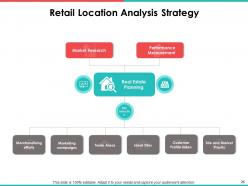
Slide 26: This slide represents Retail Location Analysis Strategy describing- Site & Market Priority, Customer Profile Index, Ideal Sites, Trade Areas, Marketing Campaigns, Merchandising Efforts.
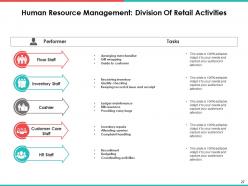
Slide 27: This slide showcases Human Resource Management : Division Of Retail Activities as- Floor Staff, Cashier, Inventory repairs, Customer Care Staff, HR Staff.
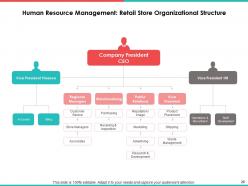
Slide 28: This slide shows Human resource management: retail store organizational Structure with related diagram.
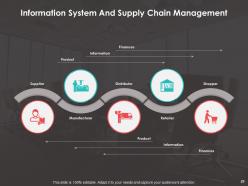
Slide 29: This slide presents Information System And Supply Chain Management describing- Supplier, Manufacturer, Distributor, Retailer, Shopper.
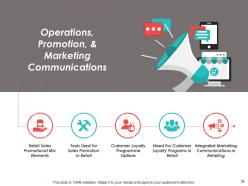
Slide 30: This slide displays Operations, Promotion, & Marketing Communications describing- Tools Used for Sales Promotion in Retail, Retail Sales Promotional Mix Elements, Customer Loyalty Programme Options, Need For Customer Loyalty Programs in Retail, Integrated Marketing Communications in Retailing.
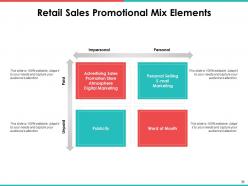
Slide 31: This slide represents Retail Sales Promotional Mix Elements as- Paid, Unpaid, Impersonal, Personal.
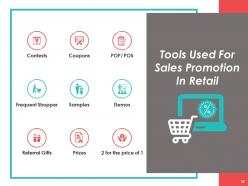
Slide 32: This slide showcases Tools Used for Sales Promotion in Retail as- Frequent Shopper, Pop/ Pos, Prizes, Referral Gifts, 2 For The Price Of 1, Contests, Demos, Samples, Coupons.
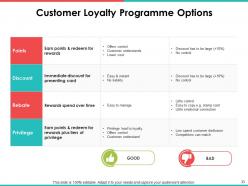
Slide 33: This slide shows Customer Loyalty Program Option with categories as- Points, discount, rebate and privilege.
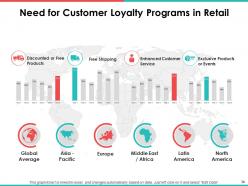
Slide 34: This slide represents Need for customer loyalty programs in retail with the help of bar graphs.
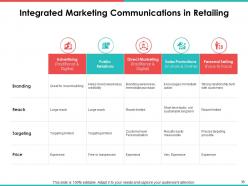
Slide 35: This slide showcases Integrated Marketing Communication In Retailing describing- Advertising, public relations, direct marketing, sales promotions etc.
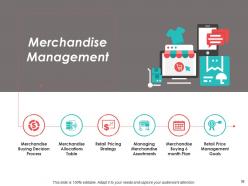
Slide 36: This slide shows Merchandise Management with- Merchandise Buying 6 month Plan, Managing Merchandise Assortments, Merchandise Buying Decision Process, Merchandise Allocations Table, Retail Price Management Goals, Retail Pricing Strategy.
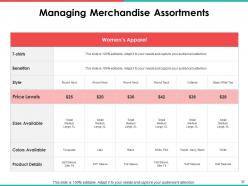
Slide 37: This slide presents Managing Merchandise Assortments with categories as- T-shirts, style, price levels, sizes available etc.
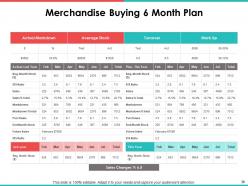
Slide 38: This slide represents Merchandise Buying 6 Month Plan in tabular form.
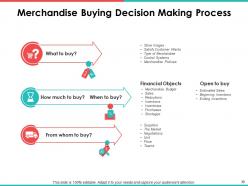
Slide 39: This slide displays Merchandise Buying Decision Process describing- What to buy? How much to buy? When to buy? From whom to buy?
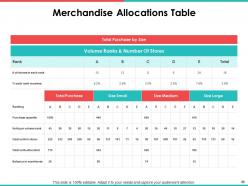
Slide 40: This slide showcases Merchandise Allocation Table with categories as- Total purchase, sizes, volume ranks and number of stores etc.
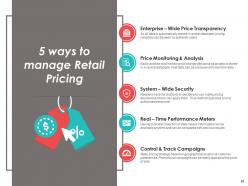
Slide 41: This slide shows 5 Ways to Manage Retail Pricing as- Price Monitoring & Analysis, System – Wide Security, Real – Time Performance Meters, Control & Track Campaigns, Enterprise – Wide Price Transparency.
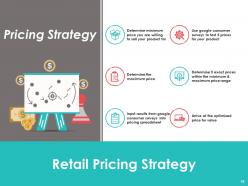
Slide 42: This slide presents Retail Pricing Strategy with related icons and text.
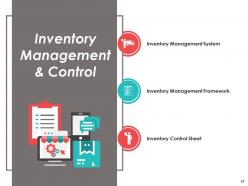
Slide 43: This slide displays Inventory Management & Control describing- Inventory Control Sheet, Inventory Management System, Inventory Management Framework.
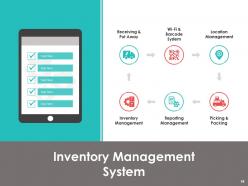
Slide 44: This slide represents Inventory Management System as- Receiving & Put Away, Wi-Fi & Barcode System, Location Management, Picking & Packing, Reporting Management, Inventory Management.
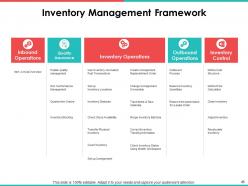
Slide 45: This slide showcases Inventory Management Framework describing- Inbound Operations, Outbound Operations, Inventory Operations, Quality Assurance, Inventory Control.
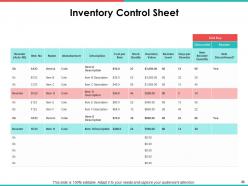
Slide 46: This slide shows Inventory Control Sheet in tabular form with categories as name, item number, manufacturer, cost per item, stock quality etc.
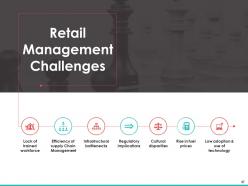
Slide 47: This slide presents Retail Management Challenges describing- Lack of trained workforce, Efficiency of supply Chain Management, Infrastructural bottlenecks, Regulatory implications, Cultural disparities, Rise in fuel prices, Low adoption & use of technology.
Slide 48: This slide displays KPI & Dashboard with related imagery and text boxes to show information.
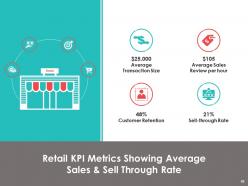
Slide 49: This slide represents Retail KPI Metrics Showing Average Sales & Sell Through Rates with- Average Transaction Size, Average Sales Review per hour, Customer Retention, Sell-through Rate.
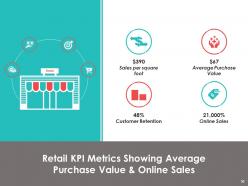
Slide 50: This slide showcases Retail KPI Metrics showing average purchase value & online sales with- Sales per square foot, Average Purchase Value, Customers Satisfied, Online Sales.
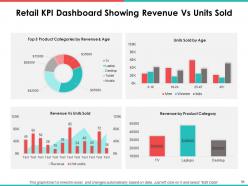
Slide 51: This slide shows Retail KPI Dashboard Showing Revenue Vs Units Sold with the help of bar graphs and pie chart.
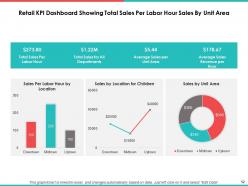
Slide 52: This slide presents Retail KPI Dashboard Showing Total Sales Per Labor Hour Sales By Unit Area.
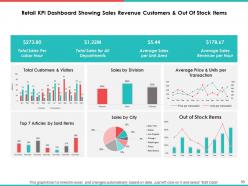
Slide 53: This slide displays Retail KPI Dashboard Showing Sales Revenue Customers & Out Of Stock Items with- Total Sales for All Departments, Average Sales per Unit Area, Average Sales Revenue per Hour, Total Sales Per Labor Hour.
Slide 54: This slide showcases Brand Management Icons.
Slide 55: This slide is titled as Additional Slides for moving forward.
Slide 56: This slide reminds about a 15 minutes tea break.
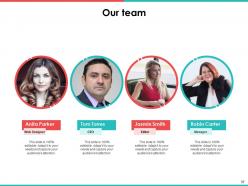
Slide 57: This is Our Team slide with names and designation.
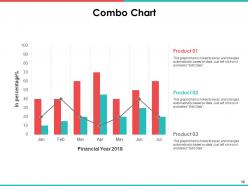
Slide 58: This slide shows Combo Chart with three products comparison.
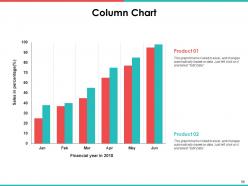
Slide 59: This slide presents Column Chart with two products comparison.
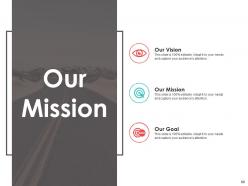
Slide 60: This is Our Mission slide with related imagery and text.
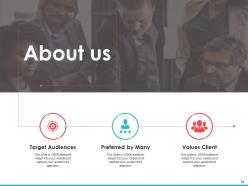
Slide 61: This is About us slide to show company specifications etc.
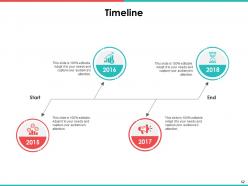
Slide 62: This is a Timeline slide to show information related with time period.
Slide 63: This is a Thank You slide with address, contact numbers and email address.
Brand Management Powerpoint Presentation Slides with all 63 slides:
Use our Brand Management Powerpoint Presentation Slides to effectively help you save your valuable time. They are readymade to fit into any presentation structure.

FAQs for Brand Management
Honestly, start with figuring out what makes you different - that's where everyone gets tripped up. Your brand positioning and messaging need to be locked down first. After that, keep everything consistent. Logo, colors, how your team talks to people, all of it. Visual identity matters more than you'd think. Don't sleep on monitoring what people say about you online either. I see too many businesses treat branding like a one-and-done thing, but it's really something you've got to keep working on. Do a quick audit of where you stand now across social, website, everything.
So here's the thing - stories just hit different than boring feature lists. People remember narratives way better than bullet points, and they actually care about your brand when there's emotion involved. Like, nobody wants to buy from some faceless corporation, right? But tell them about your founder's struggle or how you transformed someone's life? Now they're invested. Your brain literally processes stories differently than random facts. Find that moment where everything clicked for your brand - maybe when you almost failed, or your first big breakthrough. That's where your best content lives. Trust me on this one.
Honestly, social media is like a megaphone for everything - good reviews, bad experiences, all of it gets shared instantly with thousands of people. What's cool though is how it lets you actually talk with customers instead of just talking at them through ads. People definitely trust what other users say way more than corporate posts (and can you blame them?). Building loyalty happens when you stay active and respond authentically to feedback. It makes your brand feel more human somehow. The trick is watching mentions constantly and jumping in fast - if you're silent too long, customers think you don't give a damn about them.
Your customers basically tell you if your brand is actually hitting the mark or if you're way off base. Look at reviews, surveys, all that feedback - it shows you where your messaging might be falling flat. Some companies I know completely changed direction just from paying attention to what people were saying about them (and honestly, good for them). Set up a few different ways to collect feedback regularly. Then - and this is the part most brands mess up - you actually have to do something with it. Maybe start by just looking at what feedback you're already getting?
Honestly, most brands try being everything to everyone and end up being... nothing to anyone. Find your one thing that's actually different - maybe it's how you treat customers, or some feature nobody else has, or just your whole vibe. Then stick to it everywhere. Your website, your ads, how you talk to people - it all needs to feel like the same brand. I'd start by checking what your competitors are doing (probably all the same boring stuff) and find where there's room for you to be the obvious choice for something specific.
Focus on both the numbers and the feelings side. Brand awareness surveys show if people actually know you exist - do the aided/unaided recognition thing. Net Promoter Score and sentiment tracking matter way more than most people realize honestly. Market share and customer lifetime value give you the hard data. Price premium vs competitors is huge too. Brand equity surveys are solid gold for measuring how people see your quality and what makes you different. Don't go crazy though - pick like 3-4 metrics that actually match what you're trying to accomplish. You'll just overwhelm yourself otherwise.
Ugh, cultural trends are honestly such a pain but you can't ignore them. When something big shifts—like everyone suddenly caring about sustainability or Gen Z calling out fake brands—you've got to figure out if you still sound relevant. I mean, nobody wants to be that brand that feels completely out of touch, right? Monitor what's trending in your space (Google Alerts works great for this). Then decide: do we adapt our messaging or stick to our guns? Sometimes staying authentic to your original values is better than chasing every shiny new trend. It's exhausting but necessary.
Honestly, you've gotta keep watching what's actually happening with your audience right now - not what worked years ago. I do regular check-ins on my brand to catch when things start feeling stale. Way too many companies get cozy and then act shocked when they suddenly look ancient. Update your visuals every so often, shift your messaging to match what people care about today. Don't be scared to try new platforms either - calculated risks are worth it. The trick is staying true to who you are while changing how you show it. Does that make sense?
Don't go dark on social - that'll just piss people off more. Jump on it fast and be straight up about what went wrong. I've watched companies try to dodge responsibility and it's honestly painful to see how bad it gets. Your response has to sound real, not like some corporate robot wrote it. Keep refreshing those feeds constantly so you can catch new drama as it pops up. Oh, and seriously - have a game plan ready beforehand because scrambling during a crisis is the worst. The key is owning the story before everyone else does.
Honestly, rebranding is pretty risky - most don't even pay off like companies hope. You could totally confuse your loyal customers or throw away all that brand recognition you've worked years to build. That said, sometimes you really need it. Like if your current brand is seriously holding back growth, or you've had some major reputation mess to clean up from. Oh, and definitely after big business changes too. But here's what I'd do first - test out new concepts with your best customers before you blow your budget. Don't rebrand just because you're sick of looking at the same logo every day.
So brand advocacy is when your happy customers turn into like, your personal cheerleaders. They don't just buy from you - they actually defend you online and tell their friends about you. It's honestly better than any paid advertising because people trust real customers way more than ads. Plus it creates this snowball effect where advocates bring in more people who become advocates too. My advice? Find those superfans early and give them ways to share their stories. They'll keep your other customers around without you having to do much work.
So influencer collabs are great because you're tapping into audiences that already trust them. Way more authentic than regular ads, you know? Don't get caught up in follower counts though - I see brands mess this up constantly. Focus on finding people whose audience actually matches who you're trying to reach. Micro-influencers are honestly your best bet. Their engagement rates crush the mega-influencers and they won't break your budget. Plus when someone endorses your stuff, it's like instant social proof that can really move the needle on sales.
Okay so first thing - you gotta have solid brand guidelines that cover voice, visuals, messaging, complaints, all of it. Put everything in one place everyone can actually find (not buried in some random drive folder). Train anyone who deals with customers - social people, sales team, whoever. I'd do quarterly check-ins across all your channels because catching stuff early saves headaches later. Oh and make it simple for people to follow the rules instead of making them hunt around for outdated info. That's honestly where most companies mess up - they create these guidelines then make them impossible to use.
Honestly, sustainability can make or break your brand these days. Consumers will literally boycott you if they think you're just greenwashing with fake eco-friendly stuff. People are way too smart for that now. You've gotta build your messaging around what you're actually doing - like real supply chain changes, better packaging, causes you genuinely support. Don't just slap green logos everywhere and call it a day. Start by looking at what sustainable practices you already have going on. Then craft your story around those real efforts. The authenticity thing is huge because customers can smell BS from a mile away.
Dude, AI and VR are seriously game-changers for customer stuff. Like, you can create these personalized shopping experiences that actually adapt while people browse, or set up virtual showrooms where customers test products without leaving home. AI predicts what people want and serves up targeted content. VR? Creates those sticky experiences people remember way longer than regular ads. I swear the tech has gotten crazy good lately - my cousin's company just rolled out VR demos and their engagement went through the roof. Start small though. Maybe try AI chatbots for support first, then experiment with simple VR product demos to see what clicks.
-
Good research work and creative work done on every template.
-
It saves your time and decrease your efforts in half.
-
Enough space for editing and adding your own content.