


Brand Positioning Powerpoint Presentation Slides





Try Before you Buy Download Free Sample Product
 Impress Your
 Audience
 100%
100% Editable
 Save Hours
 of Time


Brand positioning is a crucial part of the marketing plan, select our Brand Positioning PowerPoint Presentation Slides to find out how to position your brand. This is very important to identify your brand uniqueness and attributes what makes you different from your competitors. The Positioning strategy PPT helps you to make a distinct place in the minds of target customers. The goal of this strategy is to highlight your product’s most powerful attributes. The brand strategy PowerPoint complete deck contains templates such as positioning strategy, brand positioning framework, brand worksheet, statement and model, product communication and repositioning, etc. Additionally, this amazing market segmentation Presentation slide is also helpful for topics like market projections, brand positioning, product strategy, brand strategy, product marketing plan, segmentation and targeting, customer engagement, brand management and many more. An effective brand positioning strategy can maximize brand value. Download product positioning PowerPoint template to get an edge over competitors. Eliminate disparities with our Brand Positioning Powerpoint Presentation Slides. Be absolutely fair in your every deal.
People who downloaded this PowerPoint presentation also viewed the following :
Content of this Powerpoint Presentation
Slide 1: This slide introduces Brand Positioning. State company name to get started.
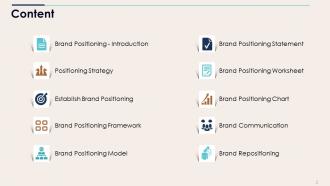
Slide 2: This slide showcases list of Contents with title. The list of content is as follow- Brand Positioning - Introduction, Positioning Strategy, Establish Brand Positioning, Brand Positioning Framework, Brand Positioning Model, Brand Positioning Statement, Brand Positioning Worksheet, Brand Positioning Chart, Brand Communication, Brand Repositioning.
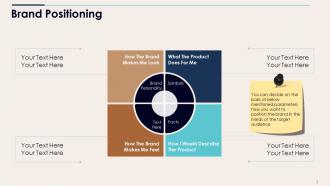
Slide 3: This slide is an introduction of brand positioning which are based on different parameters listed below represented in a quadrant.You can decide on the basis of below mentioned parameters how you want to position the brand in the minds of the target audience How The Brand Makes Me Look, What The Product Does For Me, How The Brand Makes Me Feel, How I Would Describe The Product.
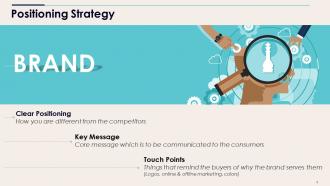
Slide 4: This slide is about Positioning Strategy which depends upon 3 major factors. Clear Positioning: How you are different from the competitors, Key Message: Core message which is to be communicated to the consumers, Touch Points: Things that remind the buyers of why the brand serves them, (Logos, online & offline marketing, colors).
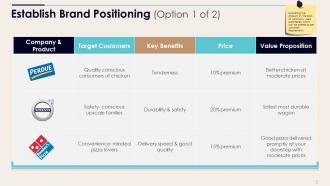
Slide 5: This slide is about Establish Brand Positioning with 2 options. The first option is: Evaluating the product on the basis of commonly used parameters which can be altered as per customer requirements
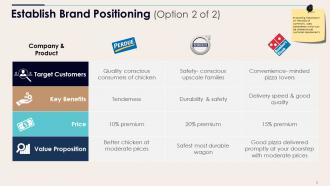
Slide 6: This slide is continuation of Establish Brand Positioning. The second option is: Evaluating the product on the basis of commonly used parameters which can be altered as per customer requirements
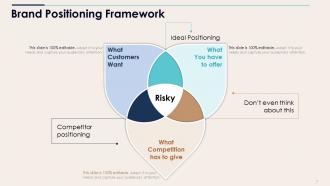
Slide 7: This slide is about Brand Positioning Framework which is based on 3 important factors: What Customers Want, What You have to offer, What Competition has to give.
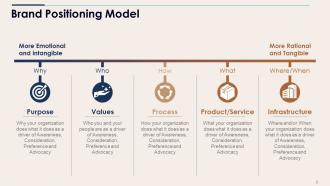
Slide 8: This slide is about Brand Positioning Model which is based on 5 important key factors which are further explained. Purpose: Why your organization does what it does as a driver of Awareness, Consideration, Preference and Advocacy, Values: Who you and your people are as a driver of Awareness, Consideration, Preference and Advocacy, Process: How your organization does what it does as a driver of Awareness, Consideration, Preference and Advocacy, Product/Service: What your organization does what it does as a driver of Awareness, Consideration, Preference and Advocacy, Infrastructure: Where and/or When your organization does what it does as a driver of Awareness, Consideration, Preference and Advocacy.
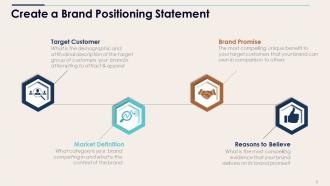
Slide 9: This slide is about to Create a Brand Positioning Statement represented by a nice diagram and icons.
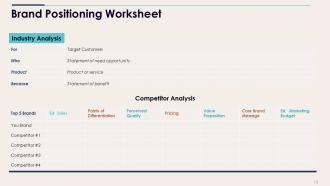
Slide 10: This slide represents Brand Positioning Worksheet designed in a tabular format where you can fill your data.
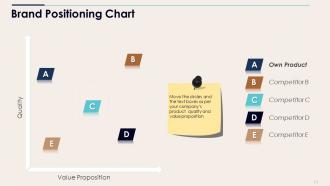
Slide 11: This slide displays Brand Positioning Chart in a graphical manner. You can move the circles and the text boxes as per your company’s product quality and value proposition
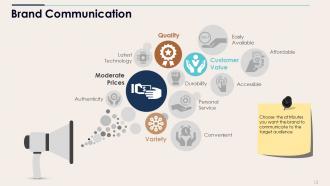
Slide 12: This slide is about Brand Communication and you can choose the attributes you want the brand to communicate to the target audience Affordable, Easily Available, Variety, Moderate Prices, Authenticity, Quality, Personal Service, Accessible, Customer Value, Convenient, Latest Technology, Durability, 24x7.
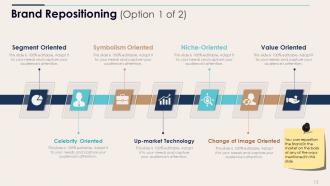
Slide 13: This slide is about Brand Repositioning with 2 different options. You can reposition the Brand in the market on the basis of any of the ways mentioned in this slide. Segment Oriented, Symbolism Oriented, Niche-Oriented, Value Oriented, Celebrity Oriented, Up-market Technology, Change of Image Oriented.
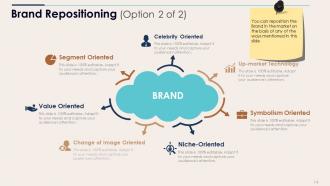
Slide 14: This slide is continuation of Brand Repositioning.You can reposition the Brand in the market on the basis of any of the ways mentioned in this slide Segment Oriented, Celebrity Oriented, Symbolism Oriented, Up-market Technology, Niche-Oriented, Change of Image Oriented, Value Oriented.
Slide 15: This slide represents Brand Positioning icon Slide. These icons can be used anywhere throughout the deck.
Slide 16: This slide reminds about 10 Minutes Break. You can change the slide content as desired.
Slide 17: This slide states that further slides are about Graph And Charts. You can change the slide content as desired.
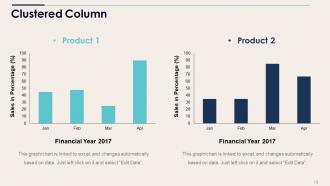
Slide 18: This slide showcases Clustered Column graph. You can compare two products using graph and are linked with excel.
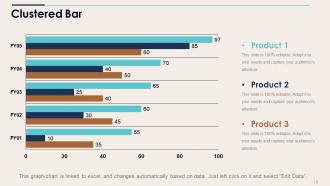
Slide 19: This slide is about Clustered Column linked with excel. Showcase comparison, specification etc. here.
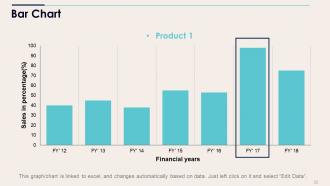
Slide 20: This slide represents Bar Chart linked to excel, and changes automatically based on data.
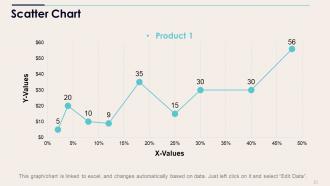
Slide 21: This slide represents Scatter Chart displayed with line graph.
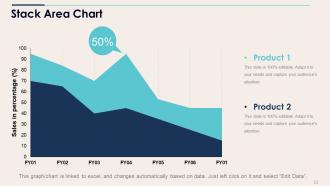
Slide 22: This slide represents Stack Area Chart. Present comparison, specification etc. here.
Slide 23: This slide is titled Additional Slides. You can change the title as desired.
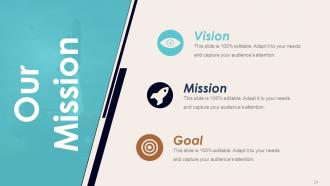
Slide 24: This slide represents Our Mission slide. You can write your company's mission, vision and goal.
Slide 25: This slide represents about our team. You can enter name, designation and images of the team members.
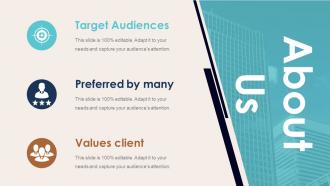
Slide 26: This slide represents About Us and you can enter your text.
Slide 27: This slide represents Our Goal. You can enter your company's goal.
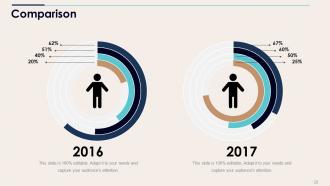
Slide 28: This slide displays Comparison of two years using a nice visual.
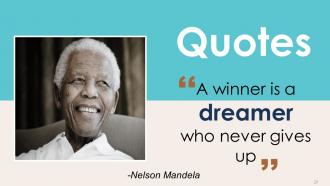
Slide 29: This slide represents Quotes. You can edit text and change images.
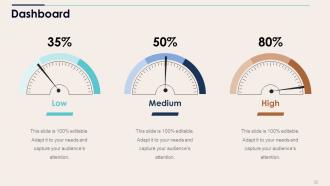
Slide 30: This slide displays Dashboard using speedometer.
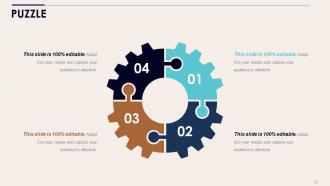
Slide 31: This slide represents a nice PUZZLE diagram.
Slide 32: This slide is about Our Target. You can write your company's target.
Slide 33: This slide represents Circular diagram.
Slide 34: This slide can be used to enter text using Venn diagram.
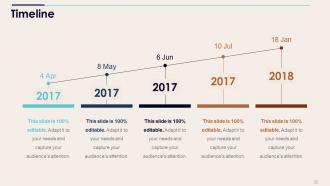
Slide 35: This slide displays timeline where you can write what your company has achieved and planning to achieve.
Slide 36: This last slide is Thank You slide. You can write your company address, contact number and email address.
Brand Positioning Powerpoint Presentation Slides with all 36 slides:
Our Brand Positioning Powerpoint Presentation Slides are bold and bright. Color your canvas as you desire.





FAQs for Brand Positioning
Honestly, start with who you're actually talking to - get crystal clear on your audience first. Map out where you sit against competitors, then figure out what problem you solve that nobody else can touch. Your messaging needs to hit people in the feels, not just list features (nobody cares about specs as much as we think they do). Keep it simple enough that your mom could explain your business in one sentence. But here's the thing - it also has to be weird enough that competitors can't just steal it overnight. Consistency across everything matters too, from your website to how you answer the phone.
Look, figuring out your target audience is honestly everything when it comes to positioning your brand. Without it, you're basically throwing darts blindfolded. Once you really get their pain points and what they actually value, you can craft messaging that hits instead of just... existing. Demographics and behaviors show you which benefits to highlight and what tone works. Psychographics reveal how to stand out from competitors in ways they'll care about. Oh, and definitely survey your current customers about why they picked you - that stuff is pure gold for positioning. Those insights will surprise you.
Honestly, competitor analysis is just figuring out where you can actually win. Map out what space everyone else has claimed so you're not fighting over the same customers – that gets expensive fast. Check their messaging, pricing, who they're targeting. Maybe they're all going premium while there's room for "quality that doesn't break the bank." Or everyone's listing features when you could focus on how it makes people feel. The whole point? Find your angle that customers care about but nobody owns yet. I'd start by stalking your top 5 competitors' websites and socials this week.
Honestly, the brands that stick with me most tell stories that actually connect to real experiences. Nike's a perfect example - they're not just pushing sneakers, they're talking about breaking through barriers and chasing your goals. Find 2-3 stories that really capture what your brand is about, then tell them everywhere. People remember stories way better than boring feature lists anyway. Just make sure everything feels authentic and consistent - like, don't suddenly switch up your whole vibe on Instagram vs your website. The trick is showing who you are through these narratives instead of just saying it outright.
Okay so you need to track two things - how people feel about your brand AND the actual business numbers. For perception stuff, do brand awareness surveys and sentiment analysis. Check your share of voice too. Then see if people actually consider you when they're buying (that's the real test honestly). On the business side - market share, pricing vs competitors, customer acquisition costs. Oh and definitely track net promoter score, that tells you if your positioning actually works. I'd set up quarterly dashboards so you catch problems early instead of scrambling later.
Dude, emotional connection is everything for brand positioning. Without it, you're just another company competing on price and features - which honestly sucks because someone will always undercut you. Look at Apple or Nike though. People pay crazy money for their stuff because those brands make them feel something, you know? They tap into identity and what people want to become. Your customers aren't just solving a functional problem - they've got deeper stuff they care about. Figure out what that is, then build your positioning around it. That's how you get people choosing you even when there's cheaper options out there.
Oh man, the worst thing you can do is try to appeal to literally everyone. You'll just blend into the background noise. I see brands constantly ripping off their competitors too - like, why would I choose you over the original? Here's what kills me: companies obsess over listing features instead of actually connecting with people emotionally. Plus when your messaging is different everywhere, customers get confused real quick. Honestly? Figure out who you DON'T want as customers first. Then find that one thing that makes you different and just... own it completely.
Find a gap your competitors totally missed. Check what messaging they're all using, then go the opposite direction or hit a segment they're ignoring. Dollar Shave Club nailed this - while everyone else was pushing "premium quality," they made it about convenience instead. Pretty genius honestly. Your repositioning has to match what you actually deliver though, or it'll backfire. Start small - audit their messaging first, spot the holes, then test your new angle with a few campaigns. Don't go all-in until you're sure it's working. Sometimes the best move is just flipping the whole script on what your product's really about.
Honestly, digital transformation turns your whole brand strategy upside down. Suddenly you're everywhere - social media, apps, websites, those annoying chatbots. It's overwhelming but actually pretty cool because now you can see exactly how people interact with your stuff instead of just guessing. The data lets you adjust your positioning super quickly when things aren't clicking. I mean, my cousin's startup pivoted three times last year just based on their app analytics. The trick is keeping everything consistent while you're constantly tweaking based on what you're learning.
Look, your audience's values are constantly shifting, and if you're not paying attention, you'll sound totally irrelevant. Remember how fast everyone pivoted during COVID? That's what I mean. Sustainability used to be niche - now it's everywhere. Remote work changed what people actually care about day-to-day. Your brand positioning needs to move with these changes or you're basically speaking to yesterday's customer. Here's what works: pick 2-3 big cultural shifts happening in your industry and check in on them every few months. Then honestly ask yourself - does our messaging still hit the same way? Sometimes the answer's uncomfortable, but it's better than being left behind.
Your unique value prop? It's what makes customers choose you instead of your competitors. Think of it as your one-sentence pitch - if you can't explain it simply, you're already losing people. Mine took me forever to figure out, honestly. But once you nail it down, everything else clicks into place. Your messaging, pricing, where you spend your marketing budget - it all flows from that core statement. The test I always use: would a middle schooler get it immediately? Write yours down today and see if it passes that test. Trust me, it'll save you so much confusion later.
So basically, your visual stuff needs to match whatever position you're going for in the market. Like, if you say you're premium but your logo looks cheap, people get confused. Apple's the perfect example - their whole clean vibe screams expensive without them having to tell you. Colors, fonts, logo design... it all has to work together to back up your brand story. I'd honestly just look at what you have now and ask "does this actually show people what we want to be known for?" If not, time to fix it. Your visuals should make your positioning super obvious.
So SEO is basically how people find you online when they're searching for stuff you do. Ranking high makes you look legit before someone even visits your site - crazy how much people trust Google's top results, right? But here's what I learned the hard way: you can't just chase any keywords. If you're going after "cheap" terms but trying to build a premium brand, you'll confuse the hell out of people. Target words that actually match your vibe. Otherwise you're just shooting yourself in the foot.
Honestly, start with a solid brand guidelines doc - tone, visuals, messaging, positioning, the whole thing. Getting everyone to actually follow it is the real challenge though. Templates are your friend here. Social, email, website... if they all use the same basic framework, you're golden even when different people run them. Oh and definitely do quarterly check-ins across everything. I can't tell you how many times I've caught weird inconsistencies that way. Bottom line: one master document everyone refers to when they're stuck.
Dude, Old Spice is probably the best example - they went from being your dad's boring deodorant to this hilarious brand that younger guys actually wanted. Apple's another obvious one, transforming from a dying computer company into this sleek lifestyle thing everyone obsesses over. McDonald's tried pivoting to healthier options too, though honestly I'm not sure how well that worked lol. Nike's genius though - they stopped being just about shoes and became this whole "just do it" mentality brand. The pattern? All these companies looked at where their customers were going, not where they'd been. That's probably the move.
-
Perfect template with attractive color combination.
-
Excellent Designs.