

Product Positioning Strategies Powerpoint Presentation Slides





Try Before you Buy Download Free Sample Product
 Impress Your
 Audience
 100%
100% Editable
 Save Hours
 of Time


Showcase various strategies to position your brand in the marketplace with the help of our informative and knowledgeable Product Positioning Strategies PowerPoint Presentation Slides. By using this content ready brand positioning presentation template, you can portray the benefits of your products to target the new as well as the existing customers. You can highlight the steps to monitor the progress of a particular product with the aid of the brand management strategy PPT theme. Use product development & planning PowerPoint graphic to explain how to create a brand value in the marketplace. Take the assistance of brand positioning framework presentation slides and illustrate the key points that help you to focus on the positioning strategy to create a positive impact on the audience. Employ this professionally designed product positioning strategies PowerPoint layout and elaborate on the factors that generate a unique impression in the consumer’s mind related to your brand or product. Therefore, download our ready-to-use market positioning PPT theme to grab the attention of your audience.
People who downloaded this PowerPoint presentation also viewed the following :
Content of this Powerpoint Presentation
Slide 1: This slide introduces Product Positioning Strategies. State your company name and begin.
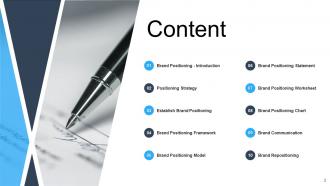
Slide 2: This slide displays the Content of the presentation.
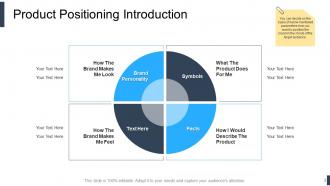
Slide 3: This slide describes Product Positioning Introduction. You can decide on the basis of below mentioned parameters how you want to position the brand in the minds of the target audience.
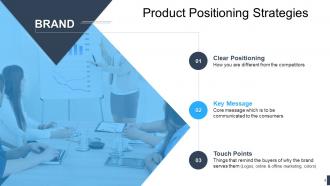
Slide 4: This slide displays Product Positioning Strategies with clear positioning, key message, touch points.
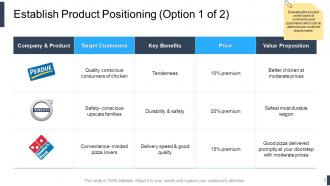
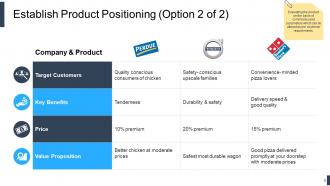
Slide 5: This is Establish Product Positioning slide.
Slide 6: This slide also displays Product Positioning. Evaluate the product on the basis of commonly used parameters which can be altered as per customer requirements.
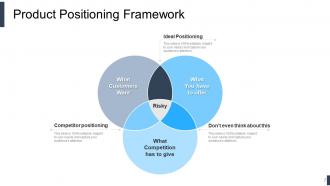
Slide 7: This slide describes Product Positioning Framework.
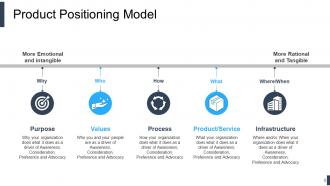
Slide 8: This slide showcases Product Positioning Model with purpose, values, process, product/service.
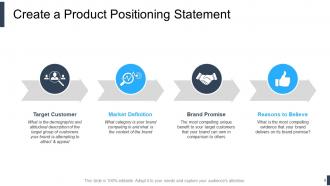
Slide 9: This slide showcases how to Create a Product Positioning Statement describing- Target customer, Market definition, Brand promise, Reasons to believe.
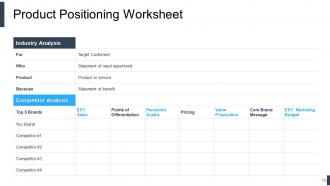
Slide 10: This slide showcases Product Positioning Worksheet.
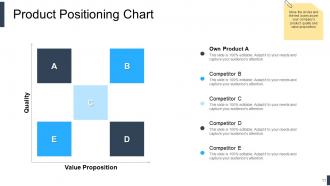
Slide 11: This slide displays Product Positioning Chart. Move the circles and the text boxes as per your company’s product quality and value proposition.
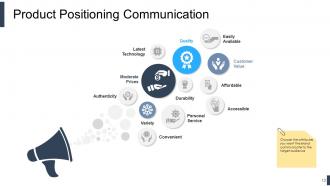
Slide 12: This slide describes Product Positioning Communication. Choose the attributes you want the brand communicate to the target audience.
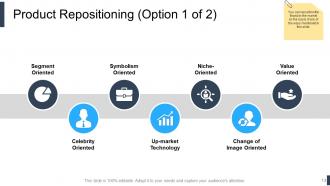
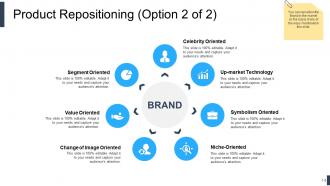
Slide 13: This slide describes Product Repositioning including- Segment Oriented, Symbolism Oriented, Niche-Oriented, Value Oriented, Celebrity Oriented, Up-market Technology, Change of Image Oriented. You can reposition the Brand in the market on the basis of any of the ways mentioned in this slide.
Slide 14: This slide also showcases Product Repositioning.
Slide 15: This is Product Positioning Strategies Icons Slide.
Slide 16: This slide displays 10 Minutes coffee Break.
Slide 17: This slide is titled as Additional Slides for moving forward.
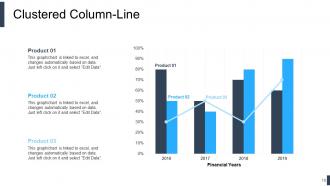
Slide 18: This is Clustered Column-Line chart slide with products comparison.
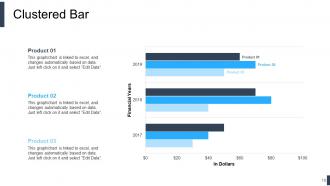
Slide 19: This is Clustered Bar chart slide with product comparison.
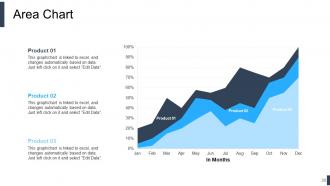
Slide 20: This is Area Chart slide.
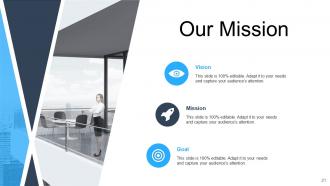
Slide 21: This is Our Mission slide with Vision, Mission and Goal.
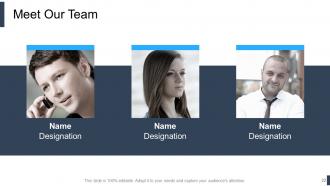
Slide 22: This is Meet Our Team slide with names and designation.
Slide 23: This is About Us slide to showcase company specifications.
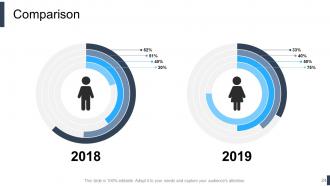
Slide 24: This slide showcases Comparison.
Slide 25: This is Our Goal slide to showcase company goals.
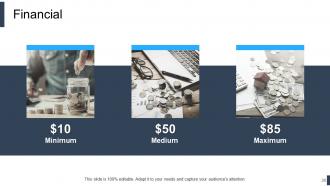
Slide 26: This is Financial slide.
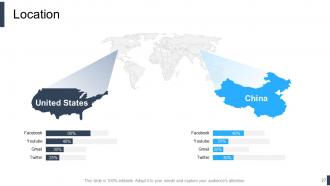
Slide 27: This is Location slide showcasing the location where company is based.
Slide 28: This slide is titled as Post it Notes. Post your important notes here.
Slide 29: This is Puzzle slide with icons and text boxes.
Slide 30: This is Target slide to showcase company targets.
Slide 31: This is Venn slide.
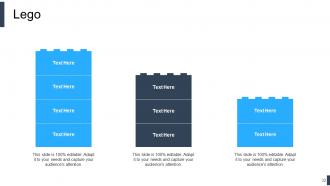
Slide 32: This is Lego slide with text boxes.
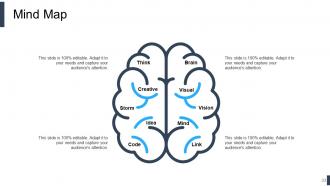
Slide 33: This slide displays Mind Map with- Think, Creative, Storm, Idea, Code, Link, Mind, Visual, Brain, Vision.
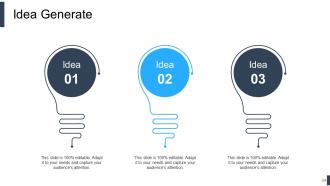
Slide 34: This is Idea Generate slide to highlight ideas and information.
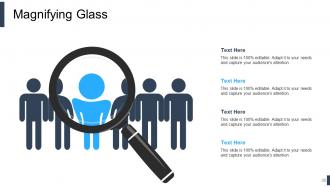
Slide 35: This slide displays the Magnifying Glass to highlight the important content.
Slide 36: This is Thank you slide with email address, address and contact number. Thanks for Watching!
Product Positioning Strategies Powerpoint Presentation Slides with all 36 slides:
Explain all the important factors considered with our Product Positioning Strategies Powerpoint Presentation Slides. Get folks to endorse your decision.




FAQs for Product Positioning Strategies
Honestly, it all comes down to three things: who you're actually talking to, what makes you different, and why anyone should give a damn. Map out your exact target audience first - and I mean specific, not "everyone who needs X." Figure out how you're genuinely different from competitors (this is harder than it sounds). Your value prop has to be crystal clear too. Oh, and make sure your positioning matches what your product can actually deliver - nothing worse than overpromising. Keep messaging consistent everywhere. Think of it like claiming your own little corner of people's brains. Sketch this stuff out before you write anything else.
Look at your current customers first - what are they like, how do they shop, what makes them tick? Surveys and your website data will tell you a lot. Check out who your competitors are targeting too, might find some gaps there. Build detailed profiles of your ideal buyers - their problems, what drives them, where they spend time online. Here's the thing though: trying to appeal to everyone just makes your messaging super generic. Pick 2-3 main groups max and really focus on them. Test your messaging with small groups before going big. You want people to see your stuff and think "oh wow, this is totally for me." That specificity is what actually works.
Honestly, competitive analysis is just figuring out what's already out there before you jump in. Map out where your competitors actually sit in customers' heads - not what they claim to be, but how people really see them. That's where you'll spot the gaps. I always tell people to audit 3-5 direct competitors' messaging first. Then - and this part's crucial - actually talk to customers to see if your assumptions are right. It's like scoping out a party before you show up, you know? Helps you avoid awkward positioning mistakes and find your own lane.
Find a gap your competitors are totally missing and just own it. Maybe it's a customer group everyone ignores, or you flip the whole category on its head. Tesla's genius wasn't just making electric cars - they made them cool and techy when everyone assumed eco-friendly meant ugly and slow. Focus on one specific thing that makes people go "yes, that's exactly what I've been looking for!" Could be emotional stuff instead of boring features. Whatever you pick, go all-in on it. Don't try to be everything to everyone - that never works anyway.
Honestly, the worst thing you can do is try appealing to everyone - you'll end up connecting with no one. Skip the buzzword BS like "innovative" and "best-in-class" because literally every company uses those. Being too broad kills your message too. Also don't use insider language that only makes sense to your team (I've seen this mistake so many times). Pick one specific audience and focus on what they actually need, not some problem from 2015 that doesn't exist anymore. Short sentences work. Test with real customers first - they'll tell you if it's garbage way faster than any internal meeting will.
Honestly, just talk to your customers more. Send surveys, read reviews, have actual conversations - you'll quickly see if there's a disconnect between what you think you're selling and what they're getting. Like if you're pushing "enterprise-grade" but everyone keeps saying how simple it is to use, that's your real value prop right there. Write down the exact words customers use when describing your product. Those phrases are marketing gold. Then tweak your messaging to match their reality instead of forcing your original vision. Oh, and definitely test any changes with a small group first - saves you from looking silly later.
Yeah, branding is huge for positioning - it's what actually makes people remember and trust your market position. Anyone can claim they're "premium" or whatever, but your brand makes customers believe it and pay up. Without solid branding backing it up, even brilliant positioning just becomes white noise that competitors can rip off easily. I mean, look at how many companies say the exact same things about being innovative. Your brand promise needs to authentically support whatever position you're going for. That's where you start - not the other way around.
Your visual design totally controls how people see your product's position in the market. Clean, minimal stuff screams premium. Bold colors and cluttered layouts? That's mass market territory. Fonts and color choices tell your audience whether you're going after enterprise money or budget shoppers - honestly, it happens before you even open your mouth. I've watched solid products get completely mispositioned because their slides looked cheap. First impressions are brutal like that. Keep everything consistent across your materials too. Quick fix: compare your current presentation visuals to what your competitors are doing and what your target market expects.
Honestly, digital marketing lets you get super precise with positioning in ways traditional stuff just can't match. You can target exact audience segments with different messages, A/B test approaches without spending a fortune, and actually see what's working through real metrics. SEO helps control how people find you, social media shows off your brand vibe. The feedback loop is insane - you'll know immediately if your positioning hits or misses based on engagement and conversions. I'd start by looking at all your digital touchpoints first. See where your message might be getting watered down or could use some work.
Honestly, emotional appeals totally change how people see where your product fits in the market. You're not just pushing features anymore - you're building these sticky mental connections that outlast any logical pitch. Nike's the perfect example, right? They're not really selling shoes, they're selling that whole empowerment vibe. Once that emotional link clicks, it can bump you from competing on price to being seen as premium, or shift you from boring and functional to something people actually aspire to own. Figure out what feeling you want people to associate with your stuff, then just keep threading it through everything you put out there.
Oh, people always confuse these two! So positioning is the vibe you want customers to associate with your product - like "we're the premium brand" or whatever. Placement is just where your stuff actually shows up. Think movie product placements or which shelf you're on at Target. They work together though. First figure out how you want people to see your brand, then put it in places that make sense. You wouldn't put a luxury product next to dollar store items, you know? Start with nailing down your positioning message. The placement part comes after - honestly it's way easier once you know what story you're trying to tell.
Honestly, brand perception surveys are your best starting point - gotta know if customers actually see you how you think they do. Track your market share and whether you can charge premium prices (that's real positioning power right there). Customer acquisition costs matter too. I'd also keep an eye on what competitors are doing and social media chatter, though that can be a rabbit hole. The real question is simple: are you pulling in the right customers who pick you for the right reasons? Check these quarterly so you don't miss any shifts.
Here's the thing - people don't buy features, they buy feelings. Instead of listing boring specs, tell a story about the problem you're solving. Like, nobody cares about "advanced algorithms" but they'll totally get excited about "helping busy parents actually enjoy their weekends again." Focus on the customer's journey and what their life looks like after using your product. Paint that picture of transformation. Honestly, I see so many companies obsess over their tech when they should be talking about outcomes. Your positioning should be about them, not you.
First thing - figure out why your current positioning sucks. Check customer feedback, sales numbers, what competitors are doing. Then find a gap you can actually fill. The hardest part? Shifting perceptions without totally confusing your existing customers (trust me on this one). Update your messaging, packaging, all that stuff so it's consistent. Your whole team needs to get the new story too - otherwise you'll have mixed messages everywhere. Oh, and if you've got budget for focus groups, do it. Way cheaper than launching something that flops.
Honestly, everyone's obsessed with slapping "AI-powered" on everything right now - it's kinda exhausting but you can't ignore it. Privacy stuff is huge too after all those data scandals. Companies are finally talking about what their product actually does for you instead of boring feature lists. Like "this makes you more productive" vs "our algorithm has 47 capabilities" or whatever. Sustainability messaging is everywhere too - though half of it feels forced. My take? Figure out the real problem you're solving first. The positioning flows way easier from there.
No Reviews