


Market targeting powerpoint presentation slides




Try Before you Buy Download Free Sample Product
 Impress Your
 Audience
 100%
100% Editable
 Save Hours
 of Time


Select the potential customers to sell products and services by utilizing Market Targeting Powerpoint Presentation Slides. Explain the types of targeting including behavioral, contextual, search, site and predictive targeting with the help of market segmentation PowerPoint layouts. The brand positioning PPT slideshow can be used to find out the market with the largest potential that can generate the maximum profit and can lead to the success of your company. Elaborate on four methods of targeting such as geographical, demographic, psychographic and behavioral with the aid of market segmentation PowerPoint templates. Explain four different sectors of the market potential and point out the sector with the large market potential by taking the assistance of STP PowerPoint complete deck. Mention the important considerations for evaluating markets such as segment size, segmental structure attractiveness. Understand the market and work on its expansion in order to achieve success by downloading the target market and segmentation PPT Presentation.
People who downloaded this PowerPoint presentation also viewed the following :
Content of this Powerpoint Presentation
Slide 1: This slide introduces Market Targeting. State your company name and begin.
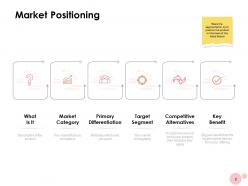
Slide 2: This slide describes Market Positioning. Basis the segmentation, try to position the product on the basis of the listed factors.
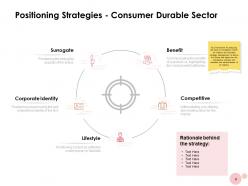
Slide 3: This slide describes Positioning Strategies - Consumer Durable Sector. Its a framework for analyzing the level of competition within an industry and business strategy development to derive five forces that determine the competitive intensity and therefore the attractiveness of an industry Rationale behind the strategy.
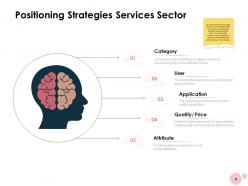
Slide 4: This slide also describes Positioning Strategies Services Sector displaying- category, user application, quality/ price, attribute.
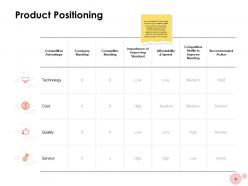
Slide 5: This slide depicts Product Positioning. Its a framework for analyzing the level of competition within an industry and business strategy development to derive five forces that determine the competitive intensity and therefore the attractiveness of an industry
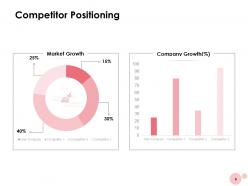
Slide 6: This slide showcases Competitor Positioning with company growth and market growth percentage.
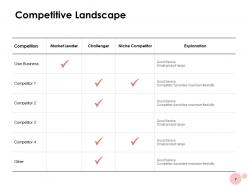
Slide 7: This slide depicts Competitive Landscape.
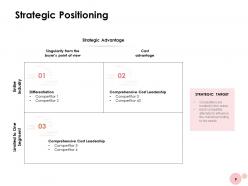
Slide 8: This slide displays Strategic Positioning showcasing the strategic targets.
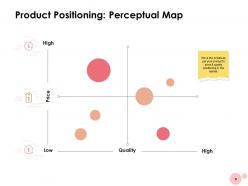
Slide 9: This slide describes Product Positioning: Perceptual Map. Move the circles as per your product’s price & quality positioning in the market.
Slide 10: This slide is titled as Additional Slides for moving forward.
Slide 11: This is Market Targeting Icons Slide.
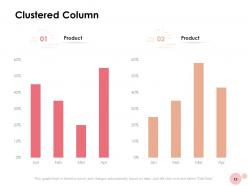
Slide 12: This slide displays Clustered Column chart with product comparison.
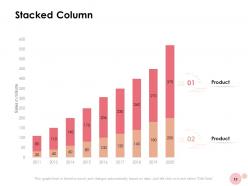
Slide 13: This slide displays Stacked Column chart with product comparison.
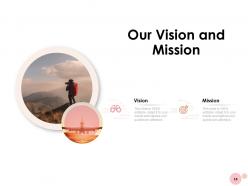
Slide 14: This slide showcases Our Vision and Mission.
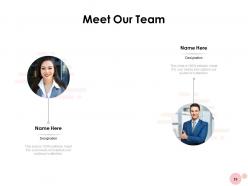
Slide 15: This is Meet Our Team slide with names and designations.
Slide 16: This is Finance slide.
Slide 17: This is Puzzle slide with text boxes and icons.
Slide 18: This is Timeline slide.
Slide 19: This slide showcases Business Target.
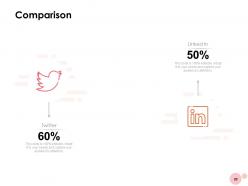
Slide 20: This is Comparison slide showcasing comparison between twitter and LinkedIn in percentages.
Slide 21: This is Thank You slide with address, Email address and contact number.
Market targeting powerpoint presentation slides with all 21 slides:
Our Market Targeting Powerpoint Presentation Slides are fairly charitable. They give it away at no extra cost.

FAQs for Market targeting
Honestly, start with the basics - age, income, where they live, that stuff. Then dig deeper into what they actually care about and how they shop. Are they loyal to brands or always switching? What problem does your thing solve for them? Here's what I learned the hard way: make sure there are actually enough of these people to keep you in business. I've watched startups chase these super tiny niches and... yeah, didn't end well. Can you even reach them easily? Like, are they on Instagram or do they only read newspapers? Create 2-3 detailed profiles based on real data, not just what you think sounds right.
Honestly, demographic segmentation is a game changer for targeting. You're basically cutting your market into groups that actually matter - age, income, education, whatever connects to buying patterns. Way better than just throwing your message out there randomly and crossing your fingers. Think of it like GPS for your marketing dollars. The trick though? Don't just go with obvious demographics. Dig into your current customer data first to see what patterns pop up. Sometimes the connections surprise you. Then build your whole targeting strategy around those real insights instead of guesses.
Okay so psychographic profiling is basically getting into people's heads - like their values, attitudes, what they actually care about. Way more useful than just knowing someone's age and gender. You'll understand they're eco-conscious, want work-life balance, prefer experiences over stuff. That's honestly where you can get really strategic with your messaging. Find those emotional triggers others are missing. Survey your current customers about what motivates them - sometimes the answers surprise you. It's like... instead of guessing what resonates, you actually know what makes them tick.
Honestly, behavioral data is way better than surveys because people lie about what they'll buy. Look at what they actually do - how often they purchase, where they browse, what content they engage with. Cart abandoners on mobile? They need a totally different strategy than desktop users. I'd start digging into your current customer data first - sounds boring but you'll spot patterns that actually predict who's gonna buy again. Those consistent behaviors are pure gold for segmentation. Someone who clicks every email but never buys is probably different from your impulse purchasers, you know?
Honestly, mix both numbers and real conversations for market research. Surveys and Google Analytics give you the hard data on who's actually engaging. But then talk to people - focus groups work, though I've gotten killer insights just chatting with potential customers over coffee (sometimes those random convos are pure gold). Check out what competitors are doing too. SEMrush is solid, or just creep their social media honestly. The trick is getting info from different angles. Don't put all your eggs in one research basket or you'll miss stuff.
Honestly, social media analytics are a goldmine for figuring out your audience. The platform insights show when people are actually online, what posts they're obsessing over, plus their other random interests. Way better than old-school research methods. I always tell people to start with the free native analytics first - Instagram and Facebook's are surprisingly good. Use all that data to build solid buyer personas, then adjust your messaging. Oh, and the engagement stuff? It'll show you which groups love video vs. photos. Sometimes I spend way too long in there, but it's honestly like having a crystal ball for your content strategy.
Honestly, I'd go niche first. You become *the* person for that specific group, which means better profits and way more loyal customers. Plus your marketing dollars actually work harder since you're not just throwing money at everyone hoping something sticks. Mass marketing? Sure, you get scale, but good luck cutting through all the crap out there unless you've got serious cash. The competition's insane. I mean, mass works if you have deep pockets and something literally everyone needs. But here's what I'd do - start small, absolutely crush that niche market, then think about expanding once you've got some real momentum going.
Honestly, targeting is everything when you're building a product. It's like having a GPS vs wandering around lost (trust me, I've done both). Your target market tells you which features matter, how to price things, what the UI should look like - basically every choice you'll make. Without knowing who you're building for, you're just throwing stuff at the wall. Super inefficient. I always tell people to nail down their target first, then build everything around that. Way easier than trying to figure it out backwards.
So basically, geographic segmentation is just targeting people based on where they live - and trust me, location makes a huge difference in what people want to buy. Like, you'd push winter coats in Minnesota while Florida gets swimwear ads, right? Plus you're not wasting money advertising everywhere when you can focus on areas that actually convert. Regional stuff matters way more than you'd think - different climates, local events, even how people talk. I'd start by looking at your current sales data by zip code first. You'll probably spot some obvious patterns pretty quickly.
You've got to watch the market like a hawk - set up social listening tools and track your competitors constantly. Don't wait for those quarterly check-ins, that's way too slow. A/B test different segments and keep multiple messaging strategies ready to swap out. Your sales team? They're gold mines for early market shifts since they talk to customers daily. Also keep some budget flexible so you can actually pivot campaigns when you spot changes. Real-time analytics will catch trends early, but honestly the hardest part isn't collecting data - it's convincing leadership to act on it quickly enough.
Look at your competitors to see what's already saturated and where the gaps are. Map out who your top 3-5 rivals are actually targeting first. Then decide if you want to go head-to-head or find those underserved segments they're missing. Big players often leave smaller niches wide open - honestly, that's where the real opportunities are. Watch how they're positioning themselves too so you can stand out differently. If everyone's chasing price-conscious millennials, maybe pivot to value-focused Gen X instead. The white space is usually more profitable anyway.
Start with conversion rates by segment - that's your best bet for knowing if you're actually reaching the right people. CAC per segment shows whether your targeting makes financial sense. Customer lifetime value matters for the bigger picture too. Click-through rates are decent but honestly can be pretty misleading sometimes. Time on site and bounce rates broken down by audience give you solid engagement intel. The real trick is comparing these across your different targeted groups instead of just staring at overall numbers. Oh, and segment your analytics from the beginning - I learned that one the hard way when I had to go back and fix everything later.
Okay so basically, when you segment your market, you can actually talk to people about stuff they care about instead of just blasting everyone with the same boring message. Like, I'm way more likely to buy from a brand that feels like they actually understand what I want, you know? You can customize everything - your ads, products, even how you talk to customers. People stick around longer because they don't feel like just another number in your database. Honestly, it's kind of obvious when you think about it. Just pick your top 2-3 customer groups and make your next campaign specifically for each one.
Honestly, just don't be sketchy about who you're going after. Kids, elderly folks, people drowning in debt - targeting them is gross and usually gets you in legal trouble. Privacy stuff is huge too - be upfront about what data you're grabbing and let people opt out. Oh, and never exclude certain groups from housing or job ads, that's discrimination 101. I've watched companies get absolutely destroyed for crossing these lines. Focus on actually helping people instead of tricking them. Way better for business long-term anyway.
Pick one tiny niche and absolutely own it - don't waste money trying to reach everyone. Facebook's audience insights is free and honestly underrated for figuring out exactly who your customers are. Then just show up where they're already scrolling. Organic social posts cost zero but can outperform paid ads (which still blows my mind). Partner with other small businesses for cross-promotion. If you're local, start hyperlocal - like ridiculously specific. Having no budget actually forces you to nail your messaging. Big companies wish they could be this focused.
No Reviews