

Market Positioning Powerpoint Presentation Slides





Try Before you Buy Download Free Sample Product
 Impress Your
 Audience
 100%
100% Editable
 Save Hours
 of Time


Check our market positioning PowerPoint presentation slides to showcase the position that your business occupies in the minds of the consumers and how it is different from the competitors. This PPT presentation comprises of 25 slides that will help you to reach your end goals. This market differentiation PPT presentation covers slide on numerous relevant subjects such as market positioning, positioning strategies-consumer durable sector, positioning strategies services sector, product positioning, competition positioning, competitive landscape, strategic positioning, and product positioning perceptual map. To make your presentation work easy, our presentation designers have provided addition slide of a line chart, column chart, area chart, and radar chart which you can use to showcase various market statistics. You can also access a slide on our mission, meet our team, about us, financial, quotes, dashboard, timeline, and thank you. Using these brand positioning presentation slides, you can represent the concept of market segmentation, brand marketing, marketing mix, product differentiation, brand differentiation, competitive advantage, and more. So, hurry up and download this ready to us market positioning presentation. Capitalize on the value of our Market Positioning Powerpoint Presentation Slides. They will prove their immnse worth.
People who downloaded this PowerPoint presentation also viewed the following :
Content of this Powerpoint Presentation
Slide 1: This slide introduces MARKET POSITIONING. State Your Company Name and begin.
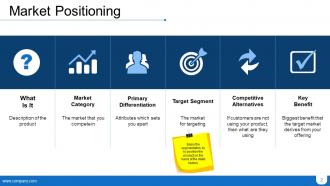
Slide 2: This slide shows Market Positioning describing- Primary Differentiation, Competitive Alternatives, What Is It, Target Segment, Market Category, Key Benefit.
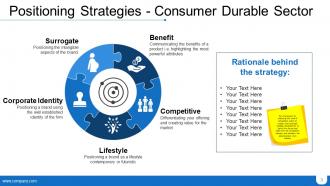
Slide 3: This slide presents Positioning Strategies - Consumer Durable Sector describing- Benefit, Corporate Identity, Lifestyle, Competitive, Surrogate.
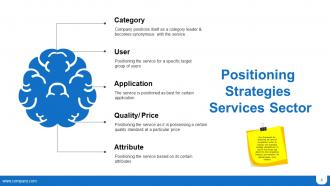
Slide 4: This slide displays Positioning Strategies Services Sector describing- Category, User, Application, Attribute, Quality/ Price.
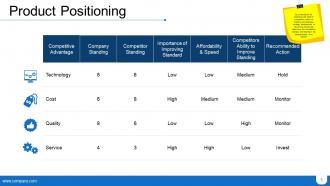
Slide 5: This slide represents Product Positioning for analyzing the level of competition within an industry and business strategy development to derive five forces that determine the competitive intensity and therefore the attractiveness of an industry.
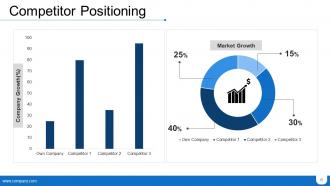
Slide 6: This slide showcases Competitor Positioning describing company growth and market growth.
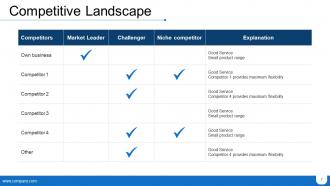
Slide 7: This slide shows Competitive Landscape in a tabular form with categories as- Competitors, market leader, challenger etc.
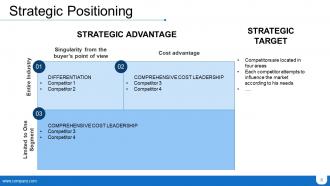
Slide 8: This slide presents Strategic Positioning with Strategic advantage and strategic target.
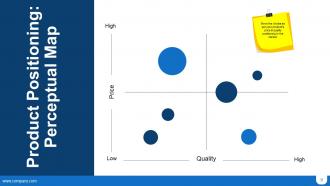
Slide 9: This slide displays Product Positioning: Perceptual Map with the help of bubble graphs.
Slide 10: This slide is titled as Graph And Charts for moving towards different graphs and charts.
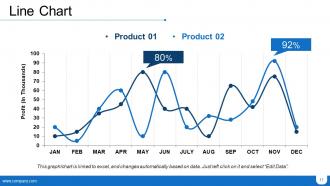
Slide 11: This slide shows Line Chart with two products comparison.
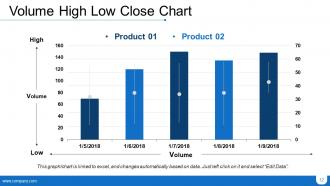
Slide 12: This slide presents Volume High Low Close Chart with two products comparison.
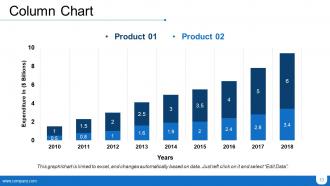
Slide 13: This slide displays Column Chart comparion product 01 and product 02.
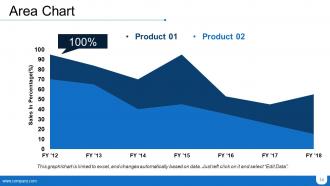
Slide 14: This slide represents Area Chart with data in percentage.
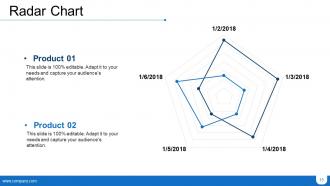
Slide 15: This slide showcases Radar Chart comparing two products.
Slide 16: This slide reminds about a 15 minutes break.
Slide 17: This slide is titled as Additional Slides for moving forward.
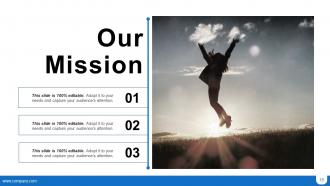
Slide 18: This is Our Mission slide with imagery and text boxes.
Slide 19: This slide shows Meet Our Team with names and designation.
Slide 20: This is ABOUT US slide to state company specifications etc.
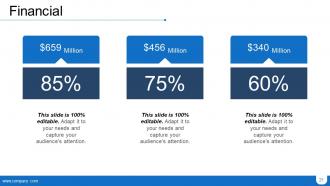
Slide 21: This is a Financial slide. Show your finance related stuff here.
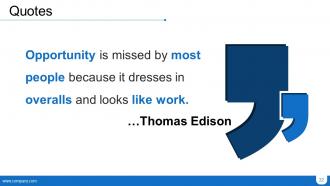
Slide 22: This is a Quotes slide to state or highlight anything specific.
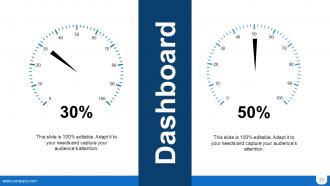
Slide 23: This is a Dashboard slide with text boxes to show information.
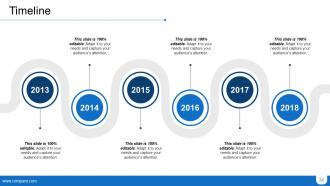
Slide 24: This is a Timeline slide. Show information related with time period here.
Slide 25: This is a Thank You slide with address, contact numbers and email address.
Market Positioning Powerpoint Presentation Slides with all 25 slides:
Enhance group dynamics with our Market Positioning Powerpoint Presentation Slides. Get them all to act in concert.






FAQs for Market Positioning
So market positioning is basically claiming your spot in people's heads - like what makes you different from everyone else they could buy from instead. You're trying to own a specific thing that matters to customers. Without it, you'll just get lost in the sea of "meh" options and end up competing on price (which honestly sucks for everyone). I always tell people to figure out what value you actually bring that others don't. Then hammer that message home everywhere - your website, emails, even how you talk about yourself. Otherwise you're just another face in the crowd hoping someone notices you.
Start with the customers you already have - dig into their demographics and buying patterns. What problems are they actually solving with your product? Build personas from that real data, not guesswork. Surveys help, but honestly your analytics probably tell you more than you think. Social media insights are pretty clutch for this too. Test your messaging on small groups first before committing to anything big. Don't try appealing to everyone - that never works. Pick one specific segment and get really good at talking to them first. You can always expand later.
Honestly, competitive analysis is like your cheat sheet for finding open spots in the market. Look at what your top 3-5 competitors are doing - their pricing, messaging, who they're targeting. I literally bookmark like 20 competitor sites and check them way too often, but whatever works right? The goal isn't finding ways to be "better" but actually different. Where are they weak or completely missing the mark? That's your opening. Once you map out their value props, you'll see gaps your product can slide into. Don't just copy - find what makes you stand out from all that noise.
Honestly, customer perception is everything when it comes to positioning. People filter your messaging through what they already think about your brand. So if they see you as the "budget option," good luck trying to go premium overnight - those ideas stick like crazy. Past experiences and what their friends say matter way more than your latest ad campaign, which is kinda frustrating but true. Start by figuring out what people actually think (surveys, checking social media comments, whatever). Then you can either work with those perceptions or slowly chip away at changing them.
Honestly, your value prop needs to nail three things or it's toast. First, what problem are you actually fixing? Second, what specific benefits will your audience get - and I mean *specific*, not some vague "we're awesome" nonsense. Third is differentiation, which most people totally botch. You can't just be another face in the crowd. Here's the thing though - you need to say all this in like two sentences max. Nobody has time for a paragraph. Once you think you've got it, test it on real people first. I've seen too many founders fall in love with value props that sound great in their heads but make zero sense to customers.
Honestly, you can't nail positioning without knowing what's happening in the market and how people actually behave. Trends shift constantly - look at how sustainability became huge - so you've got to adjust how you talk about your product's benefits. Consumer behavior shows you what messaging works and where to reach people. I've watched companies get stubborn about their old positioning and just... disappear. Stay connected through regular research and social listening (though sometimes I think we overthink the research part). Quick tip: audit your current positioning against recent trend data. You'll spot the gaps pretty fast.
Okay so SWOT analysis is probably your best starting point - just maps out strengths, weaknesses, opportunities, threats. Pretty straightforward. Perceptual mapping shows you how customers actually view you compared to competitors, which can be eye-opening. Competitive analysis grids are honestly my favorite because they make the gaps so obvious it's almost painful lol. Porter's Five Forces gets into the bigger industry stuff affecting your position. Oh and definitely do customer surveys - that's where you'll get the real tea on what people think. I'd just pick 2 or 3 of these and go for it. Don't overcomplicate things.
Honestly, presentation templates are a lifesaver if you want to look professional without spending hours on design. They give you that pre-built structure so you're not staring at a blank slide wondering where to put your value props and competitive stuff. Most of us suck at design anyway - I know I do - so why torture yourself trying to make something decent from scratch? Templates keep everything visually consistent too, which actually helps your brand message stick. Just grab one that fits your industry vibe, then swap in your own content to show what makes you different. Way easier than starting over.
Don't try being everything to everyone - that's positioning suicide. Being too vague kills you too. I see companies copy their competitors all the time, which is lazy and obvious. Never promise stuff you can't deliver on, trust me on that one. Features don't sell people, the actual value does. Test your positioning with real humans before going all-in! Write it down in one sentence first. If someone can't immediately get who it's for and why they should care, you're not there yet. Short and specific beats long and confusing every time.
Check your brand perception surveys and see if customers actually think about you the way you want. Market share growth in your target segments is probably the biggest tell. I'm obsessed with social listening lately - people say wild stuff on Twitter that'll give you way more honest feedback than focus groups. Look at your sales data and whether you can charge premium prices without losing customers. Oh, and track how much it costs to acquire new customers - if positioning's working, that should drop. Honestly just do a quarterly health check mixing all these together.
Digital marketing totally changed the positioning game. You can get super specific now instead of that old "spray and pray" thing everyone used to do. The data you get is honestly crazy - you can test different messages in real-time and actually see what works instead of just guessing. I'd start small though, pick one clear angle and test it across a few channels. Let the performance numbers tell you what to do next. Way better than those focus groups that never seemed to predict anything anyway. Micro-targeting specific audiences with personalized stuff just works better than broad messaging ever did.
Honestly, you've gotta stay on top of how new tech is shifting what customers expect. Figure out which technologies actually matter for your industry first - don't get distracted by every flashy trend. Then decide if you want to be the innovative early adopter, the reliable bridge between old and new, or maybe the solid choice for people who aren't ready to jump on every bandwagon yet. I've watched companies completely blow it by ignoring these shifts for too long. Beat your competitors to updating your value proposition. Make it super clear whether you're embracing the change or offering stability when everything feels chaotic.
Stories beat boring product specs every time. People remember narratives way better than stats - it's just how our brains work. When you tell how your product actually solved someone's real problem, that emotional connection sticks. Your competitors are probably still droning on about features while you're building relationships. The key is finding that one core story that shows why you're different, then using it everywhere. Don't overthink it though - just be authentic about what makes you special and how you've helped people.
Ok so basically you gotta get everyone on the same page with a brand playbook. Same messaging, visuals, tone - all of it. I can't tell you how many brands I see where their TikTok feels totally different from their website and it's just... weird? Document what you're doing across every channel first, then spot the gaps. Your teams need the same guidelines or they'll all go rogue. Do regular check-ins to catch stuff before it gets messy. Honestly the worst is when a company's email sounds corporate but their Instagram is trying to be cool - pick a lane!
Look for gaps your competitors totally missed - that's your opening. Study what your top 3 rivals are doing, then find the customer problems they're ignoring. Here's the thing though: you can't just flip everything overnight and confuse your current customers. Test small changes first with a few segments. Maybe tweak your messaging or add some products that hit those pain points differently. It's honestly like trying to change clothes while you're still wearing them lol. But gradual shifts work way better than dramatic changes anyway. Map out what positions everyone else owns, then grab what's left.
-
Designs have enough space to add content.
-
The Designed Graphic are very professional and classic.