


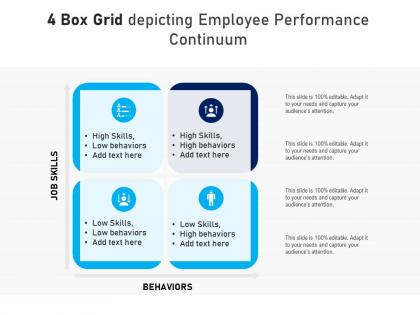
4 box grid depicting employee performance continuum




Try Before you Buy Download Free Sample Product
 Impress Your
 Audience
 100%
100% Editable
 Save Hours
 of Time


Our 4 Box Grid Depicting Employee Performance Continuum are topically designed to provide an attractive backdrop to any subject. Use them to look like a presentation pro.
People who downloaded this PowerPoint presentation also viewed the following :
4 box grid depicting employee performance continuum with all 2 slides:
Use our 4 Box Grid Depicting Employee Performance Continuum to effectively help you save your valuable time. They are readymade to fit into any presentation structure.
FAQs for 4 box grid depicting
Key performance metrics include goal achievement, quality of work, productivity levels, collaboration effectiveness, and professional development progress. These metrics enable organizations to assess contributions objectively while identifying growth opportunities, with many companies finding that balanced scorecards incorporating both quantitative results and qualitative behaviors ultimately deliver more comprehensive evaluations and stronger employee engagement.
Organizations create fair performance evaluations by establishing clear, measurable criteria, using multiple assessment methods, training evaluators on bias recognition, and implementing regular calibration sessions across departments. These systematic approaches enhance objectivity through structured feedback processes, peer reviews, and data-driven metrics, with many companies finding that transparent evaluation frameworks ultimately deliver improved employee trust and more accurate performance insights.
Self-assessment empowers employees to reflect on achievements, identify growth areas, and take ownership of their development while providing managers valuable insights into employee perspectives and career aspirations. This collaborative approach enhances evaluation accuracy, fosters meaningful performance discussions, and strengthens employee engagement, with many organizations finding that self-assessment ultimately delivers more balanced evaluations and improved professional development outcomes.
Peer feedback enhances performance evaluations by providing 360-degree perspectives, revealing collaboration skills, and identifying blind spots that managers might miss during day-to-day interactions. This comprehensive approach enables organizations to assess teamwork effectiveness, communication patterns, and cross-functional contributions more accurately, ultimately delivering more balanced evaluations and targeted development opportunities for sustained growth.
Quantitative metrics offer objectivity, clear benchmarks, and easy comparison through sales figures, productivity rates, and measurable outcomes, while qualitative metrics capture leadership skills, teamwork, and communication abilities that numbers cannot reflect. While quantitative data streamlines evaluation processes and reduces bias, qualitative assessments provide deeper insights into employee potential and cultural fit, with many organizations finding that strategic combination of both approaches delivers comprehensive performance insights and enhanced talent development decisions.
Performance evaluations significantly impact employee morale and engagement through recognition of achievements, constructive feedback delivery, and clear development pathway communication. When conducted effectively with specific examples and actionable insights, these evaluations enhance job satisfaction, strengthen manager-employee relationships, and boost retention rates, with many organizations finding that regular, well-structured assessments ultimately drive higher productivity and workplace engagement.
Performance evaluations are most effective when conducted quarterly or bi-annually, with continuous feedback sessions throughout the year rather than relying solely on annual reviews. This strategic combination enables managers to address performance issues promptly, recognize achievements timely, and align employee development with organizational goals, with many companies finding that frequent touchpoints ultimately deliver higher engagement, improved productivity, and stronger retention rates.
Effective feedback strategies include focusing on specific behaviors rather than personality traits, using the SBI model (Situation-Behavior-Impact), balancing constructive criticism with recognition, and setting collaborative improvement goals. Through regular check-ins and structured dialogue, managers in sectors like retail and healthcare find that employees respond better to actionable guidance, ultimately enhancing performance and engagement.
Technology and performance management software streamline evaluation processes by automating data collection, centralizing feedback from multiple sources, and providing real-time analytics dashboards. These platforms enable managers to track goal progress continuously, generate comprehensive reports instantly, and identify performance trends across departments, ultimately reducing administrative time while delivering more objective, data-driven evaluations and actionable insights.
Organizations must consider documentation requirements, consistency in evaluation criteria, anti-discrimination laws, due process procedures, and confidentiality standards during performance evaluations. These legal frameworks protect both employers and employees by ensuring fair treatment, reducing liability risks, and maintaining compliance with employment regulations, with many companies finding that standardized processes ultimately streamline evaluations while strengthening legal defensibility.
Performance evaluations can be aligned with company goals by establishing clear KPIs, linking individual objectives to strategic priorities, incorporating goal-specific metrics, and conducting regular progress reviews. Organizations across sectors like retail, healthcare, and manufacturing streamline this alignment through structured feedback systems, quarterly assessments, and competency frameworks, ultimately enhancing employee engagement while delivering measurable contributions to organizational success.
Common pitfalls include recency bias, halo effect, lack of specific examples, inconsistent criteria, and insufficient feedback frequency. These evaluation challenges can undermine workplace transparency and employee development, with many organizations finding that structured frameworks, regular check-ins, and measurable goals ultimately deliver more accurate assessments and enhanced performance outcomes.
Performance evaluations for remote and hybrid environments require modified metrics focusing on outcomes rather than hours, enhanced digital communication tracking, and regular virtual check-ins. These approaches enable managers to assess productivity through project deliverables, collaborative tool engagement, and goal achievement, while incorporating self-assessment components and flexible scheduling considerations, ultimately delivering more comprehensive performance insights and stronger remote team accountability.
Continuous feedback models enhance traditional evaluations by providing real-time insights, reducing recency bias, enabling immediate course corrections, and fostering ongoing dialogue between managers and employees. This approach streamlines performance management through regular check-ins, goal adjustments, and skill development conversations, ultimately delivering improved employee engagement and organizational productivity compared to annual review cycles.
Employee development planning is crucial alongside performance evaluations, as it transforms assessments from backward-looking reviews into forward-focused growth strategies that enhance retention, engagement, and skill advancement. Organizations integrating development planning with evaluations see improved employee satisfaction, reduced turnover, and stronger succession pipelines, with many companies finding that this strategic combination ultimately delivers competitive advantage through enhanced workforce capabilities.
-
Thanks for all your great templates they have saved me lots of time and accelerate my presentations. Great product, keep them up!
-
Awesomely designed templates, Easy to understand.