

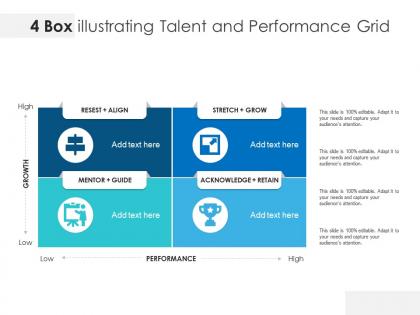
4 box illustrating talent and performance grid




Try Before you Buy Download Free Sample Product
 Impress Your
 Audience
 100%
100% Editable
 Save Hours
 of Time


Our 4 Box Illustrating Talent And Performance Grid are topically designed to provide an attractive backdrop to any subject. Use them to look like a presentation pro.
People who downloaded this PowerPoint presentation also viewed the following :
4 box illustrating talent and performance grid with all 2 slides:
Use our 4 Box Illustrating Talent And Performance Grid to effectively help you save your valuable time. They are readymade to fit into any presentation structure.
FAQs for 4 box illustrating talent
So it's just a 9-box grid where you plot employees by current performance (horizontal) and future potential (vertical). Each axis has low/medium/high categories. Stars live in that top-right corner - high performance AND high potential. Then you've got your solid workers who might be hitting their ceiling in the middle-right box. Bottom left? That's where things get awkward during review meetings. Honestly, it sounds fancy but it's pretty straightforward once you see it. Perfect for figuring out who gets promoted, who needs more training, and who you're grooming for bigger roles down the line.
First thing - nail down what "high performer" and "high potential" actually mean at your company. Sounds basic but you'd be shocked how many places skip this step. Train your managers properly on rating people because they mix up performance and potential constantly (drives me crazy tbh). Calibration sessions are huge - get leadership in a room to review ratings together so you're not all over the map. Don't just use it to rank people though. Have real conversations with employees about where they land and what they can do to level up. Short bursts work better than marathon meetings.
Look at two things - how they're actually performing and what their potential looks like. Performance is the easy part: check their goals, KPIs, and real results from the last year or so. But don't ignore the softer stuff like how quickly they learn new things, leadership skills, and whether they adapt well to change. Honestly, too many managers get obsessed with just the numbers. Also think about how long they've been in the role and how complex their job actually is. Oh, and grab info from different sources - annual reviews alone won't give you the full picture.
So this matrix thing is actually pretty smart - you plot people based on current performance vs future potential. Creates these quadrants that make it super obvious who your rising stars are. Look for the top-right corner where high performers also have serious growth potential. Way more reliable than just wing-it decisions about who seems "leadership-y." Here's the thing though - it makes you separate how someone's doing now from whether they could handle bigger stuff later. That quiet person crushing their current role? They might be perfect for management. Try it next time you're doing talent reviews and figuring out stretch assignments.
Look, your Talent Performance Matrix is only as good as the feedback feeding into it. You'll want input from managers, peers, maybe even customers to actually see where people land on performance vs potential. Most companies just wing it based on manager gut feelings - which is pretty useless tbh. The trick is keeping your feedback collection structured and consistent across teams. Otherwise you're comparing totally different standards when you plot everyone out. Regular feedback cycles help, plus training people on what decent input actually looks like. Without that foundation, you're basically just making expensive guesses about your talent.
So the talent matrix is actually super helpful for figuring out who should own what goals. Map out your top 3 organizational objectives first. Then look at your team - high performers with tons of potential? They're your go-to for big strategic stuff. Solid performers work great for the day-to-day operational things that honestly nobody wants to mess up. I've seen this work really well when you match goal complexity to people's actual capability levels. Plot it out visually and you'll probably be surprised by what you discover. Don't overthink it though.
Honestly, the worst thing you can do is play favorites - bias creeps in so easily. Plus people try to cram complex performance into just two boxes when reality is way messier. Most managers totally rush through calibrating what "good work" even means across different teams, which is kinda backwards if you think about it. Don't treat these ratings like they're carved in stone either. People move around those quadrants all the time, so you've gotta keep updating things. Use it for development, not just deciding who gets what.
Honestly, the matrix is a game-changer for succession planning. You can immediately spot your top performers and see exactly where they are development-wise. Map out high performers with high potential - boom, there's your succession pipeline. But here's what's really cool: you'll discover hidden gems in other quadrants who could be perfect with some focused development. I've watched managers completely overlook amazing internal people until they actually visualized everything this way. Oh, and start with your critical roles first, then scan the matrix to see who's ready to step up with targeted coaching.
BambooHR, Workday, and SuccessFactors all have solid performance tracking built in if you've got the budget. But honestly? Excel or Google Sheets work great too - I've seen some crazy good DIY templates that beat expensive software. Monday.com and Asana are decent if your team likes visual stuff. The real trick is picking whatever your people will actually stick with. Don't go for the flashiest option if nobody's gonna use it. My old manager tried this overly complex system once and we all just went back to spreadsheets anyway. Start basic, then upgrade if you need more bells and whistles later.
Yeah, the 9-box matrix works across pretty much any industry - you just swap out what you're measuring. Tech companies care about innovation and coding skills, while hospitals focus more on patient outcomes and following protocols. The grid stays the same, but you're plugging in totally different criteria. I'd honestly start by figuring out what 3-5 things actually separate your top performers from everyone else in your field. Then weight those based on what matters most. It's way more about customizing the evaluation piece than changing the whole framework, you know?
Getting employees involved in the Talent Performance Matrix is honestly a game-changer for accuracy. They know their own strengths and weaknesses way better than we do from the outside. Plus, people actually stick to development plans when they've helped create them - funny how that works, right? You'll also spot those quiet high performers who don't self-promote much. Trust builds naturally because you're being open about evaluation criteria instead of keeping it mysterious. The two-way conversations during the process? That's where you discover development gaps you totally missed before. Just make sure there's real space for honest feedback, not just going through the motions.
So instead of those awful once-a-year reviews (ugh), this thing makes performance talks happen regularly with actual data behind them. You'll see people moving between quadrants over time - honestly, it's pretty motivating when someone notices you're improving. High performers get the cool stretch projects while others get more focused help. The trick is updating it every quarter so it feels like a growth plan, not just another HR thing to dread. People actually start caring about where they land because they can see their progress happening in real time.
Honestly, quarterly is the bare minimum but try for every 6-8 weeks if possible. Get feedback from everyone - managers, peers, even direct reports. Timing matters too - update it right after big projects or reviews while details are still fresh. The worst thing? Letting it collect digital dust. I've seen too many companies do this. Keep tweaking the criteria as business priorities shift, and actually tell people when you make changes. Oh, and set those calendar reminders now or you'll totally forget. Trust me on this one.
So the matrix thing actually works great for spotting bias because you're using real data instead of just going with your gut. You'll catch those unconscious biases that might hold back diverse talent - especially the quieter high-performers who don't self-promote as much. Honestly, I've seen too many companies promote the loudest person in the room. Plot everyone based on clear metrics and potential indicators, then audit your current results. Look for demographic patterns across the quadrants. Are certain groups clustering in specific areas? That's your red flag right there.
So your Talent Performance Matrix only stays useful if you're actually feeding it real data. Performance metrics, engagement surveys - that stuff tells you way more than just guessing. I've seen companies miss flight risks among their best people because they weren't looking at the numbers. Honestly, the predictive stuff is where it gets interesting - you start seeing patterns you'd totally miss otherwise. Connect your HR systems and run the analysis maybe every quarter? Otherwise you're just working off outdated hunches. The data keeps recalibrating everything so you're not stuck with wrong assumptions.
-
Colors used are bright and distinctive.