Employee skills development plan ppt images

Rating:
90%
Employee skills development plan ppt images
Slide 1 of 5
Favourites Favourites

Try Before you Buy Download Free Sample Product

Audience Impress Your
Audience
Editable 100%
Editable
Time Save Hours
of Time
The Biggest Sale is ending soon in
0
0
:
0
0
:
0
0
Rating:
90%
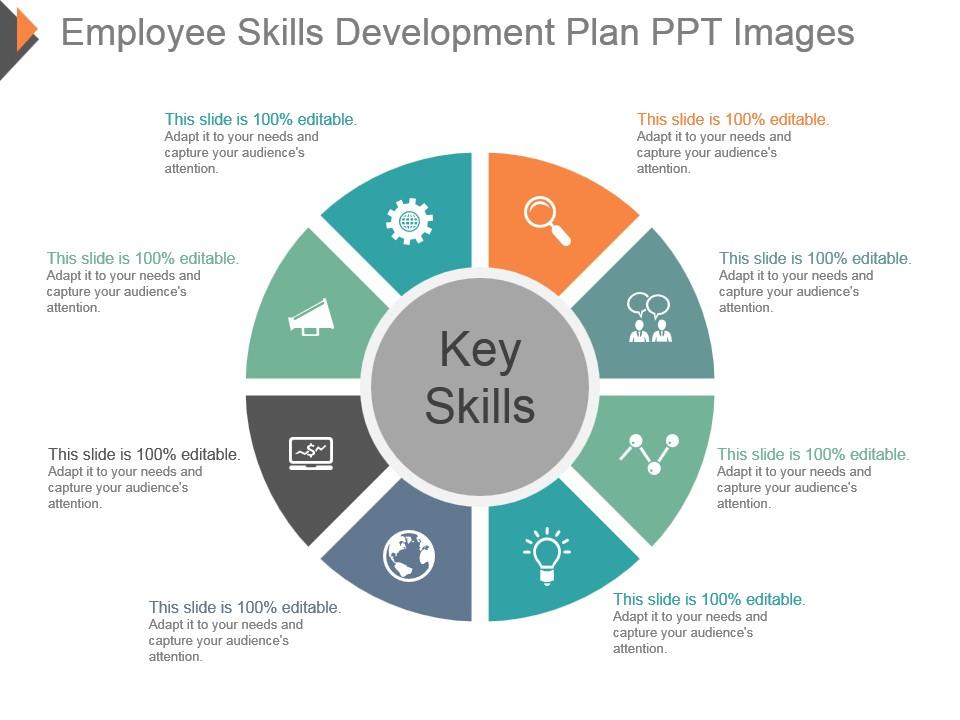
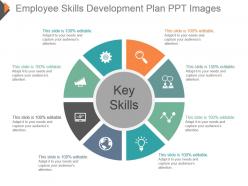
Presenting employee skills development plan ppt images. This is a employee skills development plan ppt images. This is a eight stage process. The stages in this process are key skills.

Content of this Powerpoint Presentation

Description:

The image presents a PowerPoint slide with a central theme of "Employee Skills Development Plan." At the center of the slide, we see a circular graphic labeled "Key Skills," segmented like a pie chart, with each segment representing a different skill domain with an associated icon. Starting at the top and moving clockwise, the segments are associated with the following skills: Analytical thinking (magnifying glass icon), Teamwork (three figures icon), Communication (speech bubbles icon), Innovation (light bulb icon), Problem-solving (jigsaw puzzle icon), Education (graduation cap icon), and Leadership (gear and person icon).

Use Cases:

It can be relevant in multiple industries that seek to enhance employee skills and professional development.

1. Corporate Human Resources:

Use: To present employee professional development plans and essential skill areas to focus on.

Presenter: HR Manager or Training Coordinator

Audience: Company Employees or HR Team

2. Education and Training:

Use: For constructing a curriculum focused on key employability skills.

Presenter: Educational Trainer or Curriculum Developer

Audience: Educators or Trainers

3. Technology and Software:

Use: To define crucial skills required for software development and technical teams.

Presenter: CTO or Team Lead

Audience: Software Developers or Technical Staff

4. Healthcare Administration:

Use: To outline continuing education and skill advancement for healthcare professionals.

Presenter: Healthcare Administrator or Training Specialist

Audience: Healthcare Staff or Medical Professionals

5. Retail Management:

Use: For discussing skills enhancement in customer service and retail operations.

Presenter: Retail Trainer or Operations Manager

Audience: Retail Employees or Store Managers

6. Financial Services:

Use: To lay out ongoing professional development plans for finance staff, emphasizing analytical and leadership skills.

Presenter: CFO or Finance Training Manager

Audience: Bank Staff or Financial Analysts

7. Manufacturing:

Use: To visualize the skill development strategy for manufacturing employees, including problem-solving and innovation.

Presenter: Operations Director or HR Specialist in Manufacturing

Audience: Production Line Workers or Factory Supervisors

FAQs for Employee skills development

First, figure out what skills your people actually have right now - like a baseline assessment. Then sit down and have real conversations about where they want to go career-wise. Mix up the learning approaches: formal training, mentoring (seriously underrated btw), stretch projects, online stuff. Don't do cookie-cutter programs though. Each person needs something different based on their goals and your business needs. Track how it's going with regular check-ins and set some milestones you can actually measure. The mentoring part is honestly where you'll see the biggest impact on keeping people around.

Honestly, I'd start with having people do self-evaluations alongside manager assessments - gives you both perspectives. Performance reviews are the obvious choice but they're kinda terrible for technical stuff. Watch how people actually work on projects, that tells you way more than any form. Peer feedback is clutch too since coworkers see things managers miss. Oh, and check what certifications everyone already has - you might be sitting on skills you didn't even know about. People undersell themselves constantly in self-assessments, so don't rely on just one method. Mix 2-3 approaches and you'll actually know what you're working with.

Look, you really can't build a decent skills program without actually asking your people what they need. Surveys, one-on-ones, whatever works - just get the real scoop on where they're struggling and what they want to learn. The thing is, when people feel heard, they'll actually participate instead of just rolling their eyes at another training. I'd say make it ongoing too, not some yearly checkbox thing. Needs change fast these days. Oh and honestly? The career aspiration stuff is just as important as the technical gaps - people get way more motivated when you're helping them get where they want to go.

Yeah, it really depends on what industry you're in. Tech companies are obsessed with constant learning because everything changes like every five minutes. Manufacturing focuses more on safety stuff and technical certs. Healthcare has all those compliance requirements they can't escape. Finance is super structured - they love their formal programs and regulatory boxes to check. Retail usually prioritizes customer service training, which makes sense. Honestly, I'd just look around at what similar companies in your space are doing first. Then figure out where your team actually has gaps instead of guessing.

Honestly? Time is your biggest enemy here. Managers always think training means people aren't doing "real work" - which is annoying but you'll deal with it constantly. Budget's another nightmare, especially if you want decent external courses. Getting people actually engaged is tricky too. Most resist change or don't see why they need new skills right away. And measuring ROI on soft skills? Yeah, that's basically impossible. My advice - start small with cheap, high-impact stuff. Connect everything to career growth opportunities. Once people see it helps them advance, they're way more likely to buy in.

Honestly, tech can totally transform your training programs. AI platforms adapt to how each person learns - some people need more time, others breeze through. VR is pretty cool too since employees can mess up in simulations without any real damage. Mobile apps are clutch because people can actually fit learning into their crazy schedules. Analytics show you where everyone's getting stuck, which helps you fix the weak spots. My advice? Don't go overboard initially. Pick one tool that'll solve your biggest headache first, then build from there.

Track completion rates and skill scores before/after - that's your baseline data. But here's the thing: numbers don't tell you if people actually give a damn about the training. Check their confidence levels and whether they're using new skills day-to-day. I'd also grab feedback from their managers about real performance changes. Set up check-ins at 30, 60, 90 days post-training so you can pivot if something's not working. Oh, and don't forget time-to-competency metrics - how fast are people actually getting good at the new stuff?

So here's what I'd do - grab some of your top performers and pair them up with people trying to learn those same skills. Way more effective than those boring training modules everyone skips through. Schedule regular coffee chats or quick check-ins where they can give feedback on actual projects. For leadership stuff or really specialized skills, bring in outside coaches. Oh, and don't make it super rigid - give them goals and deadlines, sure, but let the relationships build naturally. I'd probably test it with like 10 people first and see how it goes before rolling it out company-wide.

Honestly, the trick is making it feel normal instead of like homework. Get your managers talking about what they're learning - that stuff spreads fast. Block out maybe 10% of work time for skill building and don't let meetings eat it up. Have people teach each other random cool things they've figured out. Connect it to promotions and recognition so there's actually a point. Oh, and learning buddies work surprisingly well for keeping people motivated when they'd rather just scroll their phones.

Honestly, don't wait around for your boss to spell out what you should learn - that's on you. Figure out where your skills are now versus where you wanna be, then tackle those gaps head-on. Online courses, workshops, finding a mentor, whatever works. Most people totally skip the planning part which is kinda wild to me. Volunteer for stuff that scares you a little, or shadow people in other departments. Oh and actually block out time for this stuff on your calendar. Seriously - treat it like a real meeting or it'll never happen.

Honestly, cross-training is a lifesaver when someone calls out sick or quits without notice. Your team won't be scrambling to figure out who can handle what. People actually get excited about learning new stuff - beats doing the same tasks every single day. It builds way better teamwork too since everyone gets what other departments actually go through. Oh, and you'll discover hidden talents you never knew existed. Perfect for promotions down the road. Just start simple - have folks shadow each other a few hours weekly. Works like magic.

Here's what I'd do - figure out where your company wants to be in like 3-5 years, then work backwards to see what skills you're missing. Don't just chase whatever's trendy (though yeah, everyone needs some AI stuff now). Check in every quarter because priorities change constantly. Get your department heads involved too since they actually know what's coming down the pipeline. Honestly, I learned this the hard way - you can't just set up training once and walk away. Think of it more like managing investments. You wouldn't ignore your portfolio for years, right? Same deal here.

Honestly, microlearning on phones is a game changer - people actually remember stuff when it's in small chunks instead of those brutal all-day sessions. Get your team teaching each other what they're good at, works way better than you'd think. Gamification sounds cheesy but I've seen grown adults get weirdly competitive over training badges lol. VR's not crazy expensive anymore if you need hands-on practice. Job shadowing's still solid too, nothing beats learning while doing the actual work. Pick whatever matches how your people like to learn and build from there.

So Gen Z and younger millennials are all about microlearning and mobile apps - they want quick, digestible training they can do on their phone. Gen X and Boomers? They're more into traditional workshops and longer courses. Though honestly, I've worked with plenty of people who break these rules completely. My old boss was like 62 and obsessed with learning apps. The trick is just offering different formats so people can pick what clicks for them. Don't force everyone into the same box - it never works out well.

Honestly, leadership makes or breaks whether skills development actually sticks around or just becomes another dead program. You've gotta actively champion it - like actually participate and ask people about their learning goals, not just sign off on budgets. Create real time for development stuff too. I've watched so many "learning cultures" crash because managers only talked the talk. Your job is knocking down barriers and connecting people with mentors or whatever they need. Oh, and celebrate when someone picks up new skills! But here's the thing - you need to model learning yourself first. Your team watches what you do way more than they read your emails about it.

Ratings and Reviews

90% of 100
Review Form
Write a review
Most Relevant Reviews
  1. 80%

    by Davies Rivera

    Excellent products for quick understanding.
  2. 100%

    by James Lee

    Awesomely designed templates, Easy to understand.

2 Item(s)

per page: