


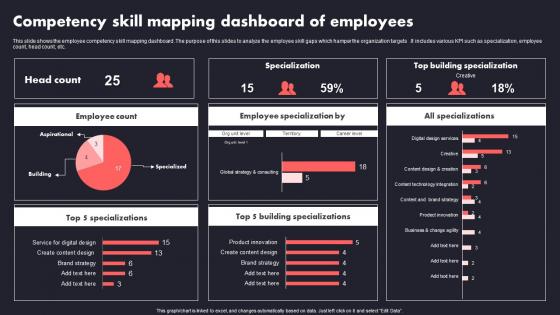
Competency Skill Mapping Dashboard Of Employees




Try Before you Buy Download Free Sample Product
 Impress Your
 Audience
 100%
100% Editable
 Save Hours
 of Time


This slide shows the employee competency skill mapping dashboard. The purpose of this slides to analyze the employee skill gaps which hamper the organization targets. It includes various KPI such as specialization, employee count, head count, etc.
People who downloaded this PowerPoint presentation also viewed the following :
Competency Skill Mapping Dashboard Of Employees with all 7 slides:
Use our Competency Skill Mapping Dashboard Of Employees to effectively help you save your valuable time. They are readymade to fit into any presentation structure.





FAQs for Competency Skill Mapping
So competency mapping is figuring out what skills and behaviors each role actually needs, then seeing where your team stacks up. Think of it like a roadmap for who's good at what. Most companies just guess when they're hiring or promoting people - kinda wild when you think about it. But when you map out what "good" looks like first, everything gets clearer. You can spot training gaps, make better hires, all that stuff. Just pick one important role and list out 5-7 key skills they need. Then honestly assess your current people against those. You'll probably find some surprises.
So competency mapping is basically like having a GPS for your career - shows you exactly where you are skill-wise versus where you need to be. Pretty useful, honestly. It highlights the gaps between what you can do now and what your role actually requires. Instead of doing random training and hoping something sticks, you can focus on the stuff that'll actually make a difference. Your manager gets better at giving you targeted feedback too. I mean, who doesn't want their development plan to actually make sense? The whole point is figuring out which skills will genuinely boost your performance.
You need behavioral indicators, proficiency levels, and role mapping. So instead of saying "good communication," write something like "actively listens during meetings" - way more specific. Create 3-5 levels from beginner to expert with real examples. Most of these models are garbage because they're too theoretical, honestly. Figure out which competencies are must-haves for each role vs just bonus points. Oh, and don't go crazy - pick your top 8-10 core ones first, then flesh out the details. That's where I'd start anyway.
So basically, core competencies are skills everyone needs no matter what they do - stuff like communication, problem-solving, working well with others. Role-specific ones are the technical things tied to particular jobs. Like, everyone might need "good communication skills" but only your data people would need to know SQL, you know? Makes sense when you break it down like that. Oh, and start with figuring out your 5-7 core ones first - that's way easier than jumping straight into the job-specific stuff. Trust me on this one.
So basically you figure out what skills and behaviors your best people have, then use that as your hiring roadmap. Way better than just winging it with interviews - which let's be honest, most companies totally do. You'll write way more focused job posts and ask questions that actually matter. Instead of going with your gut (rarely works out), you're measuring candidates against real criteria. I'd start by looking at whoever's crushing it in similar roles already. Oh and it saves you from those awkward "seemed great in the interview but can't do the job" situations.
Yeah, definitely! It makes reviews way less subjective and actually helpful. Instead of getting feedback like "be a better leader" (which means what exactly?), you're tracking actual behaviors and skills. Most HRIS systems let you build competency frameworks right into the performance templates. Game-changer for real career conversations. You can spot skill gaps during reviews, create development plans that aren't generic, and see how people progress over time. I'd start simple - pick 3-4 key competencies per role and work those into your review process. Way better than the usual vague nonsense.
Honestly, just schedule annual reviews and stick to them - get feedback from managers and employees about what skills they're actually using day-to-day. Industries move so fast now (I swear some companies are still using frameworks from 2019 like it's current). Check job market trends regularly and see what new tech is popping up in your field. I'd do quarterly check-ins with department heads too since they'll spot gaps before anyone else. Don't wait until people start complaining that everything feels outdated. Build those review dates into your calendar now or you'll forget.
Here's what's worked for me: Start with self-assessments to get a baseline, though honestly people usually rate themselves way too high (myself included lol). 360-degree feedback gives you the full picture - managers, peers, direct reports all weighing in. For technical stuff, skills tests and simulations are clutch. I'm a big fan of just observing people in action too - sometimes that tells you more than any formal assessment. Performance reviews help you track progress over time. The trick is mixing different methods depending on what you're actually trying to measure. Don't rely on just one approach.
So basically, you map out what skills your future leaders actually need, then figure out who has them and who doesn't. Way better than those random leadership trainings nobody likes. I've seen too many people get promoted without the right skills - total disaster. You can spot your rising stars early and give them targeted development instead of generic stuff. Succession planning becomes so much easier because you know exactly who's ready to move up. Oh, and it prevents those cringe moments when someone bombs in a new role. Just start by listing competencies for key positions, then see how your people stack up.
Honestly, the hardest part is convincing people it's not just another pointless HR thing. Employee buy-in is brutal. Then there's the time factor - everyone thinks it'll take like a month but you're looking at way longer. Data collection gets messy fast because everyone describes skills differently (which is super annoying). Keeping it relevant as jobs change? Good luck with that. My take: pick one department first. Get some wins under your belt to prove it works. Oh, and make sure managers actually use it for development stuff, not performance evaluations - that's where most frameworks die.
Honestly, specialized software makes competency mapping way less painful. Digital assessment tools can evaluate skills automatically instead of doing it all manually. Most platforms create visual matrices that update in real-time, plus you get dashboards to track everyone's development progress. Some even have AI that spots skill gaps - which sounds fancy but is actually pretty useful. The real game-changer though? Having everything in one place instead of dealing with a million random spreadsheets. Check out TalentGuard or SuccessFactors first, but your current HR system might already have this stuff built in.
Oh totally - competency mapping is a game changer for engagement. Employees actually know what they're supposed to be good at instead of guessing all the time. No more "am I doing this right?" anxiety, you know? People can see where they're headed career-wise and what skills they need to work on. The best part though? Getting your team involved in creating the competency map together. Makes them feel like they have a voice. I'd honestly just pick one department first - don't try to boil the ocean right away.
So basically you figure out what skills each job actually needs, then see how your people stack up against that. It's like making a skills checklist for everyone. The gaps jump out pretty fast once you do this - you'll spot exactly what's missing in each department. Honestly, it's way more helpful than I expected when I first heard about it. Gives you a solid plan for training or hiring the right people. I'd start with just one important role first, get that mapped out completely, then do the rest. Way less overwhelming that way.
Get your employees involved from the start - they actually know what good work looks like in their day-to-day. I'd map everything to real job performance instead of just skills on paper. Be super specific about what "excellent" means at each level. Honestly, don't go crazy trying to do everything at once. Pick maybe 2-3 key roles to test it out first. The big thing is linking it directly to career growth and performance reviews, otherwise people think it's just busy work. Keep the language dead simple too - if someone can't quickly scan it and get it, you've overcomplicated things.
Think of competency mapping as your cheat sheet for training decisions. Instead of those boring generic programs everyone forgets, you can spot exactly where your teams are weak and build targeted stuff that actually matters. Focus on the 3-5 skills that really drive business results - don't try to fix everything at once. The cool part is you can create individual development paths tied to career goals, then track if people are actually improving over time. Way better than throwing money at random workshops and hoping something sticks. I'd start with mapping just your most critical roles first, honestly.
-
Unique design & color.
-
Professionally designed slides with color coordinated themes and icons. Perfect for enhancing the style of the presentations.