


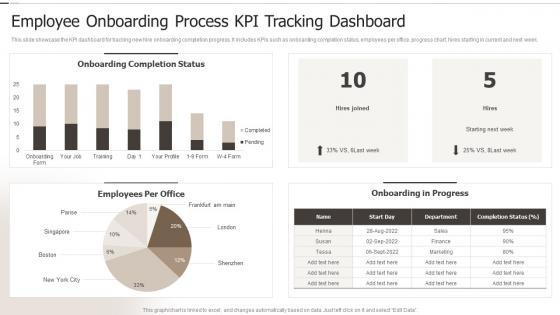
Employee Onboarding Process KPI Tracking Dashboard




Try Before you Buy Download Free Sample Product
 Impress Your
 Audience
 100%
100% Editable
 Save Hours
 of Time


This slide showcase the KPI dashboard for tracking new hire onboarding completion progress. It includes KPIs such as onboarding completion status, employees per office, progress chart, hires starting in current and next week.
People who downloaded this PowerPoint presentation also viewed the following :
Employee Onboarding Process KPI Tracking Dashboard with all 7 slides:
Use our Employee Onboarding Process KPI Tracking Dashboard to effectively help you save your valuable time. They are readymade to fit into any presentation structure.





FAQs for Employee Onboarding Process
So track how fast new people actually become productive - like when they hit their performance targets. Also check your 90-day retention and whether managers think the onboarding process sucks or not. Completion rates for checklists matter too, plus engagement survey results from new hires. Equipment setup time is weirdly important - nothing kills momentum like waiting two weeks for a laptop. Honestly, I'd start with just these basics instead of going crazy with analytics right away. You can always add more detailed tracking once you figure out what's actually broken.
Honestly, retention rates tell you everything about whether your onboarding actually works. High turnover in the first 90 days? Your process probably sucks. Nobody wants to feel completely clueless their first week - been there, done that. When people feel connected and know what they're doing, they stick around. I'd track it at 30, 90, and 365 days. You'll start seeing patterns pretty quickly. If everyone's bailing at the same point, that's where you need to fix things. It's basically like having a roadmap of what's broken.
So first you gotta define what "productive" actually means for each role - that's honestly the hardest part. Then track how long it takes new hires to hit those benchmarks. Most companies I've seen do check-ins at 30, 60, and 90 days. You can measure through manager feedback, how confident the person feels, or just straight-up output numbers. Like, are they completing their first project? Hitting sales targets? Working without constant hand-holding? Once you've got that baseline data, you can mess around with different onboarding methods and see what gets people up to speed faster.
So employee engagement is your best bet for figuring out if onboarding actually works. Track it through pulse surveys, how much people join team stuff, or just casual manager check-ins. High engagement? Your process is solid. Low scores mean something's off with training or people aren't clicking socially. I'd measure at 30, 60, and 90 days - that way you can catch problems before someone's already mentally quit. Honestly, most companies skip the 60-day mark but that's where you see the real dip if things aren't working.
Honestly, the easiest way is just tracking survey responses and exit interviews as actual KPIs. Measure stuff like new hire satisfaction scores and training ratings. Anonymous surveys are clutch here - people won't be real with you face-to-face. Also track how fast you actually fix the problems people mention, because collecting feedback and ignoring it is worse than not asking at all. I'd do simple 5-question surveys at 30, 60, and 90 days alongside your usual metrics. Oh, and measure if employees would recommend your onboarding - that one's surprisingly telling.
Definitely do eNPS surveys at 30, 60, and 90 days - those are clutch. Track your onboarding completion rates and how long it takes people to actually get productive. I'm weirdly obsessed with asking "would you recommend our onboarding to a friend?" because people can't BS that question. First-day and first-week check-ins matter too. Oh, and watch your early turnover rates within 90 days - that's where you'll see if something's broken. If you've got a buddy system, get feedback on that. Skip waiting for quarterly reviews though. Set up quick pulse surveys so you can catch problems before new people mentally check out.
Honestly, your onboarding length is gonna mess with pretty much every metric you're watching. Go too long and yeah, people stick around more and feel better prepared - but you're also burning money and they're not actually doing work yet. Rush it though? That's how you end up with people quitting three months in because they felt thrown to the wolves. I've seen both sides and it's brutal either way. You want that middle ground where people feel supported but aren't sitting in orientation forever. My advice? Track how fast people become productive alongside your retention numbers. That combo will tell you if you've hit the sweet spot or need to adjust.
Completion rates basically tell you if people are actually finishing your training modules. Low rates? Your content's probably too long or painfully boring - I've seen some compliance training that made me want to cry. When people complete training, they perform better and stick around longer because they're not confused about what they're supposed to do. Check the numbers weekly and see which sections people bail on. That's your problem right there. Also, nobody's finishing 6-hour training sessions, so maybe break those up if you haven't already.
Exit interviews are seriously underrated for this stuff. People leaving will straight-up tell you "I had no clue what I was doing for months" or "my manager basically ghosted me" - and that's gold for figuring out what to actually measure. Track things like how long it takes new hires to feel productive, or how often managers are checking in. I swear the same problems come up over and over once you start paying attention. Also worth seeing if certain onboarding steps actually help people stick around longer. Just add a few targeted questions about their first few weeks and review the patterns every quarter or so.
KPIs can show you if new hires are actually vibing with your company culture or just checking boxes. Track stuff like how they participate in team activities, their scores on culture training, or whether they're showing your core values during check-ins. Honestly, some companies do these "culture fit" ratings from managers and peers at 30/60/90 days - feels weird but it works. You'll spot the difference between someone going through the motions versus actually getting how your team operates. Plus it helps you catch red flags early and tweak your approach before things get awkward.
BambooHR and Workday are solid for tracking time-to-productivity and completion rates - though fair warning, those dashboards can feel like information overload initially. For engagement stuff, Culture Amp works well, or honestly just throw together a Google Form if budget's tight. Cornerstone's good for training metrics if you're using an LMS. The real game-changer is finding tools that actually talk to each other. Nobody wants to export data from like six different platforms every month. I'd start with whatever HR system you've already got and see what plays nice with it. Way easier than starting from scratch.
Track how many departments your new hires actually talk to in their first month or two. Then survey people about whether those conversations were useful or just awkward small talk. New employees who connect across teams early on stick around longer - it's like having friends at work makes the job less miserable. You could count project collaborations or even casual stuff like lunch meetings. Honestly, most companies suck at this because they just dump people in their own little bubble. Set a goal like "each new hire has 3+ real conversations with other departments." Makes onboarding way less isolating.
Honestly, I'd shoot for 90%+ completion on required training and get people productive within 90 days. Employee satisfaction should hit at least 4/5 during onboarding - anything lower means something's off. But here's the reality check: it totally depends on your industry. Tech companies vs manufacturing will be completely different timelines. For retention, 85% staying past 6 months is solid. Don't stress about perfect benchmarks right away though. Figure out where you're at now, then set realistic targets from there. Oh, and those satisfaction scores? They're way more telling than completion rates sometimes.
Honestly, most people get this backwards - they pick random metrics like completion rates without thinking about what actually matters to the business. Start with your company's big goals instead. Customer retention important? Track how your new customer-facing hires perform post-onboarding. Innovation a priority? Measure how fast new people jump into cross-functional projects or pitch ideas. Each metric should connect to a real business outcome, not just feel-good numbers. And definitely review these with leadership regularly since priorities change. I've seen too many teams track stuff that looked good on paper but meant nothing to the actual business goals.
Yeah, good onboarding totally boosts customer satisfaction - like 10-15% better scores. Your new people actually know what they're doing, so they handle customers way better and solve problems faster. Nobody wants to hear "uh, let me find my manager" every time they call, you know? When staff sticks around longer (which happens with decent onboarding), customers aren't constantly explaining their situation to someone brand new. Honestly, I'd check your satisfaction metrics against onboarding completion rates. The connection's pretty obvious once you look at the data.
-
This design is not only aesthetically pleasing but it has many uses making the cost worthwhile. The graphics look stunning, and you can edit them as per your needs.
-
Placing an order on SlideTeam is very simple and convenient, saves you a lot of your time.