


Implementing Business Enhancing Hr Operation Workforce Performance Analysis Kpi Dashboard




Try Before you Buy Download Free Sample Product
 Impress Your
 Audience
 100%
100% Editable
 Save Hours
 of Time


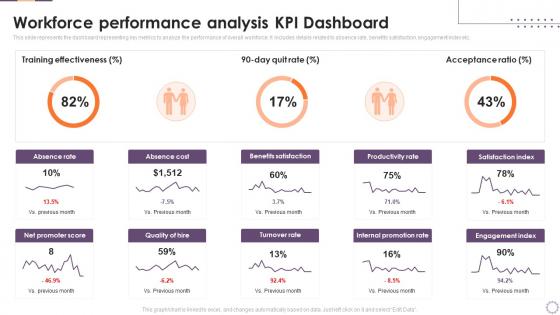
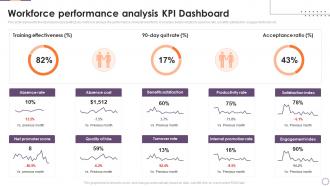
This slide represents the dashboard representing key metrics to analyze the performance of overall workforce. It includes details related to absence rate, benefits satisfaction, engagement index etc.
People who downloaded this PowerPoint presentation also viewed the following :
Implementing Business Enhancing Hr Operation Workforce Performance Analysis Kpi Dashboard with all 7 slides:
Use our Implementing Business Enhancing Hr Operation Workforce Performance Analysis Kpi Dashboard to effectively help you save your valuable time. They are readymade to fit into any presentation structure.





FAQs for Implementing Business Enhancing Hr Operation Workforce Performance
HR performance dashboards should include employee turnover rates, time-to-fill positions, employee satisfaction scores, training completion rates, and absenteeism percentages. These KPIs enable organizations to streamline talent management, enhance workforce planning, and optimize resource allocation, with many companies finding that comprehensive dashboards ultimately deliver improved retention and operational efficiency.
An HR performance dashboard aids talent acquisition and retention by providing real-time insights into recruitment metrics, candidate pipeline effectiveness, employee satisfaction scores, and turnover patterns across departments. Through comprehensive analytics, organizations can identify high-performing recruitment channels, predict retention risks, and optimize compensation strategies, ultimately enabling faster hiring decisions and reducing costly turnover while enhancing competitive advantage.
Effective HR data visualization techniques include interactive dashboards, heat maps for performance distribution, trend line charts for retention patterns, funnel charts for recruitment pipelines, and comparative bar charts for departmental metrics. These visualizations streamline complex workforce data by highlighting performance gaps, identifying talent trends, and enabling data-driven decisions, with many organizations finding that visual HR analytics significantly enhance strategic workforce planning and operational efficiency.
HR performance dashboards should be updated monthly for strategic metrics like turnover rates and employee satisfaction, while operational data such as attendance and recruitment progress requires weekly or real-time updates. Many organizations find that combining automated daily data feeds with monthly analytical reviews ensures dashboards remain actionable, enabling HR teams to identify trends early, respond to emerging issues promptly, and maintain strategic workforce planning accuracy.
Employee engagement serves as a critical performance indicator in HR dashboards, measuring satisfaction levels, retention rates, productivity metrics, and overall workforce morale through surveys, feedback scores, and behavioral analytics. These engagement metrics enable HR teams to identify trends, predict turnover risks, and optimize talent management strategies, with many organizations finding that higher engagement scores directly correlate with improved performance outcomes and reduced recruitment costs.
Organizations ensure HR performance dashboard accuracy through regular data audits, automated validation rules, standardized data entry protocols, and real-time integration with HRIS systems. By implementing cross-verification processes and training HR teams on consistent data collection methods, companies significantly reduce errors while enhancing decision-making reliability, with many finding that quarterly accuracy reviews and automated alerts ultimately deliver more trustworthy workforce analytics and strategic insights.
Common challenges in implementing an HR performance dashboard include data integration from multiple systems, ensuring data accuracy and consistency, securing employee privacy compliance, and achieving user adoption across departments. While these obstacles require careful planning, organizations successfully overcome them through phased rollouts, comprehensive training programs, and stakeholder engagement, ultimately delivering enhanced decision-making capabilities and streamlined HR operations.
HR dashboards support diversity and inclusion initiatives by tracking recruitment demographics, monitoring pay equity across groups, measuring promotion rates by diversity categories, and analyzing retention patterns among underrepresented employees. These analytics enable organizations to identify gaps in their D&I efforts, set measurable targets for improvement, and demonstrate progress to stakeholders, ultimately creating more equitable workplaces through data-driven decision making.
**INPUT**: What tools or software are recommended for creating HR performance dashboards? **OUTPUT**: Recommended HR performance dashboard tools include Tableau, Power BI, Workday Analytics, BambooHR, and Google Data Studio, each offering specialized workforce visualization capabilities. These platforms streamline performance tracking by automating data collection, enabling real-time metrics analysis, and delivering customizable reporting features, with many organizations finding that integrated solutions significantly enhance strategic workforce planning and operational efficiency. **Word count: 58 words**
HR performance dashboards impact decision-making processes by providing real-time visibility into workforce metrics, eliminating guesswork through data-driven insights, and enabling faster responses to emerging trends. Through centralized analytics, organizations streamline talent management decisions, enhance resource allocation, and identify performance patterns more effectively, with many companies finding that dashboard-driven approaches ultimately deliver more strategic, evidence-based HR outcomes.
**INPUT**: What metrics can indicate the effectiveness of training and development programs? **OUTPUT**: Training effectiveness metrics include completion rates, skill assessment scores, employee satisfaction ratings, knowledge retention tests, and post-training performance improvements. These measurements streamline program evaluation by tracking behavioral changes, productivity gains, and career advancement rates, with many organizations finding that combining quantitative results with qualitative feedback ultimately delivers enhanced workforce capabilities and competitive advantage. [Word count: 57 words]
HR performance dashboards can be tailored through customizable metrics, role-based access controls, industry-specific templates, scalable reporting frameworks, and flexible visualization options. Organizations across sectors, from healthcare systems tracking staff retention to manufacturing companies monitoring safety compliance, find that configurable dashboards enable targeted insights, streamlined decision-making, and ultimately deliver enhanced workforce management aligned with their strategic objectives.
**INPUT**: What are some best practices for presenting HR data to executives? **OUTPUT**: Best practices include using visual dashboards with key metrics, focusing on business-impact data like retention costs and productivity trends, providing actionable insights rather than raw numbers, and aligning presentations with strategic objectives. These approaches enable executives to quickly grasp workforce implications, make informed decisions about talent investments, and ultimately drive organizational performance while demonstrating HR's strategic value to business outcomes. **Word count: 60 words**
Feedback loops integrate into HR performance dashboards through real-time survey widgets, continuous 360-degree feedback modules, peer review systems, goal-setting interfaces, and automated pulse check notifications. These features enable organizations to capture ongoing employee insights, manager evaluations, and performance data seamlessly, ultimately delivering more responsive talent management and enhanced employee engagement across all organizational levels.
HR dashboards enhance workforce planning and forecasting by providing real-time analytics on employee turnover, skills gaps, recruitment pipelines, and performance trends across departments. These tools enable organizations to predict staffing needs, identify talent shortages before they impact operations, and optimize resource allocation, with many companies finding that data-driven workforce planning reduces hiring costs while improving strategic decision-making.
-
Thanks to SlideTeam, we have an ideal template to present all the info we need to cover. Their slides give our numbers and projections a more clear and enchanting look.
-
I am glad to have come across Slideteam. I was searching for some unique presentations and templates for my business. There are a lot of alternatives available here.