


HR Business Partner Dashboard To Analyze Critical Kpis




Try Before you Buy Download Free Sample Product
 Impress Your
 Audience
 100%
100% Editable
 Save Hours
 of Time


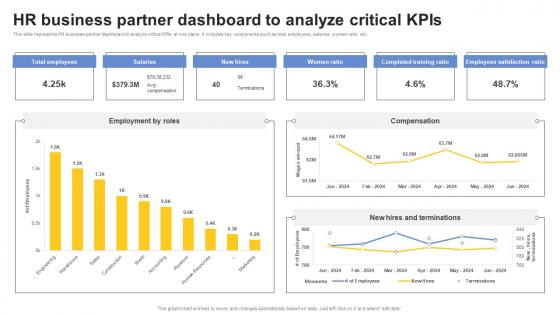
This slide represents HR business partner dashboard to analyze critical KPIs at one place. It includes key components such as total employees, salaries, women ratio, etc.
People who downloaded this PowerPoint presentation also viewed the following :
HR Business Partner Dashboard To Analyze Critical Kpis with all 10 slides:
Use our HR Business Partner Dashboard To Analyze Critical Kpis to effectively help you save your valuable time. They are readymade to fit into any presentation structure.








FAQs for HR Business Partner Dashboard To
Key performance indicators for HR Business Partner dashboards include employee engagement scores, turnover rates, time-to-fill for open positions, performance management completion rates, and training effectiveness metrics. These KPIs enable organizations to streamline talent management, enhance workforce planning, and deliver strategic insights, with many companies finding that comprehensive dashboard visibility ultimately drives better employee retention and operational efficiency.
An HR Business Partner Dashboard enhances strategic decision-making by centralizing workforce analytics, performance metrics, talent pipeline data, compensation trends, and employee engagement insights into real-time visualizations. Through comprehensive dashboards, HR leaders streamline resource allocation, identify skill gaps, and predict turnover patterns, while enabling data-driven succession planning and strategic workforce planning, ultimately delivering competitive advantage in talent management.
Effective HR data visualization techniques include interactive dashboards, heat maps for performance distribution, trend line graphs for turnover patterns, pie charts for demographic breakdowns, and gauge charts for goal tracking. These approaches streamline complex workforce analytics by highlighting key patterns, enabling quick identification of talent gaps, and presenting actionable insights, with many organizations finding that visual dashboards ultimately enhance strategic decision-making and operational efficiency.
HR Business Partner Dashboards should be updated in real-time for critical metrics like headcount and attendance, with weekly updates for performance indicators, monthly refreshes for strategic workforce analytics, and quarterly reviews for long-term trends. This strategic combination ensures HR partners can respond quickly to operational needs while maintaining oversight of broader talent management objectives, ultimately delivering timely insights that enhance decision-making and organizational effectiveness.
Common tools for creating HR Business Partner Dashboards include Tableau, Power BI, Excel, Google Data Studio, and specialized HR platforms like Workday, BambooHR, and SAP SuccessFactors. These technologies streamline workforce analytics by automating data visualization, enabling real-time reporting, and facilitating strategic decision-making, with many organizations finding that integrated platforms ultimately deliver enhanced operational efficiency and improved talent management outcomes.
HR Business Partner Dashboards can be tailored through customizable metrics, role-based access controls, industry-specific KPIs, departmental views, and configurable reporting schedules. These dashboards enhance organizational alignment by tracking recruitment efficiency, employee engagement scores, and performance indicators relevant to each company's structure, with many organizations finding that personalized analytics ultimately streamline decision-making and deliver more strategic workforce insights.
Employee engagement data serves as a critical performance indicator in HR Business Partner Dashboards, enabling strategic workforce decisions through engagement scores, retention metrics, satisfaction surveys, and productivity correlations. This data empowers HR partners to identify at-risk departments, predict turnover patterns, and develop targeted interventions, with many organizations finding that real-time engagement insights significantly enhance their ability to retain top talent and optimize team performance.
Predictive analytics can be integrated through machine learning algorithms, statistical modeling, workforce trend analysis, and automated forecasting tools that analyze historical HR data patterns. These capabilities enable HR Business Partners to anticipate turnover risks, identify high-potential employees, and forecast staffing needs, ultimately delivering proactive workforce planning and strategic talent management decisions.
Common challenges include data integration from multiple HR systems, ensuring real-time accuracy, defining relevant KPIs, maintaining data security compliance, and creating intuitive user interfaces. These obstacles often stem from fragmented HR technologies, inconsistent data formats, and varying stakeholder requirements, with many organizations finding that strategic planning and cross-functional collaboration ultimately streamline dashboard development and enhance decision-making capabilities.
HR Business Partners can leverage dashboards to align strategies with objectives by tracking workforce metrics, analyzing performance trends, monitoring talent pipeline health, and identifying skill gaps across departments. Through real-time data visualization, partners can demonstrate HR's strategic value, optimize resource allocation, and present data-driven recommendations to leadership, ultimately enabling more agile decision-making and stronger business-HR integration.
Best practices for sharing HR Business Partner Dashboard insights include scheduling regular review meetings, creating executive summary reports, customizing presentations for different audience levels, establishing clear data governance protocols, and implementing secure access controls. These approaches enhance stakeholder engagement by delivering targeted insights, facilitating data-driven discussions, and ensuring consistent communication, with many organizations finding that structured sharing processes ultimately improve decision-making speed and strategic alignment.
Integration of diversity and inclusion metrics enhances HR Business Partner Dashboards by providing comprehensive workforce analytics, enabling data-driven decision making, and identifying representation gaps across departments, levels, and recruitment pipelines. These metrics streamline equity assessments, enhance strategic workforce planning, and deliver actionable insights for inclusive culture building, with many organizations finding that measurable D&I tracking ultimately drives better talent retention and competitive advantage.
Real-time data significantly enhances HR Business Partner Dashboard effectiveness by enabling immediate identification of workforce trends, faster decision-making on talent issues, and proactive intervention during critical situations like retention risks or performance declines. This immediate visibility allows HR partners to address employee concerns, optimize resource allocation, and deliver strategic workforce insights to leadership teams, ultimately improving organizational agility and employee satisfaction.
Feedback from HR Business Partners enhances dashboard design by identifying critical data gaps, workflow inefficiencies, and user interface challenges that impact daily operations. Through direct input on metrics prioritization, visualization preferences, and integration needs, organizations can streamline dashboard functionality, improve data accessibility, and deliver more intuitive user experiences, ultimately enabling faster decision-making and enhanced strategic HR support.
Ethical considerations include data privacy compliance, consent transparency, bias prevention in analytics, secure access controls, and anonymization of sensitive information. These safeguards enhance trust by protecting employee confidentiality, ensuring fair representation across demographics, and maintaining regulatory compliance, with many organizations finding that ethical data practices ultimately strengthen employee engagement and organizational credibility.
-
These stunning templates can help you create a presentation like a pro.
-
Love the template collection they have! I have prepared for my meetings much faster without worrying about designing a whole presentation from scratch.