


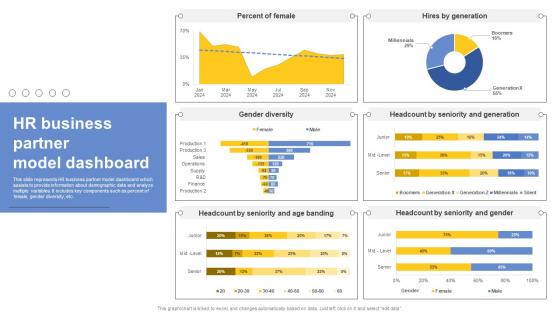
HR Business Partner Model Dashboard




Try Before you Buy Download Free Sample Product
 Impress Your
 Audience
 100%
100% Editable
 Save Hours
 of Time


This slide represents HR business partner model dashboard which assists to provide information about demographic data and analyze multiple variables. It includes key components such as percent of female, gender diversity, etc.
People who downloaded this PowerPoint presentation also viewed the following :
HR Business Partner Model Dashboard with all 10 slides:
Use our HR Business Partner Model Dashboard to effectively help you save your valuable time. They are readymade to fit into any presentation structure.









FAQs for HR Business
Hey! So basically you're the bridge between HR and whatever business units you're assigned to. You'll work with leaders on talent strategy, workforce planning, org development - succession planning, culture stuff, all that. Employee relations issues come up too, plus you'll coach managers through performance headaches. Way more strategic than old-school HR honestly. The trick is really getting your business leaders' goals first - I can't stress that enough. Build those relationships early and everything else gets so much easier. Change management will probably pop up here and there too, just depends on what's happening.
So basically, HR Business Partners actually work directly with specific business teams instead of being stuck in the HR department all day. You're not just doing paperwork and payroll stuff - you're like their strategic consultant who gets the people side of things. Way more interesting than traditional HR, honestly. Regular HR folks are usually just reacting to problems after they happen, but HRBPs are out there preventing issues and helping teams hit their goals. You get to solve real business problems that involve people. If you're thinking about it, definitely start making friends outside of HR and learn how your target department actually works. Game changer.
Honestly, business acumen is everything - you've gotta understand how money flows and where HR actually impacts the bottom line. Communication skills matter tons since you're influencing people without any real authority over them. Strategic thinking is key too because you're basically translating what executives want into actual people strategies. The whole "HR police" thing is dead (thank god). You'll also need some analytical skills for data-driven stuff and project management to actually get things done. Oh, and definitely shadow business leaders first - seriously, spend time in their world before you try having strategic conversations with them.
Honestly, you've gotta speak their language first. Figure out what's actually keeping your executives up at night - their quarterly numbers, revenue stuff, whatever crisis they're dealing with. Don't just rely on the polished company presentations either. Once you know that, connect your HR projects directly to their problems. Customer retention issues? Show how better employee engagement stops turnover and keeps those client relationships solid. I'd set up regular meetings where you're basically translating everything into business impact, not HR speak. Track what matters to them, and always draw those lines between your people work and actual results.
Honestly, skip the basic HR stuff and go straight for metrics that actually matter to the C-suite. Engagement scores are huge, plus retention rates in key departments. Time-to-fill for critical roles too - nobody wants positions sitting empty forever. Manager effectiveness through 360s is solid gold if you can swing it. Revenue per employee is probably the holy grail metric though. Internal mobility rates show you're developing talent, not just hiring it. Oh, and pulse surveys give you real-time feedback instead of waiting for annual reviews. Pick maybe 3-4 that'll make your leadership team actually care, then expand from there.
Dude, HRBP is honestly a game changer for engagement. You get someone who actually gets your team's specific problems instead of generic HR cookie-cutter stuff. They build real relationships with people, catch issues before they blow up. Your HRBP becomes like your champion who tailors solutions to what you actually need. Way better than the old transactional approach where you'd submit a ticket and wait forever. Only catch is they need to actually be embedded with your team - not just doing back-to-back meetings all day (which some totally do unfortunately).
Honestly, HRBP work is tough because you're juggling so many different things at once. Building credibility with leadership is probably the hardest part - they often see you as just another HR person instead of someone who actually gets the business. Then there's the whole balancing act between what executives want and what employees need (spoiler: they don't always align). Oh, and don't get me started on keeping up with employment law changes. My biggest tip? Relationships first, always. Come armed with data when you can. Trust me, it makes a huge difference in how seriously they'll take you.
Look, the whole point is being a strategic partner who's actually embedded in the business units. Build trust first though - seriously, without that you're just another HR person everyone ignores. Once you've got that, you can spot talent gaps and influence leadership decisions. During restructures or cultural shifts, you'll be facilitating those awkward conversations nobody wants to have. Your sweet spot? You understand both what the business needs AND how employees actually feel about it. That dual perspective lets you design solutions that people will actually buy into instead of just rolling their eyes at.
Honestly, you've gotta start showing up to their team meetings - not just when shit hits the fan. Learn what their KPIs actually are so when you pitch HR stuff, you're talking about how better hiring helps their Q3 numbers or whatever they're stressing about. Most HRBPs totally skip this part which is wild to me. Grab coffee with department heads and actually listen to what's driving them crazy. Then go back to HR and push for solutions that make sense in the real world, not just on paper. You're basically translating between two groups who speak different languages.
Okay so three main areas you should focus on. People analytics tools are huge - Workday, BambooHR, stuff like that gives you actual workforce data instead of guessing. Employee experience platforms like Culture Amp or 15Five are solid for surveys and feedback. Obviously you need good HRIS to handle all the admin crap that usually drowns you. The analytics thing is honestly game-changing though - I can't tell you how nice it is to walk into meetings with real numbers backing up what you're saying. My old boss used to just wing everything and it showed. Start with whatever gets you the best visibility into your employee data first.
So basically, HRBPs are assigned to specific business units instead of doing generic company-wide stuff. They actually get to know your team's needs and who's got potential. Way better than the old system, honestly. Your HRBP can spot who's ready to move up and figure out what skills people are missing. Plus they'll fight for training budgets that make sense for your department - not just random workshops nobody asked for. Oh, and they're good at succession planning too. Definitely worth building a relationship with yours and keeping them in the loop about your team's goals.
So many ways to get there! Internal programs are your best bet - most companies have leadership development stuff and cross-functional rotations. Getting an MBA or SHRM-SCP certification definitely helps with credibility. But honestly? Find a mentor who's already doing the job. That real-world insight beats any course. Oh, and figure out what you're weakest at first - finance, data analysis, change management, whatever. Then build your learning plan around those gaps. I mean, no point studying everything at once, right?
So here's the thing - you're already sitting at the table with leadership, which is huge. Use those regular business reviews to bring up D&I stuff naturally. Look at team demographics with managers, check hiring patterns, call out bias when you see it. I mean, you don't have to be the "policy police" sending annoying emails from corporate. Coach leaders on creating psychological safety (sounds buzzwordy but it actually works). The best part? You can push for real change from inside their world instead of being seen as an outside HR thing. Start by honestly auditing how you're approaching partnerships now.
So HR Business Partners are like your go-to people for performance stuff - they actually get how to make corporate policies work in real life. Mine helped me build a framework that didn't suck, plus coached me through some tough manager conversations. They're weirdly good at catching performance issues early too. What's cool is they can spot patterns across teams that you might miss. Don't just call them when shit hits the fan though - use them before problems blow up. Way more helpful that way, trust me.
Ugh, learned this one the hard way! You've gotta be super clear from day one about what you can actually do and what's totally outside your wheelhouse. Had a manager once who thought I could magically handle everything - nightmare. Don't wait for things to blow up either. Regular check-ins save your butt. When you can't deliver something, just be honest about why and throw out some other options. Oh, and write down the important stuff so nobody can claim they "forgot" what you agreed on later. Being upfront beats scrambling to fix misunderstandings every single time.
-
Nice and innovative design.
-
I was confident and well prepared for my presentation for the first time ever. With SlideTeam’s templates, I could deliver one of my best presentations. Will be coming back for more!